2026 Kia EV9 vs. Hyundai Ioniq 9: The Electric Three-Row Showdown
Two of the best three-row electric SUVs on the market come from the same family. They share a platform and a mission. But they are not the same car. We make the call.
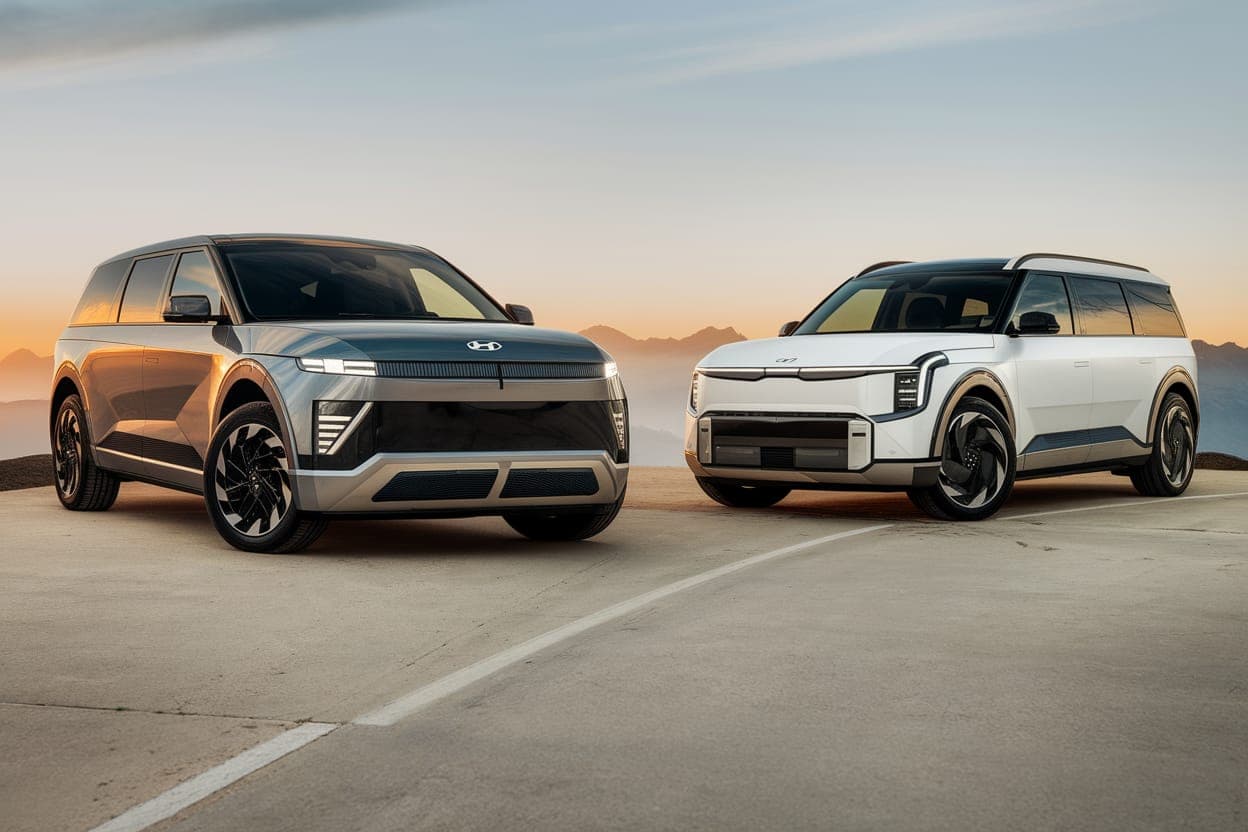
A side-by-side comparison shot of a 2026 Kia EV9 and a 2026 Hyundai Ioniq 9 on a scenic mountain road at sunset
2026 Kia EV9 vs. Hyundai Ioniq 9: The Electric Three-Row Showdown
Two of the best three-row electric SUVs on the market come from the same family. They share a platform, a battery supplier, and a mission. They are both built in Georgia. They both qualify for the $7,500 federal tax credit. They both charge from 10 to 80 percent in 24 minutes on a 350-kilowatt charger. They both have NACS ports for Tesla Supercharger access.
And yet, they are not the same car.
The Kia EV9 is the veteran. It arrived first, in 2024, and it was the first mainstream three-row electric SUV. It is boxy, upright, and distinctive. It looks like nothing else on the road. It prioritizes comfort features and driving engagement.
The Hyundai Ioniq 9 is the newcomer. It arrived for 2026, and it is sleeker, more aerodynamic, and more spacious. It prioritizes efficiency, cargo capacity, and a luxury feel. It is a living room on wheels.
They share DNA. But they serve different masters. This comparison is not about being polite. It is about giving you a decisive answer. We have analyzed the numbers, the specs, and the driving experience. We are not fence-sitting. We are making a call.
Design and Presence: Boxy vs. Sleek
The Kia EV9 makes a statement. It is boxy, upright, and slab-sided. It looks like a concept car that escaped the auto show and found its way to a dealership. The flat roof, the vertical headlights, and the squared-off rear end give it a commanding presence. It is not aerodynamic in the traditional sense. It is a brick. But it is a stylish brick.
The Hyundai Ioniq 9 takes a different approach. It is smooth, flowing, and aerodynamic. The roofline curves gently toward the rear. The body sides are sculpted. The design is futuristic rather than bold. It slips through the air rather than pushing through it.
Outward visibility favors the EV9. Its upright glasshouse and squared rear window make it easier to place in a parking lot or on a tight trail. The Ioniq 9's raked profile trades visibility for efficiency. It is not bad. But it is not as good as the Kia.
Winner: Depends on taste. The EV9 makes a statement. The Ioniq 9 slips through the air. For visibility, the EV9 wins.
Interior and Comfort: The EV9's Secret Weapon
The Kia EV9 has a secret weapon: ventilated front seats come on every single trim. No rival at the price matches this. It is a small feature, but it matters on a hot day. The EV9 also offers available lounge seats in the first and second rows with heat and ventilation.
The Hyundai Ioniq 9's answer is physical buttons and knobs. Owners consistently prefer them over touch controls. The Ioniq 9's interior is more refined and rounded, with metallic finishes that feel slightly more premium. The cabin is quieter and more isolated from the road.
The EV9's interior is more utilitarian. The materials are good, but they are not as plush as the Hyundai's. The dual 12.3-inch screens are standard, but the climate panel between them is obscured by the steering wheel. It is a small ergonomic flaw that becomes annoying over time.
| Category | Kia EV9 | Hyundai Ioniq 9 |
|---|---|---|
| Ventilated Front Seats | Standard on all trims | Available on higher trims |
| Physical Buttons | Limited | Yes, preferred by owners |
| Interior Quality | Good, utilitarian | Premium, refined |
| Quietness | Good | Excellent |
Winner: Kia EV9 for comfort features across all trims. Hyundai Ioniq 9 for material quality and refinement.
Space and Practicality: The Hyundai's Advantage
Hyundai wins cargo. The Ioniq 9 offers 21.9 cubic feet behind the third row and 86.9 cubic feet maximum. The EV9 offers 20.2 cubic feet behind the third row and 81.7 cubic feet maximum.
Both offer 42.8 inches of second-row legroom. Both seat six or seven depending on configuration. Both use flat floors from the dedicated EV platform. The EV9 has a higher seating position and better outward visibility.
The Ioniq 9's extra cargo space comes from its longer body and more efficient packaging. If you regularly carry gear, the Hyundai is the better choice. If you value visibility and a commanding view of the road, the Kia is the better choice.
| Category | Kia EV9 | Hyundai Ioniq 9 |
|---|---|---|
| Cargo (Behind 3rd Row) | 20.2 cu ft | 21.9 cu ft |
| Cargo (Max) | 81.7 cu ft | 86.9 cu ft |
| 2nd Row Legroom | 42.8 in | 42.8 in |
| Ground Clearance | 7.8 in | 6.9 in |
| Seating | 6 or 7 | 6 or 7 |
Winner: Hyundai Ioniq 9 for cargo capacity.
Powertrain and Performance: The Hyundai's Power Play
Both SUVs offer rear-wheel drive and all-wheel drive configurations. The EV9's AWD produces 379 horsepower and 443 lb-ft of torque. With the Boost upgrade, torque jumps to 516 lb-ft and 0-60 drops to 5.0 seconds.
The Ioniq 9's Performance AWD produces 422 horsepower and 516 lb-ft of torque. It hits 60 mph in 4.9 seconds.
On paper, the Hyundai is quicker. In the real world, it is basically a wash. The Hyundai gets the jump off the line. The EV9 feels more potent after that. The difference is measured in tenths of a second, not car lengths.
| Category | Kia EV9 | Hyundai Ioniq 9 |
|---|---|---|
| Horsepower (AWD) | 379 hp | 422 hp |
| Torque (AWD) | 516 lb-ft (with Boost) | 516 lb-ft |
| 0-60 (AWD) | 5.0 seconds (with Boost) | 4.9 seconds |
| Towing | 5,000 lbs | 5,000 lbs |
Winner: Hyundai Ioniq 9 for raw power. Kia EV9 for driving engagement.
Driving Dynamics: The Kia's Edge
The EV9 sits nearly an inch higher and is slightly lighter. The Kia delivers a better experience behind the wheel. It feels more composed, with better communication to the driver. The steering is more precise. The chassis is more balanced.
The Hyundai has a softer suspension that absorbs bumps better. It isolates occupants more from the world. It is the more comfortable cruiser. But it is not as engaging to drive.
The EV9's braking behavior is better than the Hyundai's. The pedal is more progressive. The stopping power is more predictable. The Hyundai's brakes feel grabby by comparison.
Neither will be mistaken for a driver's car. But the Kia is more engaging.
Winner: Kia EV9 for driving dynamics. Hyundai Ioniq 9 for ride comfort.
Range and Charging: The Hyundai's Distance
The Ioniq 9's larger battery gives it a range advantage in AWD form. It offers 311 miles of range compared to the EV9's 280. Both achieve 335 miles in RWD form.
Both charge from 10 to 80 percent in 24 minutes on a 350-kilowatt charger. Both have NACS ports for Tesla Supercharger access.
The Ioniq 9's advantage is 31 more miles of AWD range for roughly $2,000 more. That is a meaningful difference for families who take long road trips.
| Category | Kia EV9 | Hyundai Ioniq 9 |
|---|---|---|
| Battery | 99.8 kWh | 110.3 kWh |
| Range (RWD) | 335 miles | 335 miles |
| Range (AWD) | 280 miles | 311-320 miles |
| Charging (10-80%) | 24 minutes | 24 minutes |
Winner: Hyundai Ioniq 9 for range.
Technology and Safety: A Tie
Both SUVs have dual 12.3-inch screens. Both have comprehensive driver-assistance suites as standard. Neither buys a decisive safety advantage.
The EV9's climate panel between the screens is obscured by the steering wheel. The Ioniq 9's interface is more integrated and refined. The Hyundai's physical buttons are easier to use while driving.
Both offer wireless Apple CarPlay and Android Auto. Both offer over-the-air updates. Both offer advanced driver assistance features like adaptive cruise control, lane-keeping assist, and blind-spot monitoring.
Winner: Tie. Both are excellent.
Pricing and Value: The Kia's Advantage
The Kia EV9 starts at $54,900. The Hyundai Ioniq 9 starts at $58,955. That is a $4,055 difference at the base.
The EV9's top GT-Line trim starts at $73,545. The Ioniq 9's top Calligraphy Design trim starts at $78,090. That is a $4,545 difference at the top.
The Ioniq 9 offers more range and more cargo space for the extra money. The EV9 offers more standard comfort features and a more engaging driving experience.
| Trim | Kia EV9 | Hyundai Ioniq 9 |
|---|---|---|
| Base | $54,900 | $58,955 |
| Top Trim | $73,545 | $78,090 |
Winner: Kia EV9 for value. The base price is lower, and ventilated seats are standard.
The Verdict: Which One Wins?
This is a close matchup, but a clear winner emerges.
Choose the Kia EV9 if:
- You want a distinctive, head-turning design
- You want ventilated front seats on every trim
- You prioritize driving engagement
- You want better outward visibility
- You want to save $4,000 at the base
Choose the Hyundai Ioniq 9 if:
- You want maximum range (311 miles AWD)
- You want maximum cargo space (86.9 cu ft)
- You want a quieter, more refined cabin
- You prefer physical buttons over touch controls
- You want the most power (422 hp)
The Winner: Kia EV9
The Kia EV9 is the winner. It offers better value, more standard comfort features, and a more engaging driving experience. The Ioniq 9 is more powerful, more spacious, and more refined. But the EV9 is the better all-around package.
The EV9's ventilated seats on every trim are a genuine differentiator. No rival at the price matches it. The driving dynamics are better. The visibility is better. The value is better.
The Ioniq 9 is a fantastic vehicle. It is more powerful. It has more range. It has more cargo space. But it costs more, and it is less engaging to drive. The EV9 is the better choice for most families.
If you want maximum range and cargo, buy the Ioniq 9. If you want the best all-around electric three-row SUV, buy the EV9. They are both excellent, but the EV9 is the winner.
You might also like:
- 2026 Toyota 4Runner vs. Ford Bronco Comparison
- 2026 Toyota GR Corolla vs. Honda Civic Type R Comparison
- Tesla's Cybercab Is Here—And It's Already in Trouble
Disclaimer: This article is for informational purposes only. Prices, specifications, and ratings are subject to change. Always verify with official sources before making a purchasing decision.
Drift Team
EV experts and family SUV specialists