Tesla's Cybercab Is Here—And It's Already in Trouble
Tesla launched its driverless Cybercab in Austin on Thursday. By Friday morning, the feds were investigating. No steering wheel, no pedals, no mirrors—and now, no guarantee it's legal.
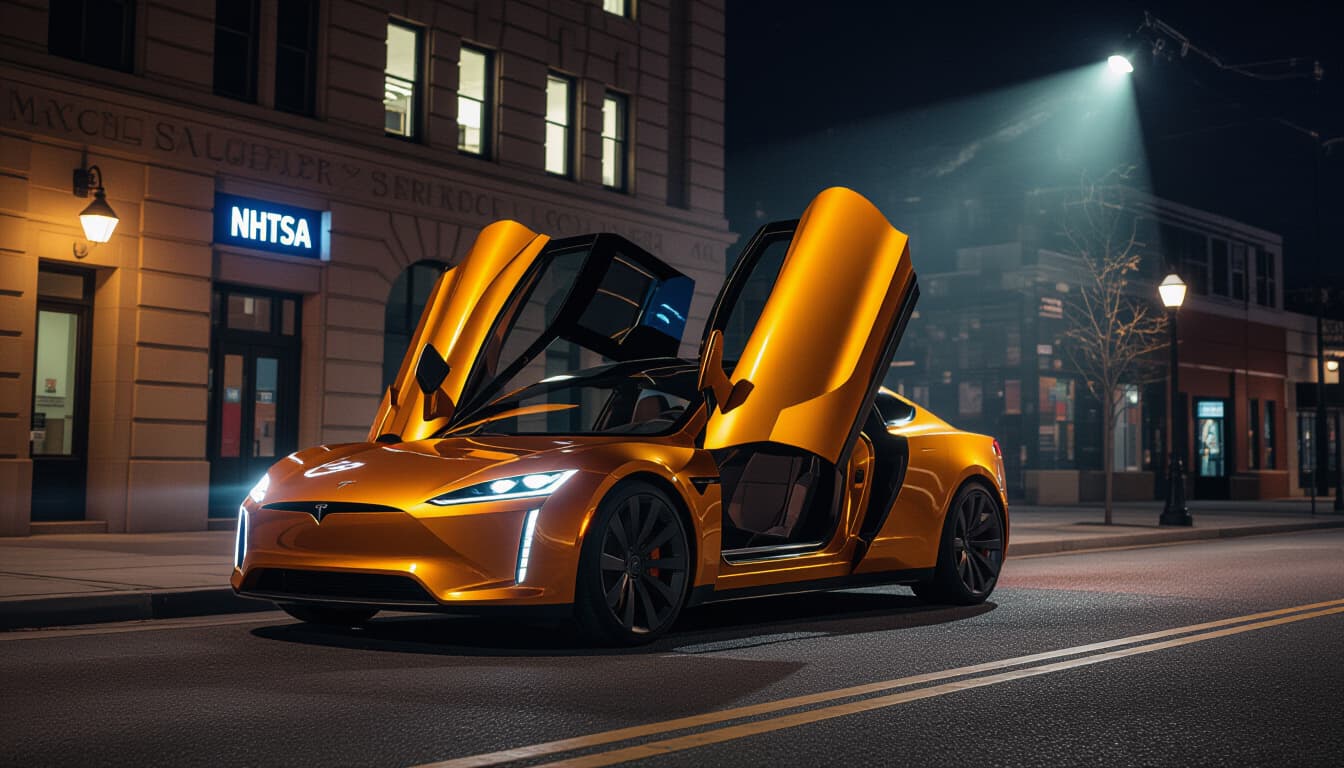
A dramatic nighttime shot of a golden Tesla Cybercab with butterfly doors open on a city street, with a federal regulatory building in the background
Tesla's Cybercab Is Here—And It's Already in Trouble
Tesla launched its fully autonomous Cybercab robotaxi in Austin, Texas on Thursday, September 3, 2026. It was a landmark moment for the company, the culmination of years of promises about a future without steering wheels or pedals. The Cybercab is the first car built specifically for unsupervised full self-driving.
By Friday morning, the federal government was investigating.
The U.S. National Highway Traffic Safety Administration opened an Audit Query into whether Tesla properly certified the Cybercab as compliant with federal safety standards. The timing couldn't be more dramatic: launch day, then a federal probe the next morning.
This is the story of Tesla's most controversial gamble yet.
The Launch: A Quiet Debut
Tesla began offering Cybercab rides in Austin on September 3. The vehicle is a two-seater with butterfly doors, finished in a distinctive gold color. It has no steering wheel. No brake pedal. No accelerator pedal. No mirrors.
Tesla's promotional video described it as "the first car that is specifically built for unsupervised full self-driving."
The rollout was unusually quiet. There was no livestream. No media access. Attendees were required to sign non-disclosure agreements. Elon Musk, who typically dominates Tesla's product launches, did not appear on stage. He pinned a simple tweet: "A storm of Cybercabs."
Tesla registered just 45 Cybercabs in Texas before the launch. For comparison, Waymo has approximately 1,000 autonomous vehicles operating in Texas. The Cybercab launch was significant, but it was also limited.
The Investigation: A Federal Probe Within Hours
Within hours of the launch, NHTSA opened an Audit Query (AQ26002) covering approximately 1,000 Cybercab vehicles. The agency announced it would examine "the process and technical data on which Tesla relied when certifying the Cybercab."
"The agency is investigating the basis of Tesla's Cybercab certification and related issues, including the extent to which the company determined that certain standards were not applicable to the vehicle," NHTSA said in a statement.
NHTSA also noted that "certain safety standards were written with a human driver in mind, making them difficult or impossible to apply to vehicles that lack conventional controls."
The probe is not a recall. It is an investigation into Tesla's self-certification process. But it signals that the federal government is not willing to accept Tesla's word without scrutiny.
The Missing Hardware: How Tesla Self-Certified
Under U.S. law, automakers self-certify that their vehicles meet Federal Motor Vehicle Safety Standards. The process relies on the automaker's own testing and data. NHTSA investigates after the fact if it has concerns.
The Cybercab lacks "permanently attached, conventional manual controls." This means many FMVSS standards—written around the assumption of a human driver—are difficult or impossible to apply. Tesla determined that some standards are simply "inapplicable" to the Cybercab.
NHTSA wants to see the work behind that decision.
NHTSA is currently reworking rules to ease the deployment of autonomous vehicles without steering wheels. But the new rules are not finalized. Tesla is operating in a gray area, and the agency is not comfortable with that.
The Market Reaction: Wall Street Unimpressed
Tesla shares dropped 5-6% on Friday, the biggest intraday decline since July 23. Investors were underwhelmed by the Cybercab launch.
"The Cybercab event was largely a bust," said one analyst. "We find the lack of direct communication from Tesla as somewhat disappointing."
Tesla's core auto business is stagnant. Investors were looking for a catalyst. The Cybercab was supposed to be that catalyst. Instead, it was a small, quiet rollout with a federal investigation attached.
The Controversy: A Secretive, Limited Rollout
The Cybercab launch was unusual for Tesla in multiple ways. The company is known for dramatic, high-energy product unveilings. This was a low-key deployment in Austin.
Tesla did not seek an exemption from NHTSA for the Cybercab. Amazon's Zoox unit, which also produces a steering-wheel-free vehicle, received NHTSA approval in July 2026. Tesla appears to have assumed it could self-certify and avoid the regulatory process.
NHTSA also believes that existing safety standards were written with a human driver in mind, making them difficult or impossible to apply to vehicles that lack conventional controls. The agency is working on new rules, but they are not finalized. Tesla is pushing forward anyway.
What's Next?
The NHTSA investigation could slow the Cybercab rollout or force Tesla to make changes. It could also result in no action, if NHTSA determines Tesla's self-certification was valid.
But the investigation is a signal. The federal government is watching. Tesla cannot simply declare its vehicles safe and expect the government to accept it.
The Cybercab is here. But its future is uncertain.
The Bottom Line
Tesla launched a car without a steering wheel, brake pedal, or mirrors. It did so without seeking regulatory approval. Within hours, the federal government opened an investigation.
Tesla has always pushed boundaries. It has always operated in regulatory gray areas. But the Cybercab is different. This is not a car with driver-assist features. This is a car with no driver.
The Cybercab is a landmark moment for autonomous driving. But it is also a test of whether Tesla's self-certification will hold up under federal scrutiny. The outcome of that test will shape the future of the autonomous vehicle industry.
You might also like:
- Mercedes-Benz and BMW Just Called Out the Entire EV Industry
- The Truth Teller vs. The Auto Industry: Why No One Is Saying Anything
- Top 10 Most Reliable Cars of 2026
Disclaimer: This article is for informational purposes only. Prices, specifications, and regulatory actions are subject to change. Always verify with official sources before making any decisions.
Drift Team
EV and autonomous vehicle experts