Mercedes-Benz and BMW Just Called Out the Entire EV Industry — Here's Why
Two century-old rivals have joined forces to criticize the industry's trend of rushing vehicles to market without adequate testing. Here is what's happening and why it matters.
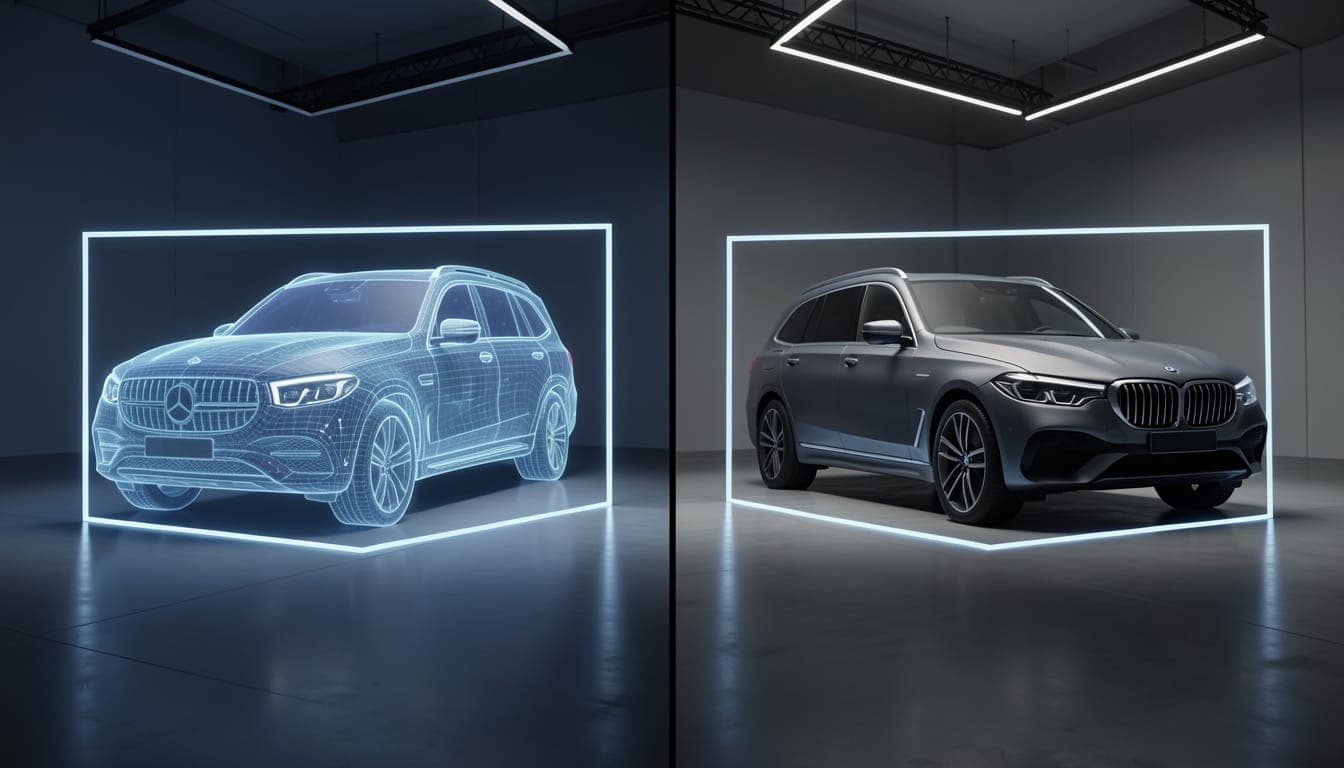
A dramatic split-screen image showing a Mercedes-Maybach GLS and BMW, with a mouse selection box framing an AI-generated ghost car
Mercedes-Benz and BMW have been rivals for nearly a century. They compete in every segment, from entry-level luxury to ultra-premium hypercars. They do not agree on much. But recently, they found common ground.
Both brands recently released creative short films that implicitly and explicitly criticize the industry's "fast-tracked vehicle" phenomenon. The topic has become a trending discussion across social media and automotive forums.
This is not just about two luxury automakers complaining. It is about a fundamental shift in how cars are being built, tested, and brought to market. It is about the tension between speed and safety, between innovation and reliability, between the old guard and the new disruptors.
Let us examine what happened, why it matters, and what it means for the future of the automotive industry.
The Videos That Started It All
Mercedes-Benz released its video in August 2026. The video opens with a Maybach GLS driving along a forest road. A mouse-dragged selection box appears on the screen, framing the entire vehicle. It makes the car look like an AI-generated image. Then the car drives out of the box, revealing that it is authentic live-action footage.
The closing caption reads: "框出来的,是车。测出来的,才是实力." In English: "A car framed is just a car; real capability is proven through testing."
BMW released a similar video in July 2026. The first half is deliberately absurd. Toy car models crash into durians and pineapples to simulate crash tests. People blow air onto scale models to mimic wind-tunnel testing. It is a satirical take on what happens when corners are cut.
The second half cuts to BMW's actual crash-testing laboratory. Professional crash-test dummies. Real wind tunnels. Massive volumes of real-world vehicle test data. The contrast is stark. The closing caption reads: "不经硬核洗礼,就不是BMW." In English: "Without undergoing hardcore validation, it's simply not a BMW."
These videos are clever, visual, and highly shareable. But they are also a serious warning. The implied target is the growing trend of "speed-to-market" vehicles.
What Is a "Speed-to-Market" Vehicle?
The term "speed-to-market" refers to vehicles that are rushed to production to seize market share or meet launch deadlines. The development cycle is shortened drastically. Essential real-vehicle validation steps are omitted or reduced.
Historically, automakers required three full years of development and validation. This included extreme-environment testing covering two winters and two summers. Cars were tested in the Arctic cold and the desert heat. They were subjected to millions of miles of real-world driving.
Today, many automakers have slashed development cycles in half. All-new vehicles are introduced in just 18 months. Facelifts can roll out every few months. The pressure to launch new models is immense.
The numbers are staggering. According to Dongchedi's statistics, during the first half of 2026, more than 576 new vehicles launched in China. That averages more than 100 new models per month, or roughly three new vehicles every single day.
| Metric | Traditional Approach | Speed-to-Market Approach |
|---|---|---|
| Development Cycle | 36 months | 18 months or less |
| Vehicle Testing | 2 winters, 2 summers | Shortened or skipped |
| New Vehicles (H1 2026) | N/A | 576+ models |
| Daily Launches | N/A | 3+ per day |
The concern is that some brands are cutting corners in validation and using digital product iteration speed to build cars. Cars are being treated like smartphones, with rapid release cycles and minimal real-world testing.
The Industry Debate: Speed vs. Safety
This is not a simple issue. There is a genuine debate about the right approach to developing new vehicles.
The Traditional Automakers' View
Mercedes-Benz, BMW, and other established automakers argue that real testing is irreplaceable. The development process is not just about engineering. It is about durability, safety, and reliability. Cars are used in extreme conditions. They are expected to last for years and hundreds of thousands of miles.
Cutting corners in testing can have serious consequences. Safety features might not work as intended. Mechanical components might fail prematurely. The long-term reliability of the vehicle could be compromised.
The New Entrants' View
New entrants argue that technology has advanced. AI, simulation, and data analytics can replace some real-world testing. Virtual testing is faster and cheaper. It allows for rapid iteration and improvement. The old way of doing things is slow and expensive.
They also argue that consumer expectations have changed. People want new features and technology faster than ever before. A three-year development cycle is too long in a rapidly evolving market.
The Concern
The concern is about who tests the cars if not the manufacturer. If automakers are rushing vehicles to market, are they doing enough to ensure safety? Are they using consumers as test drivers?
Li Jun, a senior executive at SAIC Volkswagen, put it bluntly: "The industry now has extremely short R&D cycles, cutting corners in validation, and using digital product iteration speed to build cars."
Lee Bong-gang from Beijing Hyundai added: "Some brands delete necessary testing to rush launch deadlines, turning consumers into test drivers."
NIO's Li Bin described the situation as a "new car effect death valley," meaning that new models are losing their appeal too quickly because they have not been properly developed.
The Chinese government has taken notice. On July 17, 2026, the Ministry of Industry and Information Technology held a meeting with key automakers. They were required to resist irrational competition, strengthen product testing and safety assessments, and safeguard product consistency and quality safety.
Why This Matters to You
This debate is not just for industry insiders. It matters to every car buyer.
Cars are different from smartphones. A smartphone might have a minor software bug that gets fixed with an update. A car with a safety defect could cause a crash. The stakes are much higher.
When automakers rush vehicles to market, there is a real risk that safety is being compromised. Features might not be fully tested. Components might not be as durable as they should be. The long-term reliability of the vehicle could suffer.
If you are buying a new car, it is worth asking: how thoroughly was this vehicle tested? Was it subjected to real-world validation, or was it rushed to market? The answers to these questions matter.
What Happens Next?
The debate over speed-to-market vehicles is not going away. It is likely to intensify as competition in the EV market grows.
The traditional automakers will continue to emphasize their heritage of rigorous testing and validation. New entrants will continue to push for faster development cycles. Regulators will need to decide what standards are acceptable.
The outcome will shape the future of the automotive industry. Will we have cars that are developed in 18 months with some corners cut? Or will we insist on three-year development cycles with rigorous testing?
The answer will determine how safe, reliable, and durable our cars are for years to come.
The Bottom Line
Mercedes-Benz and BMW rarely agree on anything. Their decision to jointly criticize speed-to-market vehicles is a significant moment. It signals a growing concern among traditional automakers about the direction of the industry.
The question is whether that concern is justified. Are cars really being rushed to market with inadequate testing? Or are the traditional automakers simply protecting their turf?
The answer lies somewhere in the middle. There are legitimate concerns about safety and reliability. But there is also genuine innovation happening in the industry.
The challenge for automakers is to find the right balance. Speed is important, but not at the expense of safety. Innovation is essential, but not at the expense of reliability.
The best cars will be those that manage to be both innovative and well-tested. The worst will be those that sacrifice quality for speed.
You might also like:
- The Rise and Fall of Saab
- 10 Cars That Almost Killed Their Brand
- 2026 Toyota Camry vs. Kia K5 Comparison
Disclaimer: This article is for informational purposes only. The views expressed are those of the author and do not necessarily reflect the official policy or position of Mercedes-Benz, BMW, or any other company mentioned.
Drift Team
Automotive industry analysts and car culture experts