The Rise and Fall of Saab: From Fighter Jets to Bankruptcy
Saab built cars unlike anyone else. Born from fighter jets, driven by innovation, and ultimately killed by corporate mismanagement. Here is the complete story of one of automotive history's most beloved failures.
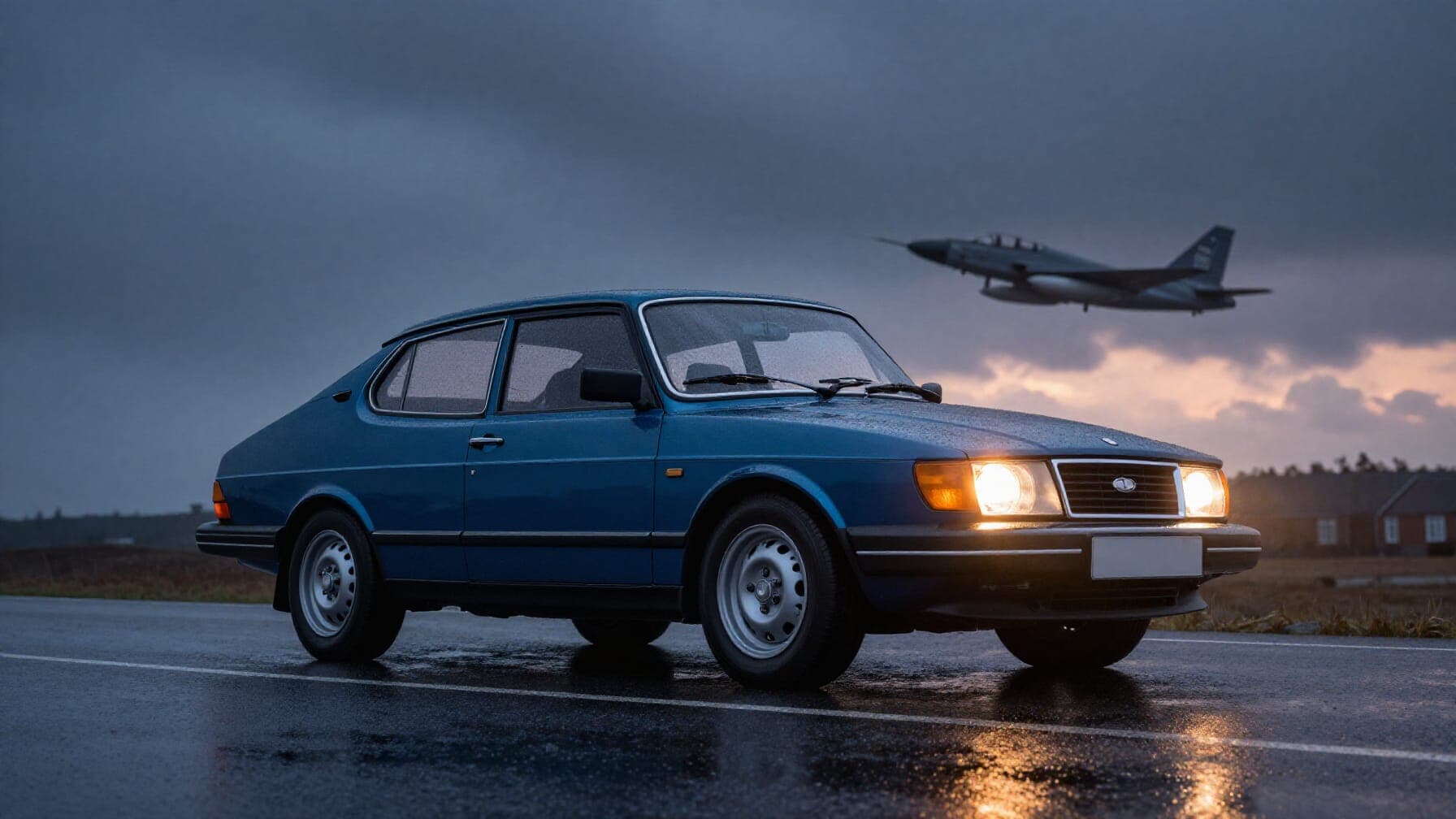
A melancholic dusk scene of a Saab 900 Turbo on a rain-slicked Swedish road with a fighter jet silhouette in the stormy sky
The Rise and Fall of Saab: From Fighter Jets to Bankruptcy
There was never another car company quite like Saab. It built cars with aircraft-grade engineering, turbochargers that changed the industry, and a quirkiness that inspired fierce loyalty. For more than 60 years, Saab produced vehicles that were unmistakably Swedish, unmistakably unconventional, and unmistakably special.
Then, in December 2011, it all ended. The brand that had once been the pride of Sweden filed for bankruptcy, 3,700 workers lost their jobs, and 4.5 million Saabs became a legacy rather than a future.
This is the story of how a fighter jet manufacturer built some of the most innovative cars ever made, why those cars captured the hearts of enthusiasts worldwide, and how corporate mismanagement, subscale operations, and a global financial crisis brought it all crashing down.
Born from Fighter Jets
Saab did not start as a car company. It started as an aircraft manufacturer. In 1937, Svenska Aeroplan Aktiebolaget was founded in Trollhättan, Sweden, to build military aircraft for the Swedish Air Force. The company quickly became a leader in aviation engineering, producing advanced fighter jets like the Saab 35 Draken and the Saab 37 Viggen.
When World War II ended, the demand for military aircraft dropped sharply. Saab needed a new revenue stream, and cars seemed like a logical pivot. In 1945, the company launched Project 92, its first automotive development program.
The engineers tasked with designing Saab's first car were not automotive engineers. They were aircraft engineers. They approached the problem of building a car the same way they approached building a fighter jet: aerodynamics, weight reduction, and structural integrity above all else. The result was the Ursaab, the first prototype, which debuted in Linköping in 1947. The production version, the Saab 92, followed in 1949.
The 92 was a revelation. It had front-wheel drive, a configuration that was unusual for the era. Its teardrop shape, inspired by aircraft design, made it exceptionally slippery through the air. The two-stroke engine was simple and efficient. The car was light, nimble, and unlike anything else on the road.
🔹 AVIATION HERITAGE
"The aerodynamics of the Saab 92 were a direct translation of aircraft design principles. The wind tunnel testing, the teardrop shape, the focus on reducing drag—all of it came from building fighter jets. Saab didn't just say they were 'born from jets.' They actually were."
— Automotive historian on Saab's design philosophy
The Early Years: Building a Reputation
In the 1950s and 1960s, Saab established itself as a small but serious player in the automotive world. The Saab 93, introduced in 1955, featured a three-cylinder two-stroke engine and was the first Saab to offer a three-speed manual transmission. The Saab 96, launched in 1960, became a rally legend, winning the Monte Carlo Rally in 1962 and 1963.
Saab also pioneered safety features that were years ahead of their time. In 1958, the company became the first automaker to offer factory-installed seat belts as standard equipment. The Saab 96 featured crumple zones and reinforced passenger compartments at a time when most cars were still built like tanks with no concern for crash energy absorption.
The company arrived in the United States in 1956, debuting at the New York Auto Show. American buyers were intrigued by the quirky Swedish cars, and Saab slowly built a following among intellectuals, architects, and doctors who appreciated the brand's unconventional approach.
But the real breakthrough was still to come.
The Saab 99: The Car That Defined the Brand
In 1967, Saab launched the 99, the first all-new model in 19 years. It was a clean break from the 92 lineage and a statement of intent. The 99 was larger, more powerful, and more sophisticated than anything Saab had built before. It also introduced features that would come to define the brand for decades.
Innovations That Were Decades Ahead
The Saab 99 featured a wraparound windshield that provided exceptional visibility. It had self-repairing bumpers that could absorb low-speed impacts without damage. It offered headlamp washers to keep the lights clean in Sweden's harsh winter conditions. It was the first production car with side-impact door beams, a safety feature that would become standard across the industry. It had heated seats, a feature that Saab pioneered and that is now ubiquitous in cold-weather markets.
And then there was the ignition. Saab placed the ignition switch between the seats, not on the steering column. This was not just quirky design; it was a safety feature. In a crash, the driver's knees could strike the steering column, and a traditional ignition key could cause serious injury. Moving the ignition between the seats eliminated that risk.
🪟
Wraparound Windshield
Superior visibility decades before it became standard
🛡️
Side-Impact Beams
First production car with this safety feature
🔥
Heated Seats
Saab pioneered what is now standard equipment
🔑
Between-Seat Ignition
Protected knees in accidents; a Saab signature
The 99 was styled by Sixten Sason, the same designer behind Hasselblad cameras and Electrolux vacuum cleaners. His design legacy included the "hockey stick" C-pillar graphic that would become a Saab hallmark, appearing on nearly every model that followed.
The Turbo Revolution
In 1976, Saab announced that it would introduce a turbocharged engine in the 99. The following year, the Saab 99 Turbo went into production. It was not the first turbocharged car, but it was the first to make turbocharging usable for everyday driving.
Before Saab, turbochargers were for race cars. They produced massive turbo lag followed by a sudden surge of power, making them unpredictable and difficult to drive in normal conditions. Saab's engineers took a different approach. They designed the turbo to deliver a smooth, wide power band with usable torque across the rev range. The focus was on drivability, not peak horsepower.
Saab didn't invent the turbocharger, but they invented the usable turbocharger. The 99 Turbo delivered torque in a way that made sense for real-world driving. You could pass a truck on a two-lane road without downshifting and without waiting for the boost to arrive. It was revolutionary.
This philosophy was decades ahead of its time. Today, almost every mainstream automaker uses turbochargers in the same way Saab pioneered. Ford EcoBoost engines deliver usable torque. General Motors' 2.0-liter turbos provide smooth, linear power delivery. The modern turbocharged engine is a testament to Saab's vision.
The Golden Era: Saab 900 and Global Success
In 1978, Saab introduced the 900, a car that would become the company's best-selling model. Nearly one million Saab 900s were produced during its 15-year production run. The 900 was available as a two-door, three-door, four-door, and five-door hatchback, with the convertible version arriving in 1986.
The Cult Following
The Saab 900 developed a cult following that was almost religious in its intensity. Doctors loved them. Architects loved them. Pharmacists loved them. The 900 was the car of choice for people who wanted to be different, who valued intellect over status, and who appreciated engineering that was both innovative and idiosyncratic.
The 900 Turbo became the enthusiast's choice. The combination of turbocharging, front-wheel drive, and Saab's signature handling made it a driver's car in the truest sense. It was not the fastest car on the road, but it was one of the most engaging.
Pop Culture Status
The Saab 900 achieved a level of pop culture recognition that few cars ever reach. In John Gardner's James Bond novels, Bond drove a Saab 900 Turbo, dubbed the "Silver Beast." On Seinfeld, Jerry Seinfeld's character drove a series of Saab 900s, and the show's writers used the car to reflect Jerry's personality: quirky, intellectual, and vaguely European.
Kurt Vonnegut, one of America's greatest novelists, managed a Saab dealership in New York. He famously joked that the experience cost him a Nobel Prize. "I have never had a job that was so educational," he once said. "I learned more about human nature from selling Saabs than I ever learned from writing novels."
Peak U.S. sales came in 1986, when Saab sold more than 47,000 cars in America. The company was profitable, growing, and beloved. It seemed like nothing could stop them.
The Seeds of Destruction
But even during the golden era, problems were brewing. Saab produced roughly 125,000 cars per year, but it competed in the premium segment with Audi, which had nearly ten times the volume and the economies of scale that came with being part of the Volkswagen Group. One analyst described Saab's situation as "Porsche volumes with Audi prices." It was the worst of both worlds.
In 1987, the stock market crash hit Saab's export markets hard. In 1989, General Motors bought a 50% stake in Saab Automobile for $600 million. The Wallenberg family, which controlled the other 50% through Investor AB, retained the other half. GM had an option to acquire the remaining shares within a decade.
The GM Years Begin
GM's investment initially seemed positive. The company provided capital, engineering resources, and access to global markets. Saab turned a profit in 1995, its first in seven years. But the cracks were already showing.
The second-generation Saab 900, introduced in 1994, shared its platform with the Opel Vectra. Longtime Saab loyalists complained that the car had lost its uniqueness. The distinctive Saab character that had defined the brand for decades was being diluted in the name of cost-cutting and platform sharing.
The tension was never managed well. Saab wanted to be premium and distinctive. GM wanted economies of scale. Neither side was willing to compromise, and the result was a slow, grinding decline.
The Badge-Engineering Era
In 2000, GM acquired the remaining 50% of Saab for $125 million. The company was now a wholly owned subsidiary, and the badge-engineering era began in earnest.
The Saab 9-2X
In 2005, Saab introduced the 9-2X, a Subaru Impreza with a Saab grille and minor styling changes. It was built in Japan, shared Subaru's all-wheel-drive system, and had nothing in common with any other Saab. It was the automotive equivalent of putting a tuxedo on a Labrador retriever.
The Saab 9-7X
Later that same year, Saab introduced the 9-7X, a Chevrolet TrailBlazer with a Saab grille and upgraded interior. It was a midsize SUV built on a truck platform, which was about as far from Saab's aviation-inspired, front-wheel-drive heritage as it was possible to get.
The 9-2X and 9-7X were sales disasters. Saab loyalists felt betrayed. Potential new buyers were confused. The cars sold in tiny numbers, and the damage to the brand was immense. Saab's reputation for innovation and uniqueness was being destroyed by the very company that was supposed to be saving it.
The New York Times described this period as "a line of rebadged models that were tepidly received." The financial reality was even worse. Saab lost money in nearly every year of GM ownership, with the exception of 1994, 1995, and 2001.
THE BIGGEST MISTAKES
- Saab 9-2X (2005): Subaru Impreza with Saab badges. Sales flop.
- Saab 9-7X (2005): Chevrolet TrailBlazer with Saab grille. Critical failure.
- Opel Platform Sharing: The 1994 900 lost the unique character that defined Saab.
- Scaled-Back R&D: GM canceled a planned 9-5 replacement in 2005.
The Financial Crisis and the End
In 2008, the global financial crisis hit. Saab's sales plummeted to just 20,791 units in 2009, a fraction of the 125,000 units the company needed to be viable. GM itself went bankrupt and was forced to cut brands. Saab was the weakest part of GM Europe, and GM wanted out.
The Spyker Gamble
In early 2010, Dutch niche carmaker Spyker purchased Saab for $400 million. The company was later renamed Swedish Automobile. The plan was to turn a profit by 2012 with new models. Sales targets were set at 50,000 units in 2010 and 100,000 units in 2011. The actual result was 32,000 units combined over both years.
Suppliers halted deliveries in April 2011 due to unpaid bills. Employees missed five months of paychecks between May and November. The company scrambled for investors in the fall of 2011, with Chinese automakers Youngman and Pang Da showing interest.
But GM blocked the deal. The company had a joint venture in China with S.A.I.C. Motor Corporation, and allowing Saab's technology to transfer to Chinese competitors made no commercial sense. The Wall Street Journal reported that "GM and S.A.I.C. want to protect their existing joint venture in China and are concerned that Youngman and Pang Da could gain access to technology they were not entitled to."
Bankruptcy
On December 19, 2011, Saab Automobile AB filed for bankruptcy. The company had produced 4.5 million vehicles since 1949. In the end, 3,700 workers lost their jobs in Trollhättan. The brand that had once been the pride of Sweden was gone.
Why Saab Failed
The University of Edinburgh researchers Oliver and Holweg identified multiple causes for Saab's failure. The company was subscale, never exceeding 150,000 units per year in an industry that required 500,000 or more to be competitive. Saab's premium positioning required premium volumes, but the company never achieved them. The GM-Saab cultural clash led to poor management decisions and a loss of brand identity. The badge-engineering era diluted the uniqueness that had made Saab special. And the financial crisis was the final straw.
The irony is that Saab was a victim of its own contradictions. To be economically viable, it had to grow. But if it grew, it would undermine the inherent value of the Saab brand. The company was caught in a trap from which there was no escape.
What Saab Left Behind
Saab AB, the defense and security company, continues to exist. It builds fighter jets, submarines, and the Gripen system. But it does not build cars. NEVS, National Electric Vehicle Sweden, acquired Saab's automotive assets in 2012 but could not use the logo. The company planned to produce electric vehicles but ran into financial trouble.
The Saab Museum in Trollhättan preserves the legacy. Enthusiasts around the world keep the cars alive. The classic Saab 900 remains a beloved collector's car, and the 900 Turbo is considered one of the greatest front-wheel-drive cars ever made.
What Saab left behind is a legacy of innovation. The company pioneered turbocharging, heated seats, side-impact door beams, carbon cabin filters, and a host of other features that are now standard across the industry. It built cars that were quirky, engaging, and utterly distinctive.
The Lesson of Saab
Saab's story is a cautionary tale. It reminds us what happens when a niche brand loses its identity in the pursuit of scale. It shows us the danger of corporate mismanagement and cultural clashes. It illustrates the harsh reality that even the most beloved brands can fail when the numbers do not work.
But Saab's story is also a celebration. It reminds us that cars can be more than transportation. They can be expressions of personality, engineering, and art. The Saab 900 Turbo, the Saab 99, and the quirky two-stroke models that started it all will always have a place in automotive history.
Driving a Saab was never just about getting from point A to point B. It was about making a statement. It was about valuing intellect over status, innovation over convention, and individuality over conformity. It was about being part of something special.
And that, in the end, is why we still remember Saab.
You might also like:
- The 10 Most Controversial Cars Ever Made
- The Legend That Wouldn't Die: The Tucker 48
- Sedan Showdown: 2026 Honda Accord vs. Toyota Camry
Disclaimer: This article is for informational and entertainment purposes only. All product names, logos, and brands are property of their respective owners. The views expressed are those of the author and do not necessarily reflect the official policy or position of any other agency, organization, employer, or company.
Drift Team
Automotive historians and Saab enthusiasts