The Last Dragon: Inside the €3 Million Apollo Evo
Ten cars. €3 million each. Illegal on the street. The Apollo Evo is the last naturally aspirated V12 hypercar, and it represents the end of an era you didn't know was closing.
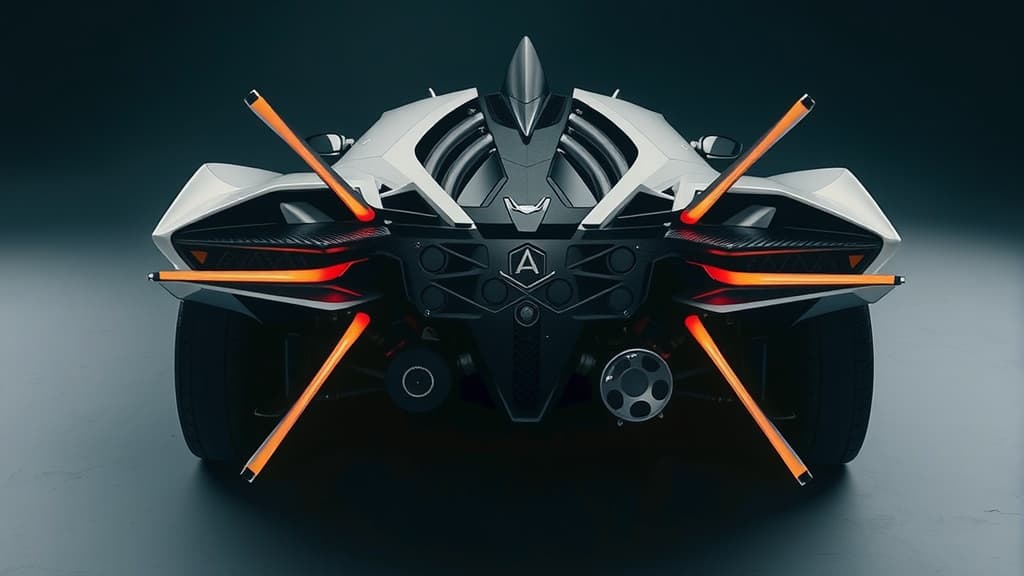
A dramatic shot of the Apollo Evo Caribbean Dragon in pearl white with diamond dust finish, blue carbon accents, and the 3D-printed titanium Dragon Skin exhaust
The Last Dragon: Inside the €3 Million Apollo Evo
There is a car that costs €3 million. It is illegal to drive on public roads. Only ten will ever exist. And it represents the end of something that will never come back.
The Apollo Evo is not a car in the traditional sense. It is a sculpture that happens to have a V12 engine. It is a piece of engineering art that was commissioned by a Dutch real estate developer who wanted something no one else could have. It is finished in pearl white with diamond dust, a paint job that took over 1,000 hours to complete.
But the most important thing about the Apollo Evo is not what it has. It is what it represents.
The Evo is the last of the naturally aspirated V12 hypercars. It has no turbos. No hybrid system. No electric motors. Just twelve cylinders, 800 horsepower, and a redline of 8,500 rpm. It is the final chapter of a story that began with the Gumpert Apollo twenty years ago, and it ends with ten cars that will never be replaced.
This is the story of the last dragon.
The Inheritance
Apollo's story begins with a man named Roland Gumpert. He was the head of Audi Sport, responsible for four World Rally Championship titles. In 2004, he founded his own company to build a supercar that would follow no rules but his own.
The first Gumpert Apollo was a weapon. It was ugly in the way that function sometimes is. It had no concessions to comfort. It was built to go fast, and it did. In 2009, it lapped the Nürburgring in 7 minutes and 11.17 seconds, becoming one of the fastest production cars ever to circle the Green Hell. The company built 44 of them.
Then it went bankrupt.
What happened next is a story of survival that is common in the hypercar world. New investors bought the assets. The company was renamed Apollo Automobil. In 2017, they unveiled a new car called the Intensa Emozione. It was wilder than anything Gumpert had built. It had 780 horsepower from a Ferrari-derived V12, a carbon fiber monocoque, and a design that looked like it had been pulled from a science fiction film.
The IE was supposed to be the beginning of a new era. Instead, it became a waiting game. Ten were planned. The company went quiet. Years passed.
Then, in July 2026, at the Goodwood Festival of Speed, the first customer car was finally delivered. It was called the Caribbean Dragon. And it was the beginning of the end.
The Dragon
The first production Apollo Evo is a commission for a Dutch real estate developer. It is called the Caribbean Dragon, and every detail of its specification tells a story.
The paint is pearl white, finished with a layer of diamond dust. Under direct sunlight, it sparkles like the surface of water on a bright day. The process took over 1,000 hours, and the car's body consists of more than 75 individual carbon fiber panels, each one painted and finished by hand.
The blue carbon fiber is inspired by the Caribbean Sea. It appears on the engine cover, the roof scoop, the wheel arches, and sections of the hood. Light, contrast, and individuality define the specification. This is not a car that was ordered from a catalog. It is a piece of personal expression.
The interior continues the theme. Butterfly doors open to reveal white and blue leather, blue contrast stitching, and embroidered Apollo logos. The center console is a lattice-like framework of blue-tinted carbon. The dashboard is supported by 3D-printed aluminum components with a natural metallic finish. The steering wheel is milled from solid aluminum and trimmed with leather and blue carbon.
But the most striking element is the exhaust. Apollo calls it the Dragon Skin. It is a one-piece titanium system created using a weld-free 3D printing process. It takes 123 hours to make. It can withstand temperatures of up to 1,000 degrees. And when the car is driven hard, the natural titanium finish will transform, developing a deep blue tint from the extreme heat.
It is not just an exhaust. It is a living part of the car.
The Heart
Behind the cockpit sits the reason for the Evo's existence. It is a 6.3-liter naturally aspirated V12. It produces 800 horsepower and 765 Nm of torque. It revs to 8,500 rpm. It is paired with a six-speed sequential gearbox that sends every ounce of power to the rear wheels.
The engine is derived from Ferrari's F140 architecture, the same V12 that powered the F12 and the LaFerrari. But this one has been torn down and rebuilt by HWA AG, the German racing specialists who have worked with Mercedes-AMG and Porsche. There are no turbos. There are no electric motors. There is no hybrid assistance.
It is a pure, old-school engine in a car that looks like it came from the future.
The numbers are staggering. The Evo accelerates from 0 to 100 km/h in 2.7 seconds. It has a top speed of 335 km/h. It weighs just 1,300 kilograms, thanks to a carbon fiber monocoque that weighs only 165 kilograms. And it generates 1,350 kilograms of downforce at speed, more than the car itself weighs.
This is physics on the edge of sanity. It is a machine that exists because someone wanted to build it, not because it made sense.
The Farewell
The Apollo Evo is not alone in its defiance. It is the last of a dying breed. The world is moving toward electrification. Ferrari has built its first electric car. Porsche is committing to hybrids. Even Lamborghini has embraced electrification.
The naturally aspirated V12 is becoming extinct. It is being legislated out of existence. It is being replaced by batteries and electric motors that are faster, cleaner, and quieter.
The Apollo Evo is a rejection of that future. It is a statement that says: not yet. It says that there is still value in noise, in vibration, in the mechanical symphony of twelve cylinders working in perfect harmony. It says that some things are worth preserving, even if they are impractical, inefficient, and expensive.
Only ten will be built. The base price is €3 million. The first one has already been delivered. The other nine will follow.
And then the silence comes.
The Legacy
The Apollo Evo is not a car that will be driven to the grocery store. It is not a car that will be seen at a Cars and Coffee. It is not a car that most people will ever see in person.
It is a car that will sit in climate-controlled garages. It will be started occasionally, driven on private tracks, and admired by owners who understand what it represents. It will appreciate in value. It will become a collector's item.
But its true value is not financial. It is historical. The Apollo Evo is a snapshot of a moment in time. It is the last car of its kind. It is the final expression of an idea that is being retired.
The Evo is the last dragon. And when the last dragon is gone, there will be nothing left but the memory of its roar.
You might also like:
- The King Is Dead: How the Lucid Air Sapphire Ended the Corvette's Reign
- The Ferrari That Broke Its Own Heart
- The Jaguar E-Type: The Most Beautiful Car Ever Made
Disclaimer: This article is for informational and entertainment purposes only. All product names, logos, and brands are property of their respective owners. The views expressed are those of the author and do not necessarily reflect the official policy or position of any company mentioned.
Drift Team
Automotive historians and hypercar enthusiasts