The King Is Dead: How the Lucid Air Sapphire Ended the Corvette's Reign
The Corvette ZR1X beat Bugatti. It was America's quickest production car. Then a four-door electric sedan showed up and made it look slow. This is the moment the performance hierarchy changed forever.
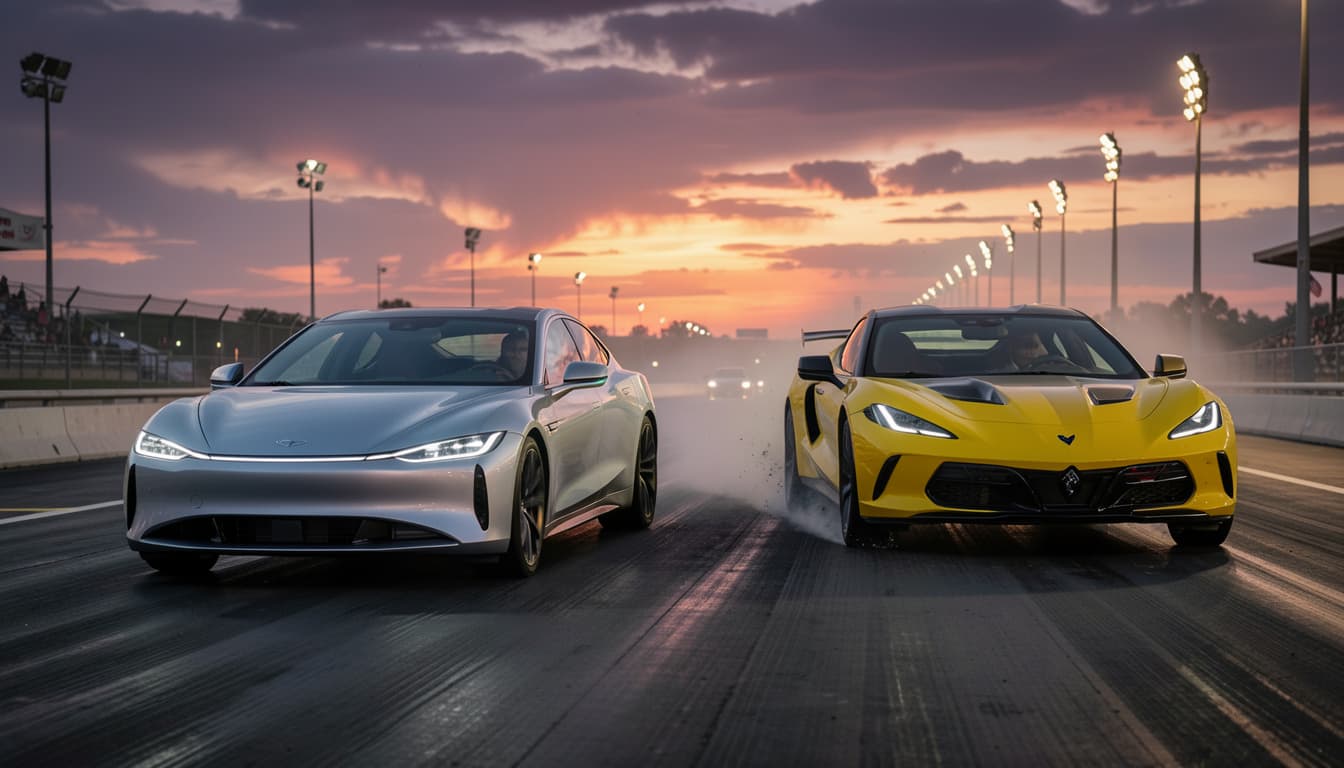
A dramatic shot of a Lucid Air Sapphire and Corvette ZR1X lined up at a drag strip at dusk, with the Lucid pulling ahead
The King Is Dead: How the Lucid Air Sapphire Ended the Corvette's Reign
There is a moment in every revolution when the old guard realizes the fight is over. For the American performance car, that moment happened in a cloud of dust and silence on an unprepped drag strip in Arizona.
The Corvette ZR1X was not a pretender. It was the most powerful Corvette ever built. It had 1,250 horsepower. It had a twin-turbocharged V8 with a flat-plane crank and a front axle driven by electricity. It had just beaten a Bugatti Chiron in a straight line. It was, by every measure the automotive world had used for a century, America's quickest production car.
And then a four-door sedan with massaging seats pulled up next to it and left it behind.
The Benchmark
The Corvette ZR1X represents the absolute pinnacle of internal combustion engineering. Chevrolet took the already brutal ZR1, with its 1,064-horsepower LT7 V8, and added an electric motor to the front axle. The result was 1,250 horsepower and 973 lb-ft of torque, delivered through an all-wheel-drive system that was designed to put every ounce of that power to the ground.
The numbers were staggering. Chevrolet claimed a 0-60 time of 1.89 seconds and a quarter-mile in 8.99 seconds at 157 mph. Independent testing backed it up. Car and Driver recorded a 1.8-second 0-60 and an 8.9-second quarter-mile, making it the quickest car the publication had ever tested. The ZR1X was, for a brief moment, the undisputed king of American performance.
It was a triumph of what gasoline and electricity could achieve together. The V8 provided the top-end fury. The electric motor provided the instant torque and the traction. It was the best of both worlds.
It was not enough.
The Challenger
The Lucid Air Sapphire was not built to be a drag car. It was built to be the world's finest luxury sedan. It has four doors. It has massaging seats. It has a 427-mile range and a cabin that rivals the best Germany has to offer.
It also has three electric motors producing 1,234 horsepower and 1,430 lb-ft of torque. And that torque is available the instant you press the accelerator. There is no waiting for turbos to spool. There is no transmission to downshift. There is simply power, delivered to all four wheels, with an immediacy that a combustion engine cannot match.
When the Sapphire and the ZR1X line up, the outcome is decided before the race even begins. The Corvette's front wheels spin. The engine screams. The turbos build boost. The Lucid simply leaves. It pulls car lengths off the line and never gives them back. In multiple races, the Sapphire ran the quarter-mile in 8.99 seconds while the ZR1X, despite its best efforts, could not close the gap.
The Corvette has more horsepower. The Lucid has more torque. And in a drag race, torque is the only currency that matters.
Why the Corvette Loses
This is not a story about the Corvette being a bad car. It is a story about physics.
An internal combustion engine, even one as magnificent as the LT7, has to build power. It needs air. It needs fuel. It needs exhaust gases to spin the turbos. It needs the crankshaft to reach the rpm range where the power lives. Every one of those steps takes time. The ZR1X's electric front motor helps eliminate some of that lag, but it cannot erase it entirely.
An electric motor does not have those problems. It produces its maximum torque at zero rpm. The moment current flows through the stator, the rotor turns. There is no combustion. There is no boost. There is no gear change. There is just motion.
That is why the Lucid wins. Not because it is more powerful. Because it is more immediate.
The Sapphire's advantage is not just off the line. Car and Driver found that the Sapphire reached 200 mph more than seven seconds faster than the ZR1X, and completed a 0-200-0 mph run in 25.7 seconds, six seconds quicker than the Corvette. The electric sedan is not just a drag strip specialist. It is a weapon across the entire performance envelope.
The New Hierarchy
For decades, the automotive hierarchy was simple. More power meant more speed. Bigger engines meant more performance. The Corvette ZR1X is the ultimate expression of that philosophy. It is the most powerful Corvette ever built. It is the quickest car Car and Driver has ever tested.
And it is no longer the fastest.
The Lucid Air Sapphire has claimed the crown. It holds the quickest 0-60 and quarter-mile records at both MotorTrend and Car and Driver. It has beaten the Corvette, the Porsche Taycan Turbo GT, and the Dodge Demon 170. It is the new benchmark.
This is not a temporary state of affairs. It is a permanent shift. The physics that make the Lucid faster will not change. The instant torque of an electric motor will always have an advantage over the delayed response of a combustion engine. The future of performance is electric, not because of regulation or environmental policy, but because electricity is simply better at accelerating.
The Corvette's Legacy
None of this diminishes what the Corvette ZR1X represents. It is a masterpiece of engineering. It is a 1,250-horsepower hybrid that can run with Bugattis and Ferraris costing ten times as much. It is the greatest Corvette ever built.
But greatness is not permanent. The ZR1X was the king. Now it is the benchmark. The car that everyone else measures themselves against. It is the target that the Lucid hit.
The Corvette was built to beat Bugatti. It succeeded. The Lucid was built to be a luxury sedan. It became the new king.
That is the story. The old guard built the most powerful weapon it could imagine. The new guard built a family car. And the family car won.
You might also like:
- Tesla's Cybercab Has a 'Stupidity Problem'
- Oil Prices Are Soaring—Here's What It Means for Your Wallet and the Auto Industry
- 2026 Kia EV9 vs. Hyundai Ioniq 9: The Electric Three-Row Showdown
Disclaimer: This article is for informational purposes only. All product names, logos, and brands are property of their respective owners. The views expressed are those of the author and do not necessarily reflect the official policy or position of any company mentioned.
Drift Team
Performance car analysts and EV enthusiasts