Porsche Mission S: The Supercar That Refuses to Go Electric
Porsche just unveiled its new mid-engine flagship. It has a tachometer, four exhaust pipes, and no battery in sight. The Mission S is a love letter to combustion, and a direct challenge to Ferrari and Lamborghini.
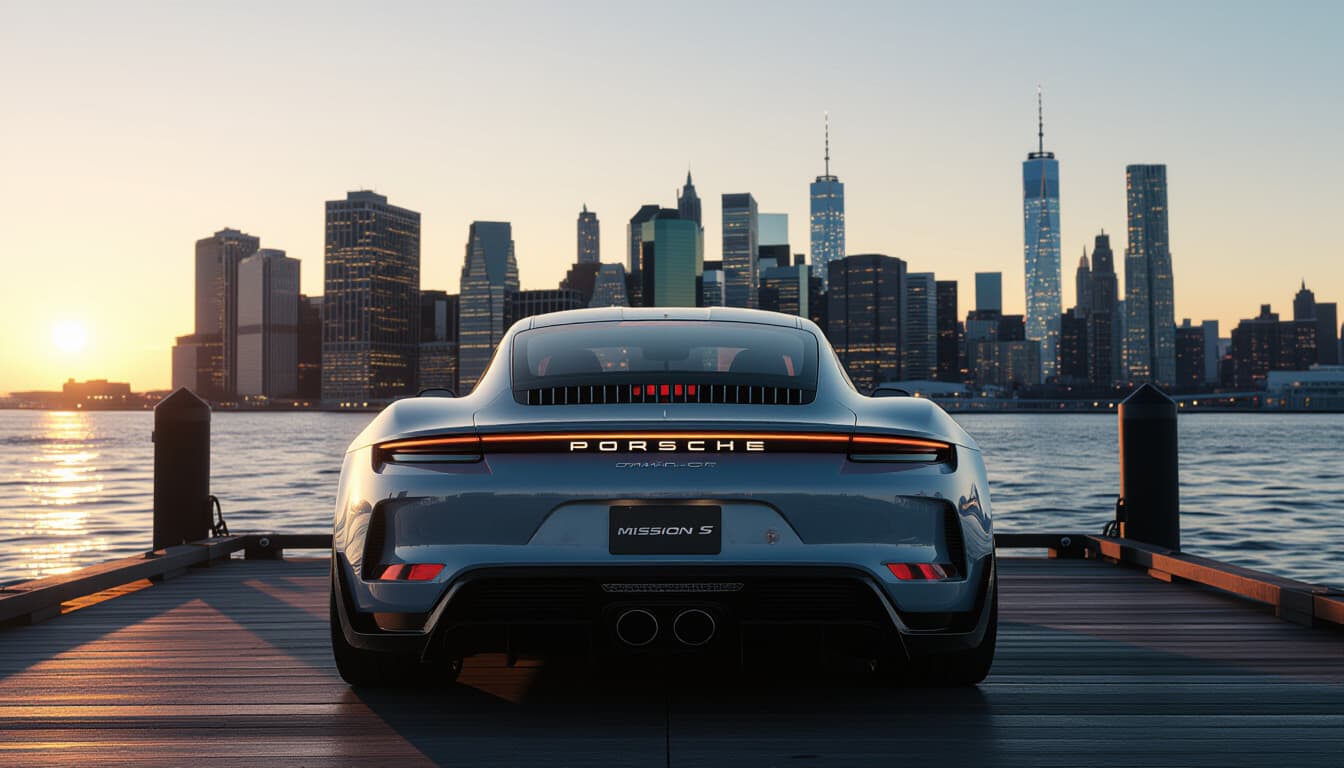
A dramatic shot of the Porsche Mission S concept on a pier in Queens, New York, with the Manhattan skyline in the background
Porsche Mission S: The Supercar That Refuses to Go Electric
Porsche just revealed its new supercar. It has a tachometer that redlines past 7,000 rpm. It has four exhaust pipes. It has a cooling fan sticking out of the engine cover, just like the 917 Le Mans racer.
It does not have a battery.
The Mission S is Porsche's first permanently available mid-engine flagship, positioned above the 911 in a way that no Porsche has been since the 918 Spyder. It is a concept for now, but Porsche is clear: this is not a one-off hypercar. This is the future of the brand's performance lineup.
And it is powered by combustion.
A Deliberate Rejection of the Electric Future
Porsche has spent the last decade promising an electric revolution. The Taycan launched in 2020. The Mission E concept previewed it. The Mission X concept, shown in 2023, was an all-electric hypercar.
The Mission S is the opposite of all that.
Porsche's chairman, Michael Leiters, said the Mission S "represents a mid-engined super sports car platform positioned above the 911 – not as a one-off hypercar, but as a permanent and versatile addition to our customer offering".
Nowhere in the official press release does Porsche mention electric power. Nowhere does it mention a hybrid system. The only clues are visual: a prominent analog tachometer, a manual gear lever, and four exhaust pipes poking out of the rear diffuser.
The message is unmistakable. Porsche is building a supercar for people who still care about the sound of an engine.
The Design: A Greatest Hits Album
The Mission S is not a radical departure. It is a celebration of everything Porsche has ever done.
The round headlights and torpedo fenders are pure 911. The flat front end is a tribute to the 911 GT1 Le Mans racer. The roofline under the rear wing echoes the 959. The wheels are a modern take on the 928's iconic dial design. And the cooling fan on the engine cover is a direct nod to the 917, the car that gave Porsche its first overall victory at Le Mans.
Even the debut location was a history lesson. Porsche chose a pier in Queens, New York, because that is where the first photos of the 550 Spyder were taken in 1953. The 550 was Porsche's first mid-engine production car. The Mission S is its spiritual successor.
The result is a car that looks unmistakably like a Porsche. It is low, wide, and muscular. It has the kind of presence that makes Ferraris look nervous.
The Interior: Less Screen, More Soul
While every other automaker is cramming bigger and bigger screens into their cars, Porsche went the other way.
The Mission S has no central infotainment screen. No passenger display. No digital clutter.
Instead, there are five circular instrument dials facing the driver. In the center is an analog tachometer with a real needle. Behind it is a small digital display. Depending on the drive mode, the tachometer moves closer to the driver or further away.
For navigation and other functions, Porsche designed a retractable smartphone mount with MagSafe compatibility. Your phone becomes the screen. It slides out when you need it and disappears when you don't.
It is a deliberate rejection of the direction the rest of the industry is going. And it is brilliant.
The Engine: A Mystery Worth Waiting For
Porsche has not confirmed what is under the engine cover. But the rumors are exciting.
The most persistent speculation points to a new eight-cylinder boxer engine. If true, it would be the first flat-eight in a production Porsche. The company has only ever built such engines for racing and for two special 914 prototypes owned by the Porsche and Piech families.
The tachometer in the Mission S redlines past 7,000 rpm. The exhaust note at the reveal was described as "decidedly un-electrified". And the car has four exhaust pipes, a roof scoop, and a visible cooling fan.
Whatever is in there, it is not a battery.
Why This Matters
Porsche's electric sales have not met expectations. The company predicted 80% of its sales would be electric by 2030. It has since revised that to 20%.
The Mission S is Porsche's admission that its core customers are not ready to give up combustion. It is a car built for the people who buy Porsches because of the way they sound, the way they feel, and the way they make you feel alive.
It is also a direct challenge to Ferrari and Lamborghini. Both have committed to hybridized supercars. Ferrari's F80 is a hybrid. Lamborghini's Revuelto is a hybrid. Porsche is going the other way.
The Mission S is not a hybrid. It is not electric. It is a supercar for the purists.
The Bottom Line
The Porsche Mission S is a statement. It says that combustion is not dead. It says that supercars should be loud, visceral, and emotional. It says that Porsche still knows how to build a driver's car.
There is no production date. No price. No confirmed engine specification. But the message is clear.
Porsche is building a supercar for the people who still believe in the roar.
You might also like:
- The Ferrari That Broke Its Own Heart
- The $40 Million Ferrari Nobody Wanted
- The Last Dragon: Inside the €3 Million Apollo Evo
Disclaimer: This article is for informational and entertainment purposes only. All product names, logos, and brands are property of their respective owners. The views expressed are those of the author and do not necessarily reflect the official policy or position of any company mentioned.
Drift Team
Automotive industry analysts and Porsche enthusiasts