The Ferrari That Broke Its Own Heart
Ferrari built its first electric car. The people who love Ferrari most want the logo ripped off it. The stock dropped 8% in a day. And it sold out anyway. This is the story of a brand at war with itself.
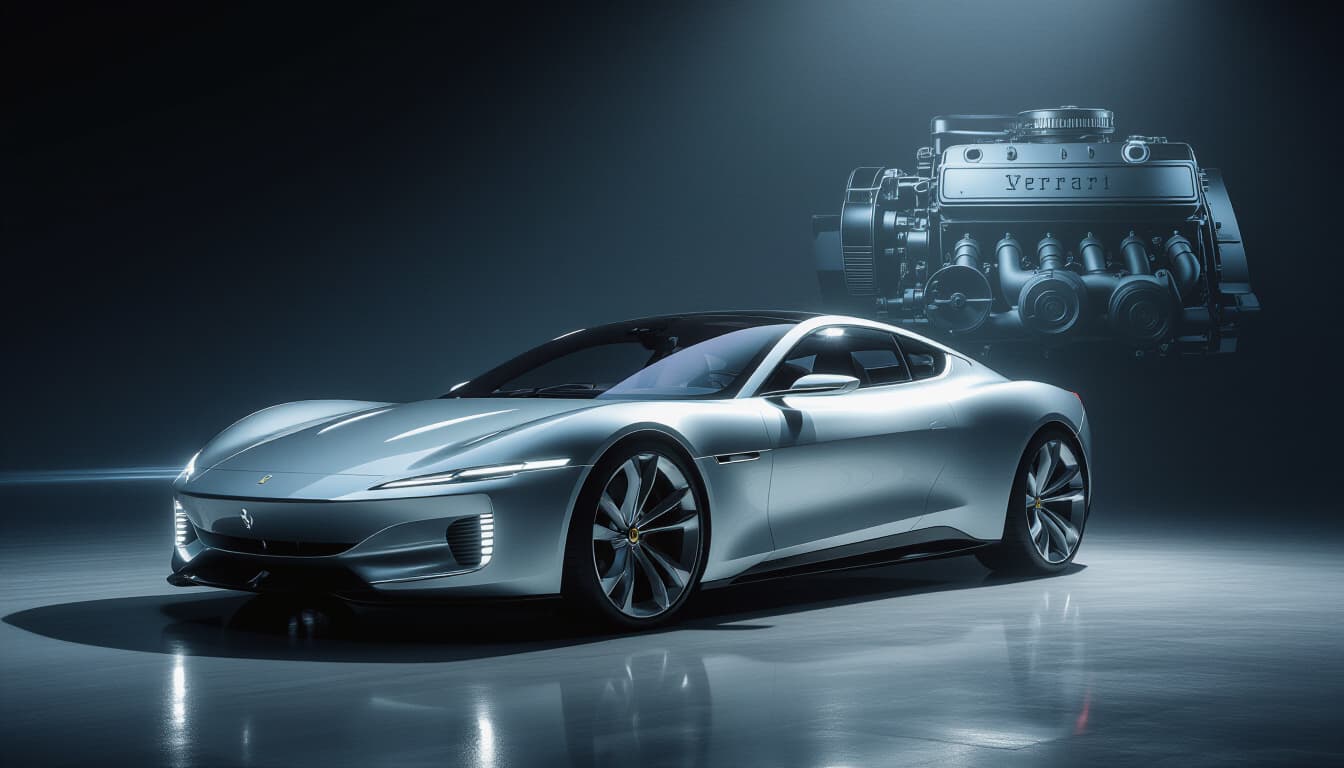
A dramatic shot of a Ferrari Luce electric sedan in a dark studio, with a ghostly, faded image of a classic Ferrari V12 engine in the shadows behind it
The Ferrari That Broke Its Own Heart
There is a moment in every legend's life when it has to decide what it is willing to lose to survive. For Ferrari, that moment arrived on May 26, 2026, in Rome, when the company pulled the cover off a five-door hatchback and called it a Ferrari.
The car is called the Luce. In Italian, it means "light." The irony was not lost on anyone.
Within hours, the people who love Ferrari most were calling for its logo to be ripped off. The former chairman said it risks destroying a myth. The stock fell 8% in a single day. The owners' club said it had "shaken the very foundations of our legendary Ferrari."
And then, two months later, the entire 2026 allocation sold out.
This is not a story about a car. This is a story about what happens when a brand built on emotion is forced to confront a future that has no sound, no vibration, and no soul. The Luce is Ferrari's answer. The question is whether the answer is good enough.
What Ferrari Actually Built
The Luce is not a sports car. It is not a supercar. It is a four-door, five-seat grand tourer that happens to be the fastest four-door Ferrari ever built.
The numbers are staggering. Four electric motors, one on each wheel, produce 1,050 horsepower and 990 Nm of torque. It accelerates from zero to 100 km/h in 2.5 seconds. It has a top speed of 310 km/h. It has a 122 kWh battery and a range of 530 kilometers.
But the numbers are not the story. The story is what Ferrari had to sacrifice to achieve them.
The Luce weighs 2,260 kilograms. That is the heaviest Ferrari ever built. It has the lowest drag coefficient in Ferrari history, achieved through 6,000 computer simulations and a design process that prioritized aerodynamics over emotion. The wipers park vertically at the edges of the windshield because the computer told them to. The shape was designed by a wind tunnel, not by a man.
The interior was designed by Jony Ive and Marc Newson, the men who made the iPhone. It is minimalist, elegant, and utterly unlike any Ferrari before it. It has physical buttons and a single 12.5-inch OLED instrument cluster. It is a rejection of the screen-heavy interiors that have defined modern luxury cars.
Ferrari says the car is a triumph. The people who buy Ferraris are not so sure.
The Rebellion
Ferrari owners are not ordinary car buyers. They are a cult. They call themselves the Ferraristi. They own multiple cars. They attend rallies. They organize fundraising events. They had their cars blessed by Pope John Paul II in St. Peter's Square in the 1990s.
When they saw the Luce, they revolted.
"It has shaken the very foundations of our legendary Ferrari," said Fabio Barone, president of the Italy-based Passione Rossa Ferrari owners' club. "How can you have a Ferrari without any vroom?"
The internet was less diplomatic. The Luce was compared to a Nissan Leaf, a vacuum cleaner, and the Fiat Multipla, a car once crowned the world's ugliest. One meme showed a Luce flipped upside down with an iPhone charger plugged into its underside. Another called it a "Chinese appliance."
Luca di Montezemolo, Ferrari's longest-serving chairman in the post-Enzo era, was the most brutal. He hesitated before speaking, ran his fingers through his hair, and then delivered his verdict.
"If I were to say what I really think, I'd be doing Ferrari a disservice," he said. "We risk destroying a legend. I hope they at least remove the prancing horse from that car."
He added a line that stung more than any design critique: "This is certainly a car that at least the Chinese won't copy."
Matteo Salvini, Italy's deputy prime minister, wondered aloud what Enzo Ferrari would say. The implication was clear. The founder would be appalled.
The 8% Drop
The market agreed with the critics. Ferrari stock fell 8.4% on the Milan exchange and 5.3% in US trading the day after the unveiling. It was the sharpest reaction to a car design that analysts could remember.
"This is by far the sharpest reaction we've seen for a car design," said Anthony Dick of Oddo BHF. "The market has spoken."
But the market was not just reacting to the design. It was reacting to the strategy. Ferrari had originally said EVs would be 40% of its lineup by 2030. It had scaled that back to 20%. Porsche, Lamborghini, and McLaren had all slowed their EV plans. Ferrari was going the other way.
Investors saw a company betting its identity on a technology its customers did not want.
The CEO's Defense
Benedetto Vigna did not back down.
Ferrari's CEO is a physicist by training. He speaks in measured, precise sentences. He does not do emotion. But when the critics came for his car, he defended it with a conviction that bordered on defiance.
"There is strong interest, including from new clients," Vigna said. "We've already received bank transfers. Clients who were there want it."
He dismissed the design criticism as the product of people who had not seen the car in person. "If you see it and try it, you immediately understand it was not copied and it has nothing to share with other EVs you have seen and are produced by others, in terms of interiors, exterior and performance."
His most revealing line came later, when he was asked about the criticism from Ferrari's most loyal customers.
"True innovation is not democratic. Innovative ideas rarely emerge from immediate consensus."
It was a polite way of saying that the people who loved Ferrari most might not be the people who decide what Ferrari becomes.
The Sound of Silence
Here is the problem at the heart of the Luce. Ferrari is not a car company. Ferrari is a feeling.
That feeling is built on sound. A Ferrari V12 at 8,000 rpm is one of the greatest sounds in human history. It is a symphony of mechanical violence. It is the reason people put posters on their walls and save for decades to buy one.
The Luce has no engine. It has no V12. It has no sound.
Ferrari knew this was a problem. So they built something different.
Instead of playing fake engine noises through speakers, Ferrari installed sensors on the axles that capture the actual vibrations of the electric motors. Those vibrations are equalized, amplified, and delivered through the cabin. It is the automotive equivalent of an electric guitar. The sound is real. It comes from the car itself.
Gianmaria Fulgenzi, Ferrari's product director, compared it to a sailboat versus a motorboat. "Both are exciting but in different ways," he said.
The Ferraristi are not convinced. "How can you have a Ferrari without any vroom?" Barone asked. It was not a rhetorical question.
The Surprise
Two months after the unveiling, the Luce had sold out its entire 2026 allocation of 500 units.
The buyers were not the traditional Ferraristi. They were Chinese billionaires and Silicon Valley tech founders. They were people who grew up with iPhones, not carburetors. They did not care about the sound. They cared about the technology, the design, and the fact that the car was made by Ferrari.
"Ferrari's marketing and customer analysis capabilities are a level above those of its competitors," said Scott Sherwood, an analyst.
James Grzinic of Jefferies added: "The large-scale wealth creation centered on AI-related technology companies could translate into new demand for Ferrari."
The irony is brutal. The car that "destroyed the brand" for traditionalists is opening a new market for Ferrari. A market that is younger, tech-focused, and growing. A market that does not care about the past.
Ferrari's 2030 target for the Luce is 2,500 units. That is about 5% of annual sales. The company says this will not undermine its 30% operating profit margin.
But the number is not the point. The point is the signal. Ferrari is telling the world that it is willing to risk its identity to survive. And the world is buying.
The Fight for the Soul
This is not just about one car. It is about what Ferrari is.
For 80 years, Ferrari has been about combustion. The sound. The vibration. The smell. The drama. The feeling that you are driving something alive.
The Luce has none of that. It is silent. It is smooth. It is efficient. It is a machine, not an animal.
Ferrari says it is not abandoning combustion. EVs will be 20% of the lineup by 2030. The rest will be hybrids and combustion. The company just unveiled the 12 Cilindri Manuale, a V12 with a six-speed manual, priced at $675,000. Analysts see it as a direct counterbalance to the Luce.
But the Luce is a statement. It says Ferrari is willing to lose the Ferraristi to gain the future.
The question is whether a brand built on emotion can survive the transition to a technology that has no emotion. The Luce is Ferrari's answer. It says: we will build the emotion in. We will engineer the feeling. We will make you feel something, even without a V12.
Whether it works is not up to the Ferraristi. It is up to the next generation of buyers. The ones who grew up with iPhones. The ones who do not care about engine notes. The ones who want a Ferrari that is faster, quieter, and cleaner.
The Legend That Refused to Die
Ferrari has been here before. Every generation of Ferrari has been criticized by the one before it. The 308 was not a real Ferrari because it had a V8, not a V12. The F40 was not a real Ferrari because it had no carpets. The Purosangue was not a real Ferrari because it had four doors.
They were all wrong. And they were all right.
The Luce is not a real Ferrari. It has no V12. It has no sound. It has no soul. It is a luxury sedan with a prancing horse on the front.
But it is also the fastest four-door Ferrari ever built. It is the most technologically advanced Ferrari ever built. It is the first Ferrari designed for a generation that does not remember a world without electric cars.
Ferrari built a car that feels like nothing at all. And it might be the most important Ferrari ever made.
The legend is not dying. It is transforming. Whether the Ferraristi can accept that is their problem, not Ferrari's.
You might also like:
- The King Is Dead: How the Lucid Air Sapphire Ended the Corvette's Reign
- Tesla's Cybercab Has a 'Stupidity Problem'
- The Jaguar E-Type: The Most Beautiful Car Ever Made
Disclaimer: This article is for informational and entertainment purposes only. All product names, logos, and brands are property of their respective owners. The views expressed are those of the author and do not necessarily reflect the official policy or position of any company mentioned.
Drift Team
Automotive industry analysts and brand strategists