The $40 Million Ferrari Nobody Wanted
Ferrari built the most hated car in its history. The stock crashed. The fans revolted. Then someone paid $40 million for the first one. This is the story of how the ugliest Ferrari ever made became the most valuable.
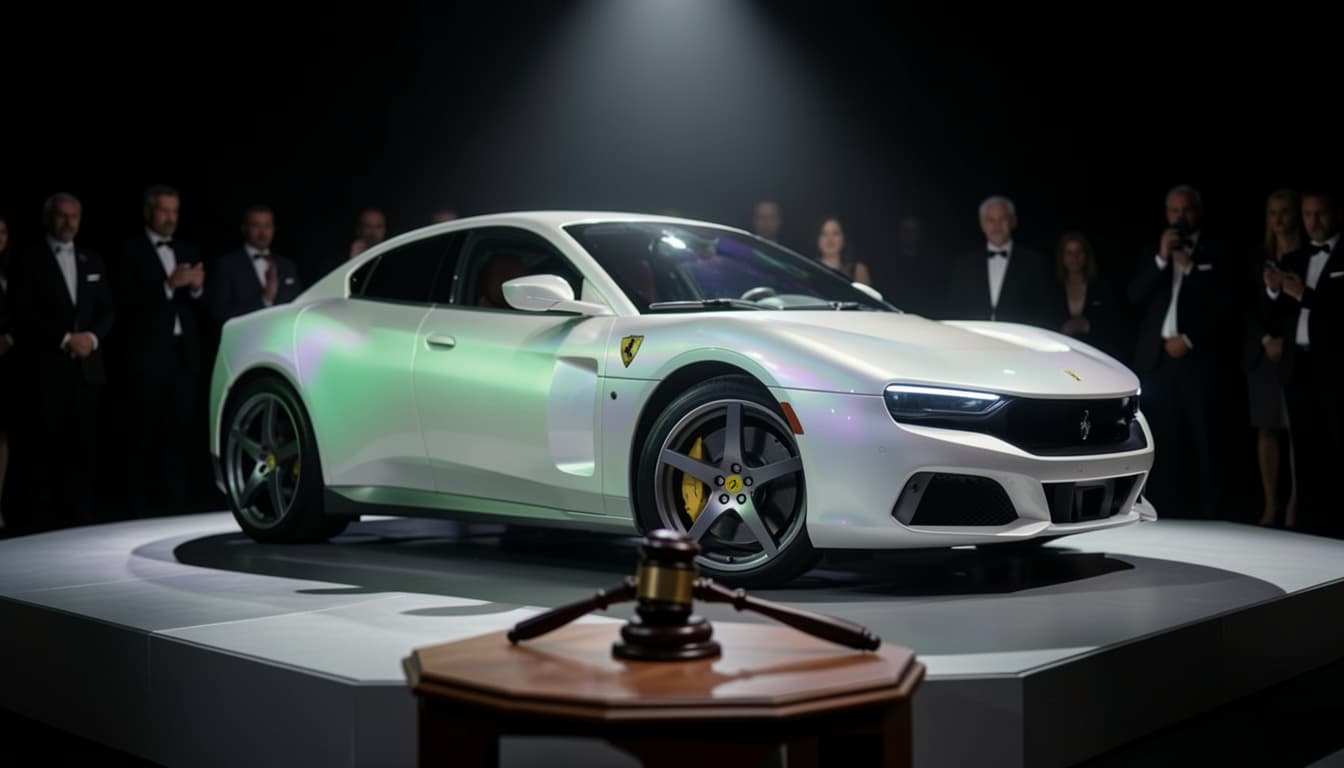
A dramatic shot of a pearl-white Ferrari Luce Chassis 0 on an auction block at Monterey Car Week, with a gavel and spotlight
The $40 Million Ferrari Nobody Wanted
In May 2026, Ferrari revealed its first electric car. The world recoiled. Ferrari fans called it an abomination. A former chairman said the company should rip the prancing horse logo off the front. The stock dropped 8% in a single day. The car was declared dead on arrival by everyone who had ever loved the brand.
Three months later, someone paid $40 million for the first one.
The Ferrari Luce did not change. It was the same car that had been mocked, meme-ified, and dismissed as a catastrophe. Nothing about it was redesigned. Nothing was softened. The same car that was called a "Chinese appliance" and a "vacuum cleaner" became the most expensive new car ever sold at auction.
This is not a redemption story. This is not a story about how the critics were wrong and Ferrari was right. This is a story about something darker and more honest: the machinery of myth, money, and the ugly truth about how value is created in this world.
And I will say this plainly: I think it is a disgrace.
The Car That Broke Ferrari's Heart
The Luce is not a beautiful car. It is not even a controversial car in the way a Lamborghini Countach or a Tesla Cybertruck is controversial. Those cars provoke strong reactions because they are bold. They make a statement.
The Luce is different. It is a five-door hatchback. It has a glass roof. It was designed by Jony Ive and Marc Newson, the men behind the iPhone, and it looks like a piece of consumer electronics that happened to grow wheels. One critic said it looked like it was "designed by ChatGPT" in two minutes. Another asked if they could sue Ferrari for hurting their eyes.
Luca di Montezemolo, the man who ran Ferrari for 23 years, did not mince words. He said the car risked "the destruction of a myth." He hoped Ferrari would remove the prancing horse from the car because it had "no right to wear it".
The stock fell 8.4% on the Milan exchange the day after the unveiling. The company's own global marketing director admitted that Ferrari "didn't expect such a magnitude" of negativity.
The world had spoken. The Luce was a failure.
The Auction
Three months later, at Monterey Car Week, Ferrari put the very first Luce up for auction. It was called Chassis 0. It had a one-of-a-kind pearl-white finish that shifted between green and violet depending on the light. The interior was wrapped in special metallic leather. It had bespoke wheels, custom brake calipers, and a plaque that identified it as the first Luce ever built.
The pre-auction estimate was $1.1 million.
The bidding started at $1 million. It climbed quickly. Ten million. Fifteen million. Twenty million. The crowd watched in disbelief. The bids kept coming. Thirty million. Then someone jumped from $36 million to $40 million and ended it.
The auctioneer brought down the gavel. The Luce had just set a record for the most expensive new car ever sold at auction.
The buyer was Dr. Herbert Wertheim, an 87-year-old billionaire. He is an optometrist and inventor who founded a company that makes optical lens dyes. He has over 100 patents. He is worth an estimated $4.9 billion. He was not at the auction in person. He bid by phone.
The Man Who Paid $40 Million
Herbert Wertheim is not a car collector in the traditional sense. He does not buy cars to drive them. He buys them to give them away.
He told the Wall Street Journal that the Luce "will not be my personal car to go to Publix." He said he plans to loan the car to charities so they can use it to raise even more money. "This is happiness," he said. "I'm going to give it all away".
It sounds noble. And on some level, it is. The $40 million went to the Ferrari Foundation, which funds educational programs. The money is going to a good cause.
But there is another layer to this story. And it is the layer that makes this entire spectacle feel less like philanthropy and more like a transaction.
The Tax Math
When you buy a car at a charity auction and pay far more than the car is worth, you are not just buying a car. You are making a charitable donation. And charitable donations are tax-deductible.
The Luce has a retail price of about $640,000. Wertheim paid $40 million. The difference between those two numbers, roughly $39.4 million, can be treated as a charitable donation. Under US tax rules, Wertheim could potentially deduct a significant portion of that amount from his taxable income.
One analysis estimated that Wertheim could save more than $13 million in taxes as a result of this purchase. He spent $40 million on a car he does not intend to drive. He gets a $40 million charitable donation on his tax return. The car goes to charity. The charity gets a car it can raffle or auction. Wertheim gets a massive tax write-off and, almost certainly, the gratitude of Ferrari's most senior executives.
And that last part is important.
The Price of Access
Ferrari does not sell cars to just anyone. The company is famously selective about who it allows to buy its most exclusive models. You cannot walk into a Ferrari dealership and order a limited-edition hypercar. You have to be invited. You have to have a relationship with the brand. You have to have bought multiple Ferraris over many years. You have to be someone Ferrari wants to be associated with.
When Wertheim paid $40 million for Chassis 0, he did more than buy a car. He bought a position. He bought Ferrari's attention. He bought the kind of goodwill that opens doors that money alone cannot open.
This is how the world works. The ultra-wealthy do not just buy things. They buy access. They buy influence. They buy the right to be first in line for the next thing. The $40 million is not a price. It is an investment in a relationship.
And the charitable framing makes it all palatable. It makes it feel good. It makes it feel righteous. But it is still a transaction. The money moves from one pocket to another. The charity gets its cut. The buyer gets his deduction. Ferrari gets its record. Everyone wins.
Except the people who actually believed in the myth.
The Myth That Refused to Die
Here is the thing that bothers me most about this story.
Ferrari is a brand built on something real. It is built on the sound of a V12 engine. It is built on the feeling of a car that wants to kill you. It is built on the knowledge that Enzo Ferrari would rather sell fewer cars than build something he did not believe in.
The Luce is the opposite of all that. It is silent. It is safe. It is efficient. It is a car designed by a committee and a computer. It has no soul. And the people who love Ferrari knew that immediately. That is why they revolted. That is why they called it an abomination.
But Ferrari did not have to listen to them. Because Ferrari did not need their approval. Ferrari needed the approval of people like Herbert Wertheim. People who do not care about the sound of a V12. People who see a Ferrari not as a machine to be driven, but as an asset to be held. People who will pay $40 million for a car they will never drive, because the car is not the point. The car is the ticket.
The myth of Ferrari is still alive. But it is no longer a myth about driving. It is a myth about money. And the Luce, the ugliest Ferrari ever made, is now the most valuable one. That is not a triumph. That is a confession.
The World We Live In
I am not naive. I know how the world works. I know that wealthy people use charitable donations to reduce their tax bills. I know that access is a commodity. I know that records are made to be broken and that $40 million is a rounding error for a man worth $4.9 billion.
But I also know that something is lost when a brand like Ferrari reduces itself to this. When the most hated car in its history becomes the most expensive one. When the auction price has nothing to do with the car and everything to do with the game being played around it.
The Luce was supposed to be Ferrari's future. Maybe it is. But if this is the future, then the future is not about cars. It is about the people who own them. And the people who own them do not care what they look like. They only care what they are worth.
The $40 million Ferrari is a disgrace. Not because it is ugly. Because it is a perfect symbol of everything that is wrong with the way value is created in this world. The rich get richer. The myth gets sold. And the rest of us are left to wonder what any of it actually means.
You might also like:
- The Ferrari That Broke Its Own Heart
- The King Is Dead: How the Lucid Air Sapphire Ended the Corvette's Reign
- The Jaguar E-Type: The Most Beautiful Car Ever Made
Disclaimer: This article is for informational and entertainment purposes only. The views expressed are those of the author and do not necessarily reflect the official policy or position of any company mentioned. Tax laws are subject to change and vary by jurisdiction. Consult a professional for specific advice.
Drift Team
Automotive industry analysts and cultural critics