Tesla's Cybercab Has a 'Stupidity Problem' — Viral Video Shows Man Jumping in Front of Driverless Cars
A viral video shows a man repeatedly jumping in front of a driverless Tesla Cybercab in Austin. The car stops every time. But the incident exposes a problem no engineer can solve.
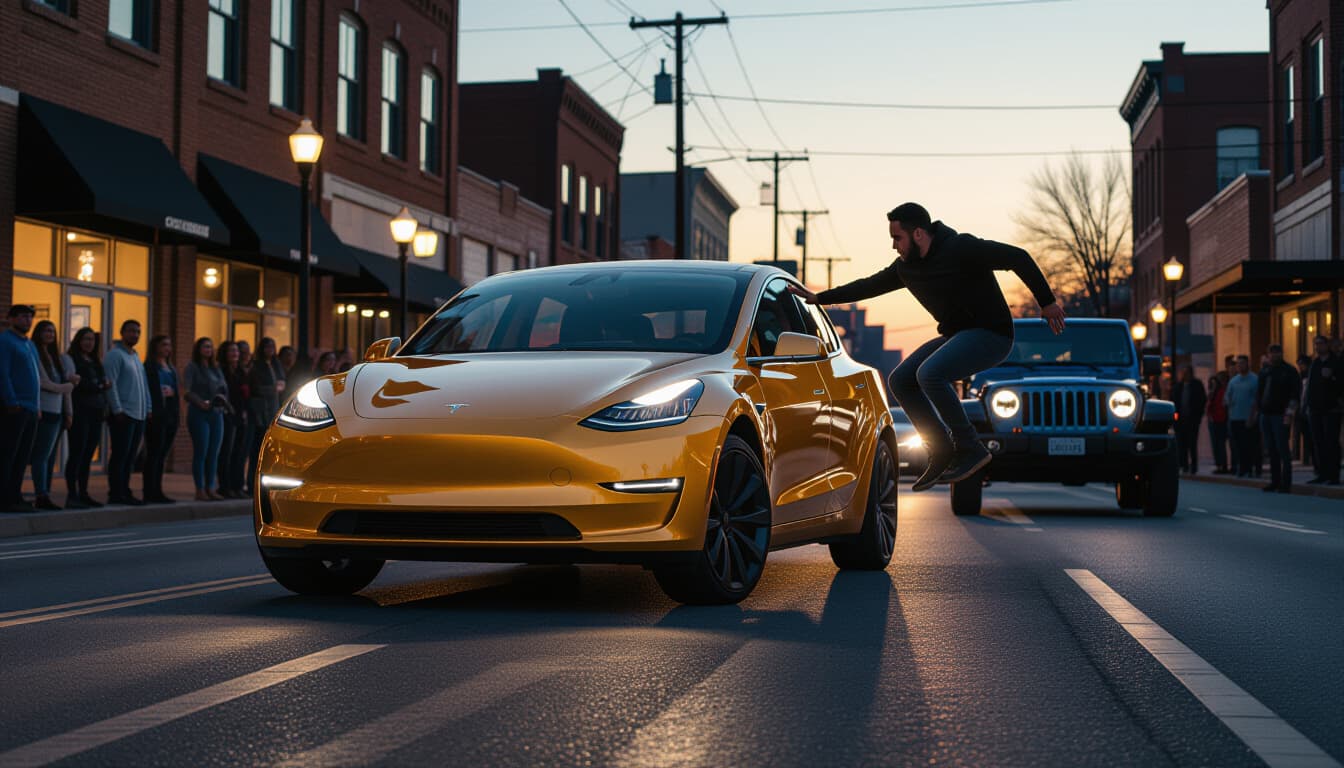
A dramatic shot of a golden Tesla Cybercab stopped on an Austin street as a man jumps in front of it, with traffic backed up behind
Tesla's Cybercab Has a 'Stupidity Problem' — Viral Video Shows Man Jumping in Front of Driverless Cars
Tesla's driverless Cybercab has met its first real-world obstacle. It is not a technical failure. It is a human one.
A viral video from Austin, Texas, shows a man repeatedly jumping in front of a moving Cybercab, forcing it to slam on its brakes. The video has racked up over 1.3 million views on X. The car stops every single time. It works exactly as designed. And that is the problem.
The Cybercab was built to detect pedestrians and avoid collisions. It does that flawlessly. But it cannot account for a person who deliberately exploits that safety feature. It cannot honk. It cannot swerve. It cannot gesture. It just stops, waits, and hopes the human gets bored.
The video has sparked a debate about the future of autonomous vehicles. The technology is impressive. But the humans sharing the road with it are unpredictable, sometimes reckless, and occasionally just looking for a laugh.
The Video That Went Viral
The footage is simple and absurd. A man hides behind a pole on a city street. He waits for the Cybercab to approach. Then he jumps out in front of it.
The Cybercab detects him and stops. It does not hit him. It does not honk. It just sits there.
The man runs alongside the car, then jumps in front of it again. The Cybercab stops again. This repeats several times. A blue Jeep behind the Cybercab gets stuck and has to change lanes to get around. The car sits in the middle of the street with its hazard lights on while traffic backs up behind it.
The video was re-posted by Jesse Cohen, senior financial analyst at Investing.com, who warned it could be "a big issue going forward with Tesla robotaxis." The clip has since been shared thousands of times, with commenters expressing a mix of amusement and concern.
Some praised the Cybercab for its flawless pedestrian detection. Others questioned what happens when the prankster is not alone. What happens when ten people do this? What happens when it becomes a trend?
The 'Adversarial Interaction' Problem
There is a technical term for what happened in Austin: adversarial interaction. It refers to behaviors designed to trick, block, or test autonomous vehicles. It is not new. Waymo and Cruise vehicles have been targeted for years.
The most common tactic is called "coning." People place traffic cones on the hoods of autonomous vehicles, which causes them to stop and wait for a human to remove the obstruction. The cars cannot move until the cone is gone. It is a simple, low-tech way to disable a high-tech machine.
The problem is fundamental. Autonomous vehicles are programmed to prioritize safety. They are cautious. They are polite. They follow the rules. That makes them predictable, and predictability makes them exploitable.
A human driver would honk, gesture, or navigate around an obstacle. A human driver might even get out of the car and confront the prankster. A driverless car cannot do any of those things. It can only wait.
The Cybercab's Constraints
The Cybercab was designed to be fully autonomous. It has no steering wheel. No pedals. No mirrors. There is no way for a passenger to take control in an emergency.
Tesla has equipped the Cybercab with a stop button. If a rider feels unsafe, they can press it to initiate a pull-over and connect to Robotaxi Support. But when a prankster blocks the car, there is no manual override. The passenger can only sit and wait.
This is the paradox at the heart of the Cybercab. It is designed for unsupervised full self-driving. But it cannot handle a situation that requires supervision. It is too polite, too cautious, too trusting of human behavior.
The Cybercab assumes that people will follow the rules. The viral video proves that they will not.
The NHTSA Investigation
The timing of the video could not be worse for Tesla. The Cybercab launched on September 3, 2026. On the same day, the National Highway Traffic Safety Administration opened an Audit Query into whether Tesla properly certified the vehicle.
The issue is the Cybercab's lack of conventional controls. Under U.S. law, automakers self-certify that their vehicles meet Federal Motor Vehicle Safety Standards. Many of those standards were written with a human driver in mind. Tesla determined that some standards are simply "inapplicable" to the Cybercab.
NHTSA wants to see the work behind that decision. The agency is investigating "the extent to which Tesla's certification depended on determinations that certain FMVSS are inapplicable to the Cybercab."
The investigation is not a recall. It is a probe into Tesla's self-certification process. But it signals that the federal government is not willing to accept Tesla's word without scrutiny.
NHTSA is also working on eight rulemakings to update safety standards for autonomous vehicles. The rules are not finalized. Tesla is operating in a gray area.
The Market Impact
Tesla shares dropped about 6% following the Cybercab launch and the NHTSA investigation. The Austin event failed to impress investors. There was no livestream. No media access. No Elon Musk on stage.
The Cybercab is positioned as a key part of Tesla's future revenue model. But operational hiccups like the viral video could slow adoption and invite more scrutiny. Every incident becomes a data point for regulators, competitors, and skeptics.
The stock drop was the biggest intraday decline since July 23. Wall Street was underwhelmed. The Cybercab was supposed to be a catalyst. Instead, it was a small, quiet rollout with a federal investigation attached.
What This Means for Autonomous Vehicles
The viral video is funny. But it points to a serious challenge.
Autonomous vehicles must not only understand human error. They must also understand deliberate bad behavior. They must be able to distinguish between a pedestrian who accidentally steps into the street and a prankster who jumps in front of the car on purpose.
That is a difficult problem. Human drivers use social cues to navigate these situations. They make eye contact. They honk. They gesture. They communicate. Autonomous vehicles cannot do any of that.
The scalability problem is even bigger. If one person can block a Cybercab, what happens when many people do it? What happens when it becomes a coordinated effort? What happens when cities become hostile to autonomous vehicles?
There is also a legal gray area. Who is responsible when a prankster causes a traffic jam or an accident? The prankster? The car manufacturer? The passenger? The law has not caught up to the technology.
The long-term question is whether autonomous vehicles will need to develop "social" capabilities to handle adversarial interactions. They might need to learn how to honk. They might need to learn how to navigate around obstacles without waiting for them to move. They might need to learn how to be assertive, not just polite.
The Bottom Line
Tesla's Cybercab passed its first test of pedestrian detection. It stopped every time. It did not hit anyone. It worked exactly as designed.
But it failed a different test. It could not handle a prankster. It could not navigate around a human obstacle. It could not assert itself. It just waited, and the traffic piled up behind it.
The Cybercab is too polite for its own good. It is too safe, too predictable, too trusting. And that is a problem no engineer can solve.
The future of driving might require humans to behave better, not just machines to drive better. The Cybercab is ready for the road. But the road is not ready for the Cybercab.
You might also like:
- Tesla's Cybercab Is Here—And It's Already in Trouble
- Google Gemini AI Is Coming to Your Car: What It Means for Drivers
- Oil Prices Are Soaring—Here's What It Means for Your Wallet and the Auto Industry
Disclaimer: This article is for informational purposes only. The views expressed are those of the author and do not necessarily reflect the official policy or position of Tesla, NHTSA, or any other company or agency mentioned.
Drift Team
EV and autonomous vehicle analysts