Oil Prices Are Soaring—Here's What It Means for Your Wallet and the Auto Industry
Brent crude is closing in on $100 a barrel. The Strait of Hormuz is effectively closed. And your next fill-up is about to get more expensive. Here is what is happening and why it matters.
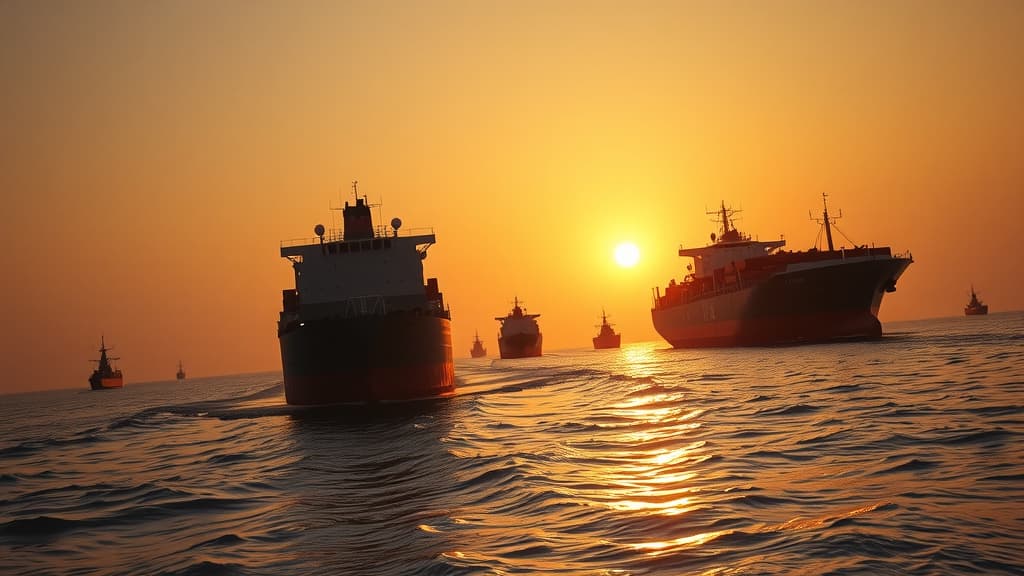
Oil tankers navigating through the narrow Strait of Hormuz at sunset with warships visible in the background
Oil Prices Are Soaring—Here's What It Means for Your Wallet and the Auto Industry
Oil prices are surging. Brent crude climbed to $96.80 a barrel on Monday, while West Texas Intermediate rose to $92.14. Both benchmarks posted their largest weekly gains in months, with Brent up 7.8% and WTI gaining nearly 10% last week.
The reason is a 33-kilometer stretch of water that most people have never heard of: the Strait of Hormuz.
Before the conflict, this narrow waterway carried roughly one-fifth of the world's oil supply. Today, it is effectively closed. The number of tankers transiting the strait has dropped sharply, with as few as five to eight ships per day compared to more than 100 before the fighting began.
This is not just a geopolitical story. It is a story about what you pay at the pump, what it costs to ship goods, and what happens to the auto industry when energy prices spiral out of control.
What Is Happening in the Strait of Hormuz?
The Strait of Hormuz is the world's most important oil chokepoint. It connects the Persian Gulf to the open ocean. Nearly 20% of global crude oil passes through it.
Since the U.S.-Iran conflict began in late February, the strait has been a battleground. Over the weekend, the U.S. military struck three Iranian oil tankers near Kharg Island, Iran's main oil export hub. The U.S. said the strikes were a response to Iranian ballistic missile attacks on U.S. warships.
Iran responded by targeting three tankers on what it called "unauthorized routes" in the strait, as well as three U.S. vessels.
Maritime intelligence firm Marisks described the escalation as a turning point: "Commercial tankers are now being deliberately used as instruments of reciprocal economic pressure, substantially weakening the previous distinction between military confrontation and commercial shipping".
Iran's Supreme National Security Council secretary, Mohsen Rezaei, announced that a new restricted zone will be established outside the strait in the coming days, extending from the U.S. naval blockade line into the Persian Gulf.
How High Are Oil Prices Right Now?
| Benchmark | Price | Weekly Change |
|---|---|---|
| Brent Crude | ~$96.80/barrel | +7.8% |
| WTI Crude | ~$92.14/barrel | +9.9% |
Brent crude has surged by roughly 30% since the conflict began in late February. Refined products like diesel have seen even larger increases.
What Does This Mean for Gas Prices?
The national average for regular gasoline hit $4.15 a gallon over Labor Day weekend—a record for the holiday. That is up from $2.98 before the conflict began.
Diesel, the fuel that moves freight and delivery networks, hit a record $5.85 a gallon on Friday.
California drivers are paying even more. The statewide average is $5.78 a gallon, well above the national average. In Salinas, the cheapest gas is still over $5.25
AAA spokesperson Aixa Diaz noted that August gas prices were the highest on record for that month, at $4.07 a gallon. That record is likely to be broken again in September.
Patrick De Haan, petroleum analyst for GasBuddy, said drivers should brace for the most expensive September, October, and November on record.
What Does This Mean for the Auto Industry?
This is where the story gets personal for anyone who owns a car—or is thinking about buying one.
Higher fuel costs: Every time you fill up, you are paying more. The average driver will spend hundreds of dollars more on gas this year compared to last year.
Used car market shift: Higher gas prices historically push buyers toward more fuel-efficient vehicles. This is already happening: sales of used electric vehicles and hybrids are surging. European BEV registrations rose 51.4% year-over-year in March 2026.
Production disruptions: The automotive supply chain is under pressure. S&P Global Mobility revised its global light-vehicle sales forecast downward by 650,000 to 900,000 units for 2026. Production could be reduced by up to 3.6 million units below pre-war projections if the conflict persists.
Commodity costs: Automakers are facing higher costs for raw materials. U.S. manufacturers face approximately $5 billion in additional annual commodity costs due to the conflict.
Naphtha dependency: Asian automakers are particularly exposed. Japan, South Korea, and India rely heavily on Gulf crude and naphtha for petrochemical production. Toyota, Maruti, and other major OEMs have already confirmed production disruptions.
What Happens Next?
ANZ analysts expect a prolonged standoff punctuated by calibrated military action to continue through 2026. A gradual reopening of the strait is not expected until late in the fourth quarter, with pre-war throughput not returning until early 2027.
OPEC+ kept its output policy unchanged for October at a Sunday meeting.
The risk is asymmetric. If the standoff persists, Brent could push toward $100 a barrel. If de-escalation happens, prices could drop quickly. But traders see little near-term path to that outcome.
Track Live Oil Prices
Oil prices are moving fast. The situation in the Middle East is changing daily. If you want to track live prices for WTI Crude, Brent Crude, gasoline, diesel, and more, visit our Live Oil Prices page. We update the data every 60 seconds so you can stay informed.
The Bottom Line
Oil prices are surging because the Strait of Hormuz is effectively closed. That means higher gas prices, higher diesel prices, and higher costs for the auto industry. The conflict is not ending soon. And the pain at the pump is likely to continue through the fall.
If you are in the market for a car, it is worth considering fuel-efficient options. If you are already driving, it is worth planning for higher fuel costs.
The auto industry is resilient, but it is not immune to geopolitical shocks. The next few months will be challenging. But history shows that the industry adapts—and so do drivers.
You might also like:
- Tesla's Cybercab Is Here—And It's Already in Trouble
- Mercedes-Benz and BMW Just Called Out the Entire EV Industry
- Top 10 Most Reliable Cars of 2026
Disclaimer: This article is for informational purposes only. Oil prices, gas prices, and market conditions are subject to change. Always verify with official sources before making any financial decisions.
Drift Team
Automotive industry analysts and energy market experts