The Toyota 2000GT: Japan’s First Supercar
In 1965, Toyota was known for reliable family cars. Then it unveiled the 2000GT, Japan’s first supercar. Only 351 were built, yet its influence reshaped Toyota and the entire Japanese sports car story.
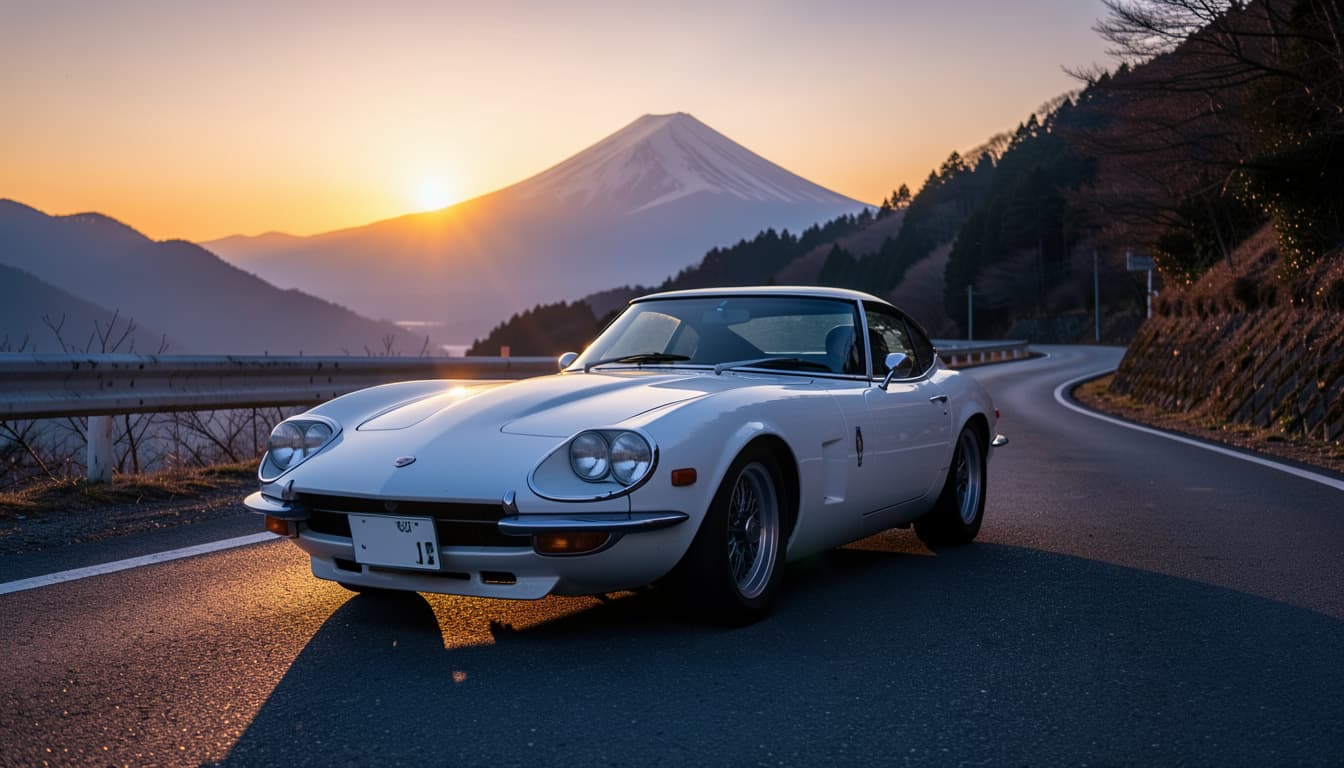
A low, sleek aluminum Toyota 2000GT coupe on a quiet mountain road at golden hour, long bonnet and wrap-around glass highlighted
The Toyota 2000GT: Japan’s First Supercar
In 1965, Toyota was known for building sensible, reliable family cars. Then it unveiled a stunning aluminum-bodied grand tourer with a twin-cam straight-six, a space-age chassis, and a silhouette that looked like it belonged on another continent. The 2000GT was Japan’s first supercar, a bold gamble that changed Toyota’s reputation forever.
Only 351 were built between 1967 and 1970. Today, concours examples sell for well over a million dollars. But the 2000GT’s value is not just monetary. It is the car that proved Japan could build a world-class sports car, and it set the stage for everything that followed, from the 240Z to the Supra and beyond.
This is the story of how a conservative automaker, a motorcycle and piano company, and a handful of determined engineers created a legend.
A Bold Gamble
In the early 1960s, Toyota’s image was practical, not exciting. Its lineup was dominated by dependable sedans and compact cars. Performance was not part of the brand identity.
That began to change after the Japanese Grand Prix reignited domestic enthusiasm for speed. Motorists started demanding cars with more power, better handling, and a sense of occasion. Toyota saw an opportunity to redefine itself.
The company wanted a halo car, a practical yet high-performance grand tourer that could be driven every day. The project was ambitious for a brand known for caution. Early concepts were even rejected by Nissan, which doubted the market for such a car. Toyota, however, saw the strategic value and greenlit the program.
There is also a persistent rumor that German-American designer Albrecht von Goertz influenced the early styling direction. Whether or not his sketches directly shaped the final body, the ambition was clear: Toyota wanted a car that could stand alongside Europe’s best.
Yamaha’s Masterpiece
Toyota did not build the 2000GT alone. Yamaha Motor Co. played a central role. Yamaha built the prototype under contract and hand-assembled the production cars, bringing a level of craftsmanship that matched the project’s ambitions.
Yamaha’s involvement makes sense in context. This was a company with deep expertise in high-revving engines, precision manufacturing, and fine finishing. The same skills that went into motorcycles and pianos were applied to a supercar.
At the heart of the 2000GT was the 3M engine. Toyota started with a 2.0-liter straight-six from the Crown sedan. Yamaha then transformed it with a new dual overhead cam cylinder head, triple Solex carburetors, and careful tuning. The result was 150 horsepower, a remarkable figure for a 2.0-liter engine in the mid-1960s.
That power, combined with a lightweight aluminum body and advanced chassis, gave the 2000GT a top speed of 136 mph (220 km/h) and a 0–60 mph time of around 8.6 seconds. By the standards of the day, that was serious performance.
| Specification | Toyota 2000GT |
|---|---|
| Engine | 2.0L DOHC inline-six (3M) |
| Horsepower | 150 hp |
| Torque | ~129 lb-ft (triple Solex) |
| Weight | 1,120 kg |
| 0–60 mph | ~8.6 seconds |
| Top Speed | 136 mph (220 km/h) |
| Production | 1967–1970, 351 units |
| U.S. Price | $7,150 (1967) |
| Modern Value | $1M+ for top examples |
The chassis was equally advanced. An X-shaped backbone frame provided rigidity. Four-wheel independent suspension, disc brakes all around, and optional magnesium wheels completed the package. This was not a modified sedan. It was a purpose-built grand tourer.
The Design
The 2000GT’s shape was the work of Toyota designer Satoru Nozaki. He created an ultra-low aluminum body just 45.7 inches tall. The long bonnet, muscular fenders, and swooping roofline gave the car a classic GT proportion that still looks modern today.
Up front, large driving lamps were covered by plexiglas, with pop-up headlights mounted above them. The wrap-around windscreen and fastback roof enhanced the sense of motion even when the car was standing still. Inside, the dashboard featured rosewood veneer, full instrumentation, and a level of fit and finish that rivaled European rivals.
Automotive historians have called it “the most beautiful car ever to come from the Land of the Rising Sun.” That is not just nostalgia. The 2000GT’s design balanced elegance and aggression in a way few cars from any country achieved in that era.
“The most beautiful car ever to come from the Land of the Rising Sun.” — Automotive Historian
Proving Its Worth
Before the first customer took delivery, Toyota needed to prove the 2000GT was more than a show car. In 1966, it entered three prototypes in the Yatabe Speed Trials, a grueling 72-hour endurance event on a high-speed test track.
During the run, a tropical storm hit the facility. Rain lashed the track. Winds howled. Most teams would have withdrawn. Toyota kept going.
When the dust settled, the 2000GT prototypes had smashed three world records and set 13 new international records in various classes. Toyota had demonstrated durability, speed, and engineering integrity on a global stage. The 2000GT was world-class before it ever reached a showroom.
Bond… James Bond
The 2000GT’s most famous moment came in 1967, when two cars were featured in the James Bond film You Only Live Twice. Toyota provided the vehicles, but there was a problem: Sean Connery was too tall to fit under the 2000GT’s low roofline.
Toyota’s solution was to convert two coupes into open-top roadsters with faux folding roofs. These were the only open-top 2000GTs ever produced. On screen, they looked exotic, futuristic, and perfectly at home in the Bond universe.
Decades later, Daniel Craig named the 2000GT as his favorite Bond car during an appearance on Top Gear. That endorsement introduced the car to a new generation of enthusiasts and cemented its status as one of cinema’s great automotive icons.
Legacy
Only 351 Toyota 2000GTs were built: 337 road cars and a handful of special racing models. Just 54 were officially sold in the United States. Scarcity, beauty, and historical importance have driven values sharply higher over time. Concours-condition examples now regularly exceed $1 million at auction.
But the 2000GT’s influence goes beyond price tags. It was Toyota’s first true halo car, a vehicle that transformed the brand’s image from purely practical to aspirational. In many ways, it was the spiritual ancestor of Lexus, proving that a Japanese manufacturer could build a car that competed with the best of Europe.
The 2000GT also paved the way for the Japanese sports cars that followed. The Nissan 240Z, Toyota Celica and Supra, Mazda RX-7, Honda NSX, and countless others owe a debt to the path the 2000GT carved. It showed that Japan could do more than copy. It could innovate, inspire, and lead.
The Car That Changed Everything
The Toyota 2000GT was a bold gamble that succeeded against all odds. A conservative automaker, a motorcycle and piano company, and a small team of engineers and designers created a car that changed how the world saw Japanese engineering.
It was fast, beautiful, and technologically advanced. It set records, starred in a Bond film, and became a collector’s dream. But more than that, it was a symbol of ambition. The 2000GT proved that Japan could build a supercar, and it gave Toyota the confidence to aim higher.
More than half a century later, the 2000GT remains what it always was: the car that changed everything.
Quick Reference: Toyota 2000GT at a Glance
| Category | Detail |
|---|---|
| Production | 1967–1970, 351 units |
| Body | Aluminum 2+2 coupe (plus 2 Bond roadsters) |
| Engine | 2.0L DOHC inline-six (3M), triple Solex |
| Power | 150 hp |
| Weight | 1,120 kg |
| 0–60 mph | ~8.6 seconds |
| Top Speed | 136 mph (220 km/h) |
| Chassis | X-shaped backbone frame |
| Suspension | 4-wheel independent |
| Brakes | 4-wheel disc |
| U.S. Price | $7,150 (1967) |
| Modern Value | $1M+ for top examples |
Timeline: From Concept to Icon
- 1965 – Tokyo Motor Show: the 2000GT concept stuns the automotive world.
- 1966 – Yatabe Speed Trials: 2000GT prototypes set multiple world and international records.
- 1967 – Production begins; first customer deliveries.
- 1967 – You Only Live Twice released; two 2000GT roadsters appear as Bond cars.
- 1970 – Production ends after 351 units.
- 2000s–2020s – Values climb; concours examples exceed $1 million at auction.
What Do You Think?
If you could choose one classic Japanese sports car to own, would it be the Toyota 2000GT, the Nissan 240Z, the Mazda Cosmo, or something else entirely?
You might also like:
- The 10 Most Controversial Cars Ever Made
- The Legend That Wouldn’t Die: The Tucker 48
- The Ferrari F40: The Last Great Analogue Supercar
Disclaimer: This article is for informational and entertainment purposes only. All product names, logos, and brands are property of their respective owners. Specifications and historical details are based on publicly available sources and may vary by market and source.
Drift Team
Automotive historians and classic car enthusiasts