The Ferrari F40: The Last Great Analogue Supercar
Enzo Ferrari had one year left to live. He spent it creating the ultimate supercar. The F40 was his final masterpiece—a raw, unforgiving machine that demanded skill and rewarded bravery. It is the last great analogue supercar.
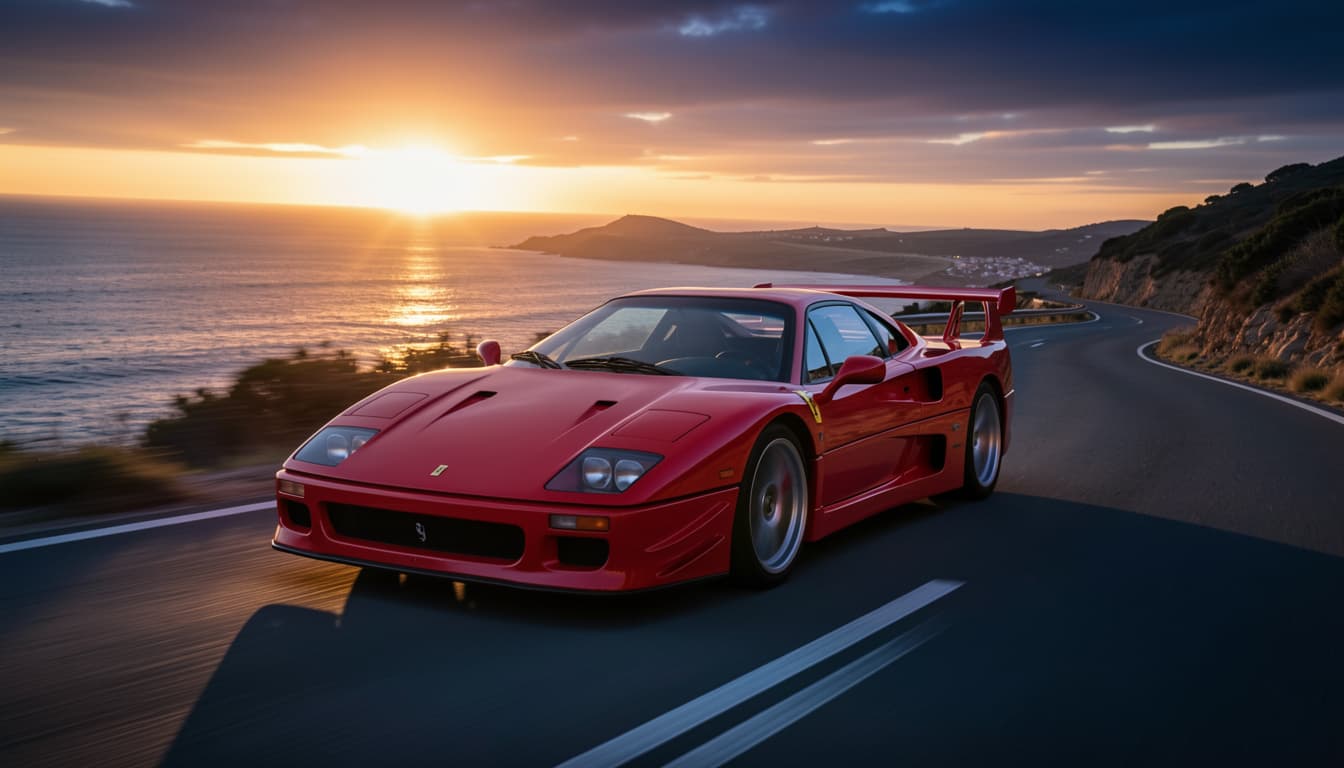
A dramatic cinematic shot of a Ferrari F40 in Rosso Corsa on a winding coastal road at sunset
The Ferrari F40: The Last Great Analogue Supercar
Enzo Ferrari had one year left to live. He was 89 years old. His health was failing. The company he had built was at a crossroads, facing increasing competition from the likes of Lamborghini and Porsche. The automotive world was changing, and the "Commendatore" knew he would not be around to see what came next.
But he was not done yet.
In the final years of his life, Enzo Ferrari commissioned one last car. He did not want a comfortable grand tourer or a luxurious GT. He wanted a true Ferrari. A car that would strip away every modern convenience and deliver the purest driving experience possible. A car that would be his final statement to the world.
The result was the Ferrari F40. It was developed in just 13 months. It was the first production car to exceed 200 mph. And it became the definitive supercar of the 1980s.
The F40 was not just a car. It was a monument. A final, defiant act from a man who refused to be forgotten.
The Commendatore's Final Act
Enzo Ferrari was a man of contradictions. He was a dictator who demanded absolute loyalty. He was a perfectionist who tolerated no compromise. He was a visionary who built an empire from nothing.
By the mid-1980s, his empire was under threat. Ferrari had not won the World Constructors' Championship since 1983. Lamborghini was building the Countach, a car that was more outrageous than anything Ferrari produced. Porsche had the 959, a technological tour de force.
The Commendatore was losing his grip. But he was not ready to surrender.
He summoned his engineers and designers. He told them he wanted to build a car that would reassert Ferrari's dominance. A car that would be the fastest, the most extreme, the most Ferrari.
The brief was simple: build a supercar that would be the ultimate expression of the brand. No compromises. No concessions. Just raw, unfiltered performance.
The F40 was born.
The 13-Month Miracle
The F40 was developed in an astonishing 13 months. By modern standards, that timeline is impossible. Most supercars take four to five years to develop.
The team was small and dedicated. Ermanno Bonfiglioli led the engineering effort. Leonardo Fioravanti designed the shape. Test driver Dario Benuzzi was responsible for the handling.
They started with the 288 GTO Evoluzione, a radical prototype that had never gone into production. The Evoluzione had a twin-turbo V8 engine, a lightweight chassis, and aggressive aerodynamics. It was a promising starting point.
But the F40 needed to be more than a reworked prototype. It needed to be a masterpiece.
The team worked around the clock. They reworked the engine, increasing power to 478 horsepower from 2.9 liters. They used magnesium to save weight, even though it cost five times as much as aluminum. They developed a tubular steel spaceframe with Kevlar panels, creating a chassis that was both rigid and lightweight.
The result was a car that weighed just 1,100 kilograms. It was lighter than a Lotus Elise, but with almost five times the power.
| Specification | Ferrari F40 |
|---|---|
| Engine | 2.9L Twin-Turbo V8 |
| Horsepower | 478 hp |
| Torque | 426 lb-ft |
| Weight | 1,100 kg |
| 0-100 km/h | 3.9 seconds |
| Top Speed | 324 km/h (201 mph) |
| Production | 1987-1992 (1,311 units) |
The Engineering Brilliance
The F40 was a masterpiece of engineering. Every component was designed for performance.
The Engine
The 2.9-liter twin-turbo V8 was derived from the 288 GTO Evoluzione. It produced 478 horsepower at 7,000 rpm and 426 lb-ft of torque at 4,000 rpm. The turbochargers were mounted low to reduce lag and improve throttle response.
The engine was a marvel of forced induction. At 1.1 bar of boost, it delivered a surge of power that was both addictive and terrifying.
The Chassis
The F40's chassis was a tubular steel spaceframe reinforced with Kevlar panels. The design provided exceptional torsional rigidity while keeping weight to a minimum. The use of Kevlar was revolutionary at the time, a material borrowed from aerospace and military applications.
The chassis was strong enough to handle the immense forces generated by the engine and the aerodynamics.
The Interior
The F40's interior was a statement. There was no stereo, no electric windows, no power steering, and no ABS. A pull cord replaced the interior door handle. The seats were thinly padded racing buckets.
It was the automotive equivalent of a bare-knuckle boxing match. No frills. No comfort. Just the driver, the car, and the road.
This stripped-down approach was intentional. Enzo Ferrari wanted a car that demanded total commitment from the driver. He wanted a car that would test the skills of even the most experienced enthusiast.
The Aerodynamics
The F40's aerodynamics were developed in the wind tunnel. The massive rear wing generated significant downforce. The NACA ducts on the hood channeled air to the engine. The unique taillight arrangement was functional as well as iconic.
The result was a car that was stable at high speeds, even at over 200 mph.
The First Drive: A Revelation
When Dario Benuzzi first drove the F40, he was not impressed. The prototype's handling was "poor." The car was twitchy and unpredictable.
The team spent months refining the suspension, the turbochargers, the brakes, and the tires. They tested endlessly. They worked tirelessly.
The final product was a revelation. The F40 was stable at high speeds. It had immense grip. The downforce from the rear wing kept the car planted, even at 200 mph.
But the F40 was not an easy car to drive. It had no power steering, no ABS, and no electronic aids. The driver was in complete control.
"The car demands the skill and commitment of the driver but generously repays it with a unique driving experience," Benuzzi later said.
The F40 was a car for purists. It rewarded bravery and punished mistakes. It was not for everyone. And that was exactly the point.
The Reveal: July 21, 1987
On July 21, 1987, the Ferrari F40 was unveiled at the Civic Centre in Maranello. The secrecy surrounding the car made the event a shock. No one had expected Ferrari to produce something so extreme.
The crowd erupted in thunderous applause. Enzo Ferrari was there, witnessing his final masterpiece.
"The car is a true Ferrari," he said.
It was his last great public appearance. A year later, on August 14, 1988, the Commendatore was gone.
The F40 was his epitaph.
The Controversy
The F40 was not without controversy. Critics complained about the Spartan interior. They called the car "raw" and "uncompromising."
But the F40 was not built for critics. It was built for enthusiasts.
The car was a commercial success. Ferrari originally planned to build just 400 units. Demand was so high that production eventually reached 1,311. The F40 was a phenomenon.
The car even changed hands on the second-hand market for over £1 million in the late 1980s. It was a symbol of the decade's excess and ambition.
The Legend Today
Today, the Ferrari F40 is one of the most valuable collector cars in the world. Values have skyrocketed, with some examples selling for over $2.5 million.
But the F40's value is not just monetary. It is a legend. A symbol of a bygone era.
"I have never experienced a presentation like that of the F40," one attendee recalled. The moment was electric, the crowd buzzing with the recognition that they were witnessing history.
The F40's legacy is secure. It is the last great analogue supercar. A car that demanded total commitment from the driver. A car that rewarded bravery and punished mistakes. A car that was built by a dying man as his final statement to the world.
The F40 is the end of an era. It is the moment when the supercar reached its peak and began its slow decline into the world of electronics and driver aids.
It is a legend.
The F40 and the Miura: A Complete Picture
The Miura and the F40 are the bookends of the supercar era. The Miura invented the genre. The F40 perfected it.
The Miura was a revelation: mid-engine, beautiful, and fast. The F40 was a culmination: raw, powerful, and uncompromising.
The Miura was the beginning. The F40 was the end.
Together, they tell the story of the supercar. They remind us of a time when cars were built by people, not computers. When driving was a skill, not a pastime. When the supercar was the ultimate expression of automotive passion.
The Miura and the F40 are legends. They will never be forgotten.
Why the F40 Still Matters
The Ferrari F40 is more than a car. It is a symbol of a bygone era, a testament to the vision of a dying man, and the final masterpiece of the greatest supercar brand in history.
It reminds us that driving is not just about getting from point A to point B. It is about the connection between man and machine. It is about the thrill of speed, the satisfaction of skill, and the joy of the open road.
The F40 is a reminder of what cars can be. It is a legend that will never fade.
You might also like:
- The Lamborghini Miura: The Car That Invented the Supercar
- The Ford GT40: The Car That Conquered Ferrari
- The Legendary Porsche 959: The Car That Almost Bankrupted Porsche
Disclaimer: This article is for informational and entertainment purposes only. All product names, logos, and brands are property of their respective owners. The views expressed are those of the author and do not necessarily reflect the official policy or position of any other agency, organization, employer, or company.
Drift Team
Automotive historians and supercar enthusiasts