The Lamborghini Miura: The Car That Invented the Supercar
In 1966, a tractor company humiliated Ferrari. The Lamborghini Miura was the world's first supercar, and sixty years later, it remains the most beautiful car ever built.
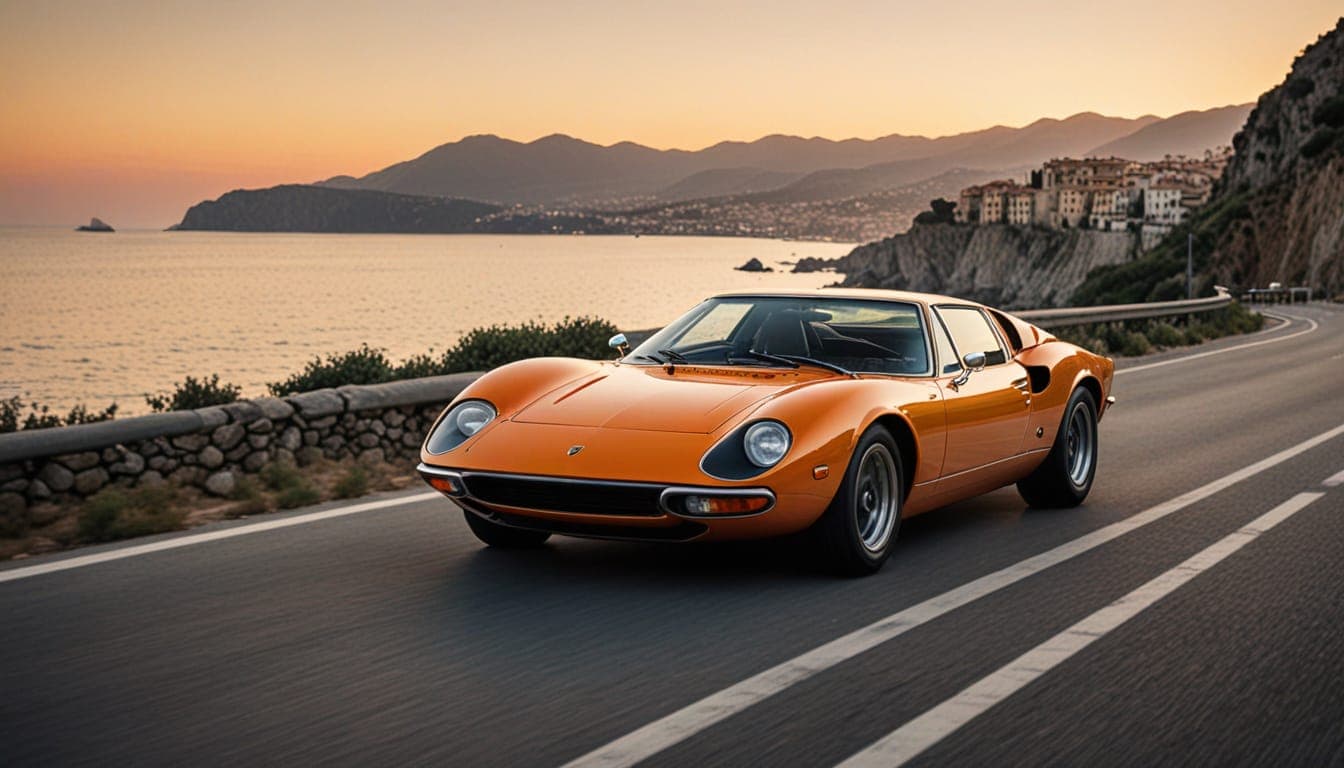
A dramatic low-angle shot of a Lamborghini Miura P400 in striking orange on a winding Italian coastal road at sunset
The Lamborghini Miura: The Car That Invented the Supercar
In 1966, a tractor company humiliated Ferrari. The Lamborghini Miura was the car that did it, and in doing so, it invented an entirely new category of automobile. The supercar was born.
On March 10, 1966, at the Geneva Motor Show, Lamborghini unveiled a car that would change the automotive world forever. It had a mid-mounted V12 engine, a body so low it barely reached your waist, and a top speed that made it the fastest production car on the planet. The Miura was not just a new car. It was a complete rethinking of what a high-performance road car could be.
This is the story of how a tractor manufacturer built the most beautiful car ever made, how a group of young engineers created a legend in secret, and how the Miura established the template that every supercar still follows today. It is a story of ambition, genius, and the birth of an icon.
The Tractor King Who Wanted to Beat Ferrari
Ferruccio Lamborghini was a wealthy man. He had built a fortune manufacturing tractors after World War II, and by the early 1960s, he was one of the most successful industrialists in Italy. He owned Ferraris, as any wealthy Italian of the era did.
But Ferruccio had a problem. His Ferrari 250 GT had a faulty clutch. He took it to Enzo Ferrari himself to complain. Enzo dismissed him, telling him to stick to tractors. The insult was the spark that ignited a rivalry.
Ferruccio decided to build his own cars. Not just any cars, but cars that would beat Ferrari at their own game. He founded Automobili Lamborghini in 1963, and by 1964, the company had produced its first car, the 350 GT. It was a beautiful, elegant grand tourer, but Ferruccio wanted something more radical. He wanted a car that would humiliate Ferrari on the road and on the track.
The Miura was the answer.
The Young Guns Who Built a Legend
The Miura was not designed by a team of seasoned automotive veterans. It was designed by a group of young engineers who were barely out of university. Gian Paolo Dallara was 28. Paolo Stanzani was 26. Test driver Bob Wallace was in his early thirties. They were passionate, brilliant, and eager to prove themselves.
The team was inspired by the mid-engine layout of racing cars. They wanted to build a road car with the same configuration, a car that would put the engine behind the driver and concentrate mass between the axles. This was a radical idea for a production car. At the time, road cars had their engines in the front.
The young engineers worked on the project in secret, with Ferruccio's blessing. They knew they were building something special. The challenge was fitting a massive V12 engine into a mid-engine layout without making the car impossibly long. Dallara came up with a brilliant solution: mount the engine transversely, sideways across the car. This would save space and keep the wheelbase short.
In 1965, Lamborghini presented the bare chassis at the Turin Motor Show. Painted satin black and displayed with the engine installed, the lightweight steel structure drew huge attention. Though it was only a chassis, it showcased a radical new concept for a road car. The world was intrigued.
The Turin Surprise
The chassis alone was a sensation. Showgoers swarmed the stand, fascinated by the compact, mid-engine layout. The car would be low, wide, and aggressive. It would look like a predator poised to pounce.
But there was a problem. Lamborghini had no body for the car. The engineers had built the chassis, but they had not yet designed the body. Ferruccio needed a coachbuilder, and he needed one fast.
He approached the major Italian design houses. Pininfarina declined. They were loyal to Ferrari. Nuccio Bertone, however, saw the opportunity. According to legend, he examined the chassis and told Ferruccio that his studio would design "the perfect shoe for this wonderful foot." The partnership that followed would make history.
Bertone assigned the project to a young designer named Marcello Gandini. Gandini had just joined the company, but he was already showing signs of genius. He was given three months to design the body of the Miura. Three months to create something that would define an era.
Gandini's Masterpiece
Marcello Gandini was 28 years old when he designed the Miura. He had three months. He worked day and night, sketching, refining, and perfecting the body. The result was a masterpiece.
The Miura was low, just 105 centimeters tall. It was wide, aggressive, and elegant. The headlights had distinctive "eyelashes" that gave the car a fierce, almost human expression. The rear vents were black slats that provided cooling and became a signature design feature. Instead of traditional chrome trim, Gandini used black anodized detailing, giving the car a modern, sporty look.
The body was a perfect marriage of form and function. Air channels directed cooling to the brakes and engine. The side intakes fed air to the V12. The front hood had slats that allowed air to escape from the radiator. Every line had a purpose, and every purpose was executed with grace.
Ferruccio Lamborghini saw the completed design and knew they had something special. "With this," he said, "we enter legendary status."
The Name: A Fighting Bull
The Miura was named after the famous Spanish fighting bulls bred by Don Eduardo Miura Fernández. The Miura bulls were known for their ferocity and bravery. The name was perfect for a car that was about to take on the establishment.
The naming convention would become a Lamborghini tradition. Later models would be named after other fighting bulls, including the Espada, the Islero, the Murciélago, and the Aventador. The Miura was the first, and it set the standard.
The World's Fastest Car
On March 10, 1966, the Lamborghini Miura debuted at the Geneva Motor Show. It was finished in a striking orange. The crowd was stunned. Nothing like it had ever been seen before.
The specifications were breathtaking. The Miura had a 3.9-liter V12 engine producing 350 horsepower at 7,000 rpm. It was mounted transversely behind the driver, sharing a common housing with the transmission and differential. The car weighed just 1,125 kilograms. It could accelerate from 0 to 100 kilometers per hour in 6.7 seconds and reach a top speed of 280 kilometers per hour.
This made the Miura the fastest production car in the world.
The mid-engine layout transformed weight distribution, giving the car a level of responsiveness that was unheard of at the time. The steering was direct, the engine response immediate and dramatic, and the chassis communicated vividly with the driver. The Miura was a race car for the road.
The automotive world was stunned. Ferruccio had done it. He had humiliated Ferrari.
The Evolution: From P400 to SV
The Miura was produced in three distinct variants over its eight-year production run.
P400 (1966-1969)
The original Miura P400 was the car that started it all. It was powered by a 350-horsepower V12, had a top speed of 280 kilometers per hour, and could reach 100 kilometers per hour in 6.7 seconds. Lamborghini produced 275 examples of the P400.
P400 S (1969-1971)
The Miura S was an evolution of the original. Power was increased to 370 horsepower through revised carburetion and tuning. The suspension was improved, and ventilated brakes were added. Production increased to 338 units.
P400 SV (1971-1973)
The SV, or Super Veloce, was the ultimate Miura. Power was increased to 385 horsepower at 7,850 rpm. The rear track was widened from 1,400 to 1,540 millimeters, improving stability. The SV featured separate lubrication systems for the engine and transmission, addressing one of the earlier cars' key weaknesses. This improved reliability and thermal management.
The SV could reach 290 kilometers per hour and accelerate to 100 kilometers per hour in under 5.5 seconds. Only 150 examples were built. Today, the SV is the most sought-after of all Miuras.
The Technical Flaws That Made It More Human
The Miura was not perfect. It had its flaws, and those flaws made it more endearing.
The shared lubrication system for the engine and transmission was technically brilliant but could cause issues under hard driving. The engine and transmission oil would mix, leading to overheating and potential failure. The SV addressed this with separate lubrication, but earlier cars required careful maintenance.
The front end would lift at high speeds, a result of the car's aerodynamic design. This made the steering light and required a confident driver. The car demanded respect, and it punished those who did not give it.
The Miura was also notoriously difficult to drive in the rain. The rear wheels would spin easily, and the car was prone to oversteer. It was a car for skilled drivers, not for the faint of heart.
These flaws are part of the Miura's legend. They remind us that the car was built by humans, not by computers. They give it character and personality.
The Cultural Icon
The Miura quickly became a cultural icon. It was the car of the 1960s, the embodiment of style, speed, and success.
Celebrities flocked to the Miura. Frank Sinatra owned one. Dean Martin owned one. Rod Stewart owned one. The car appeared in films, including the opening sequence of The Italian Job, cementing its place in pop culture.
The Miura also established Lamborghini's tradition of offering bold, customizable colors. Customers could choose from a wide palette of striking shades, including Azzurro Mexico Metallizzato, Giallo Fly, and Arancio Miura. This early emphasis on personalization would become a core part of the Lamborghini experience.
The Miura also found a new life in the digital world. It has appeared in video games across the Forza, Gran Turismo, Asphalt, and Assetto Corsa franchises, allowing new generations to experience the legend.
The 60th Anniversary Celebration
In 2026, Lamborghini celebrated the Miura's 60th anniversary with an unprecedented display of the car's enduring legacy. At the Pebble Beach Concours d'Elegance, the company gathered 43 Lamborghini Miuras, the largest assembly of Miuras ever brought together anywhere in the world.
The event also saw the debut of the Revuelto Miura 60° Homage, a limited edition of just 99 examples that reinterprets the iconic styling cues of the original Miura for Lamborghini's current flagship model. The homage is available in nine exterior colors inspired by shades offered on the original Miura, and features two-tone liveries, classic interior design elements, and dedicated "Miura 60" logos.
The celebration was a reminder that the Miura's legacy is as strong as ever. Sixty years after its debut, the car still captures the imagination.
The Legend Today
The Lamborghini Miura is one of the most valuable collector cars in the world. A 1972 Miura P400SV sold for $6 million at auction in 2026. Well-preserved examples of the SV can fetch even more.
The Miura's legacy is not just about value. It is about influence. Every mid-engine supercar built today owes a debt to the Miura. The Ferrari F40. The McLaren F1. The Porsche 918. The Lamborghini Aventador. They all follow the template established by the Miura.
The Miura proved that a car could be both a work of art and a technological marvel. It proved that a small company could take on the establishment and win. It proved that design could be bold, daring, and utterly breathtaking.
Why the Miura Still Matters
The Lamborghini Miura is more than a car. It is a symbol of what is possible when passion, talent, and ambition come together. It is the story of a tractor king who refused to accept second place. It is the story of young engineers who dared to dream. It is the story of a designer who created a masterpiece in three months.
The Miura established the template for every supercar that followed. It made the mid-engine layout the standard for high-performance cars. It proved that a car could be both beautiful and brutally fast.
And sixty years later, it remains the most beautiful car ever built. The Miura is not just a legend. It is the legend.
You might also like:
- The Legendary Porsche 959: The Car That Almost Bankrupted Porsche
- The Legend That Wouldn't Die: The Tucker 48
- The Rise and Fall of Saab
Disclaimer: This article is for informational and entertainment purposes only. All product names, logos, and brands are property of their respective owners. The views expressed are those of the author and do not necessarily reflect the official policy or position of any other agency, organization, employer, or company.
Drift Team
Automotive historians and supercar enthusiasts