The Ford GT40: The Car That Conquered Ferrari
In 1963, Henry Ford II was humiliated. In 1966, he got his revenge. The Ford GT40 didn't just beat Ferrari at Le Mans—it destroyed them, taking 1st, 2nd, and 3rd place.
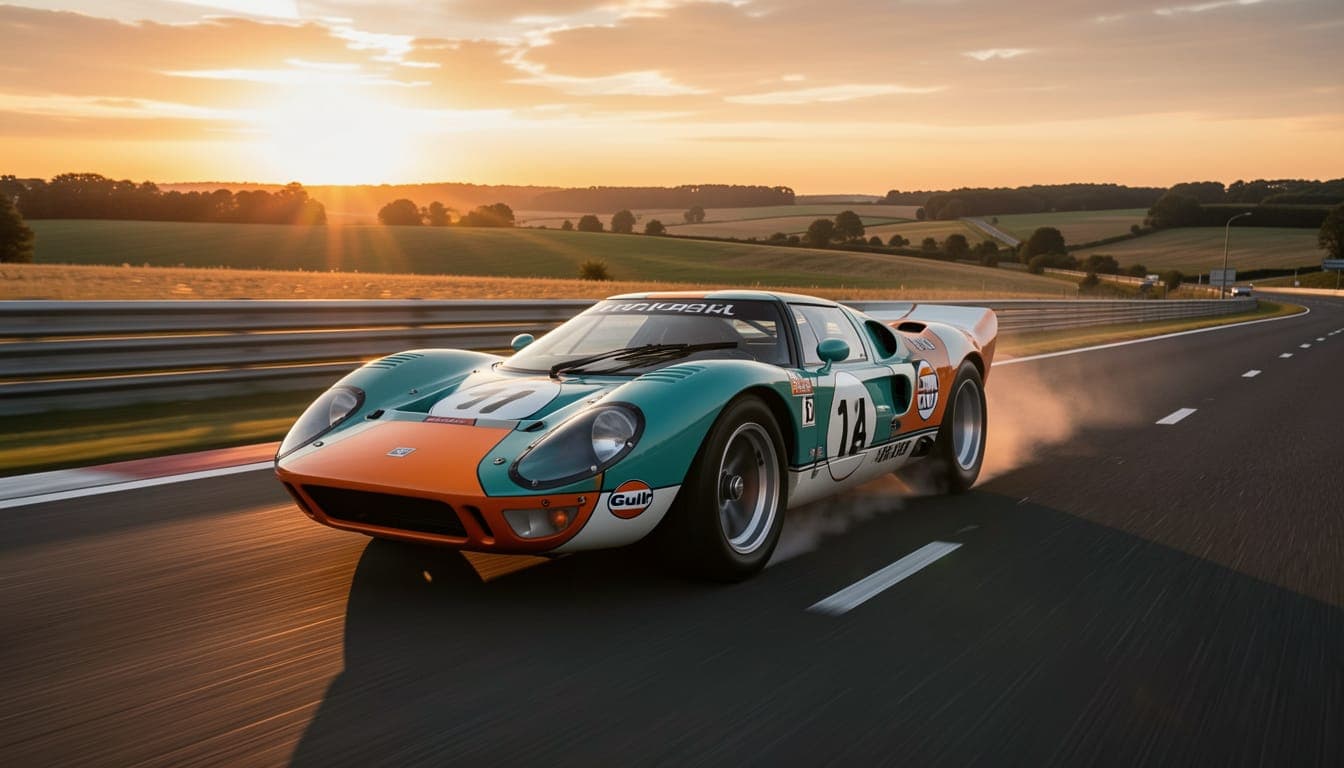
A Ford GT40 Mk II in Gulf Oil racing livery at speed on the Mulsanne Straight at Le Mans
In 1963, Henry Ford II was humiliated. In 1966, he got his revenge. The Ford GT40 didn't just beat Ferrari at Le Mans. It destroyed them.
The GT40 took 1st, 2nd, and 3rd place at the 24 Hours of Le Mans in 1966. All 14 Ferraris that entered the race were parked before the race was half over. It was the most humiliating defeat in Ferrari's racing history. And it happened at the most prestigious race in the world.
This is the story of how Henry Ford II spent millions to build a car that could beat Ferrari at Le Mans. It is a story of ambition, engineering, and the ultimate revenge. It is the story of the Ford GT40.
The Insult: Ferrari Says No
Henry Ford II wanted to go racing. He wanted to win at Le Mans, the most prestigious race in the world. But Ford had never built a purpose-built race car. They needed help.
In 1963, Ford approached Enzo Ferrari with a proposal. Ford would buy 90% of Ferrari for $10 million. Enzo Ferrari would continue to run the racing program. Ford would get the technology and the prestige.
The deal was almost done. The contracts were signed. The lawyers were ready. Then, at the last moment, Enzo Ferrari walked away.
The reason was control. The contract required Ferrari to get Ford's approval for major expenditures. Enzo Ferrari could not accept that. He was a dictator. He would not be told what to do by anyone.
The Italian media backlash against selling to Americans also fueled his decision. Selling to Ford would have been seen as a betrayal of Italian pride. Enzo Ferrari could not bear the shame.
Henry Ford II was furious. He had been humiliated. He had been made to look like a fool. He reportedly told Don Frey, his head of advanced vehicle development: "You go to Le Mans, and beat his ass."
The GT40 program was born.
Building a Car from Scratch
Ford had no racing division at the time. They had never built a purpose-built race car. They had no experience. They had no team. They had no car.
They had seven months.
Chief engineer Roy Lunn proposed a revolutionary design. The engine would go in the middle, behind the driver. This was a radical idea at the time. Most road cars had their engines in the front. Race cars had their engines in the front. But Lunn knew that mid-engine was the future.
Ford partnered with Eric Broadley of Lola Cars, a British race car builder. Broadley had experience with mid-engine designs. He would help Ford build a car that could win Le Mans.
The design was 40 inches tall. The height gave the car its name: GT40. The car was low, wide, and aggressive. It looked like nothing else on the road.
The first cars were rushed to completion in just seven months. It was an impossible task. The cars were not ready. They were fast, but they were fragile.
The GT40 program was a disaster in the making.
1964: Humiliation
In 1964, Ford entered three GT40s at Le Mans. The cars were fast. The cars were beautiful. But the cars were not reliable.
All three GT40s retired with mechanical issues. The engines failed. The transmissions failed. The brakes failed. Everything failed.
Ferrari dominated the race, taking 1st, 2nd, and 3rd place. Enzo Ferrari was delighted. Henry Ford II was humiliated again.
The only consolation was Phil Hill setting a lap record in the GT40. He pushed the car to its limit, proving it was fast. But speed without reliability was worthless.
Ford's program was in crisis. The company had spent millions. They had nothing to show for it.
1965: Shelby Takes Over
Ford needed a miracle. They called Carroll Shelby.
Shelby was a racing legend. He had won Le Mans in 1959 driving an Aston Martin. He was a brilliant engineer and an even better manager. He knew how to win.
Ford handed the GT40 program to Shelby. He was given the task of fixing the car and winning Le Mans.
The Mk II was born. It featured a 7.0-liter V8 producing 485 horsepower and 475 lb-ft of torque. It was a brute force approach. American muscle for a European race.
The Mk II was fast. It won at Daytona. It won at Sebring. It dominated the American races.
But at Le Mans, disaster struck again. All the GT40s retired. Ferrari won its final Le Mans of the era.
Henry Ford II was patient, but he was losing patience.
1966: The Revenge
The Mk II was perfected for 1966. The 7.0-liter V8 was tuned to perfection. The "bundle of snakes" exhaust system was a work of art. The car was reliable, fast, and brutal.
Ford entered eight cars at Le Mans. Ferrari entered fourteen. The odds were against Ford.
The race started. The GT40s were fast. The Ferraris were fast. But the GT40s were relentless.
Hours passed. The Ferraris began to fail. One by one, they retired. The engines overheated. The transmissions failed. The drivers pushed too hard.
By the end of the race, all 14 Ferraris were parked. They had all retired. The GT40s dominated.
Ken Miles and Denny Hulme were leading by four laps. They were going to win. Then Ford ordered a formation finish.
The company wanted a photo finish. They wanted the cars to cross the line together. It was a publicity stunt.
Miles slowed down. The other GT40s caught up. They crossed the line together.
But there was a problem. The rules stated that the winner was the car that covered the most distance in 24 hours. The McLaren/Amon car had started farther back on the grid. It had covered more distance. It was declared the winner.
Ken Miles was robbed of a win he had earned.
Henry Ford II didn't care. He had his victory. He had beaten Ferrari. He had his revenge.
The Controversy That Made the Story
The 1966 finish was controversial. It still is.
Ford ordered Miles to slow down. He did. He lost the win. McLaren/Amon was awarded the victory. Miles was heartbroken.
"Carroll, you couldn't have done that to me," Miles told Shelby.
It was a devastating moment. Miles had earned the win. He had led by four laps. He had dominated the race. But Ford wanted a publicity stunt. Miles was a pawn in the company's PR game.
Miles never got his Le Mans win. He died later in 1966 while testing the Ford J-car at Riverside Raceway. His legacy is one of tragedy and triumph.
The controversy made the story. It added humanity to the legend. It reminded us that racing is not just about cars. It is about people.
The Technical Marvel
The GT40 was a technical marvel. It was years ahead of its time.
The mid-engine layout was revolutionary for the era. It placed the engine behind the driver, lowering the center of gravity and improving handling. The car was a race car first and a road car second.
The 7.0-liter V8 was a brute force approach. It produced 485 horsepower and 475 lb-ft of torque. It was American muscle at its finest.
The "bundle of snakes" exhaust system was a work of art. It was a complex network of pipes that extracted maximum power from the engine. It was beautiful and brutal.
The car was 40 inches tall. The aerodynamic design was cutting-edge. The car was low, wide, and aggressive. It looked like a predator.
| Vehicle | Engine | Horsepower | Torque | Le Mans Result |
|---|---|---|---|---|
| Ford GT40 Mk II | 7.0L V8 | 485 hp | 475 lb-ft | 1st, 2nd, 3rd (1966) |
| Ferrari 330 P3 | 4.0L V12 | 420 hp | 330 lb-ft | DNF (1966) |
| Porsche 906 | 2.0L Flat-6 | 220 hp | 160 lb-ft | 4th, 5th, 6th (1966) |
The GT40 was a mechanical masterpiece. It was built to win. And it did.
The Legacy: Four in a Row
The GT40 didn't just win Le Mans in 1966. It won in 1967. And 1968. And 1969.
Four consecutive victories. A streak that defined an era.
- 1966: Mk II wins with McLaren/Amon, and Miles/Hulme takes 2nd.
- 1967: Mk IV (designed entirely in the U.S.) wins with Foyt/Gurney.
- 1968: Mk I (privateer) wins with Rodriguez/Bianchi.
- 1969: Mk I wins again with Ickx/Oliver.
The GT40 became the only American car to win Le Mans. It proved American muscle could beat European sophistication. It was a triumph of engineering and determination.
Ford's Total Performance era was born. The company was no longer just a manufacturer of family cars. It was a racing powerhouse.
The GT40's legacy continues today. The Ford GT was introduced in 2005 as a tribute to the GT40. The second-generation Ford GT won Le Mans in 2016. The GT40 is still winning races 50 years later.
The Legend Today
The Ford GT40 is one of the most valuable collector cars in the world. Values range from $9 million to $12 million.
Chassis P/1046, the 1966 Le Mans winner, was restored to its original glory. It is a museum piece, a relic of racing history.
Chassis P/1016, the 3rd-place car from 1966, was offered at auction. It is a reminder of the glory days.
The GT40's appearance in the film Ford v Ferrari (2019) introduced the story to a new generation. The movie was a critical and commercial success. It made the GT40 a global icon.
Ford returned to Le Mans in 2027 with an LMDh Hypercar. The GT40's legacy is still alive.
The GT40 is more than a car. It is a symbol of ambition, determination, and revenge. It is the ultimate American racing story.
The Lesson of the GT40
The Ford GT40 is a reminder that anything is possible. A company that had never built a race car built a car that conquered Ferrari. A company that had been humiliated achieved redemption.
The GT40's story is one of engineering brilliance, determination, and revenge. It is a story of ambition and triumph.
It is also a story of tragedy. Ken Miles was robbed of a win he had earned. He died a hero, but he never got his Le Mans victory.
The GT40's legacy is complex. It is a story of triumph and tragedy. It is a story of human ambition and human frailty.
But above all, it is a story of a car that conquered Ferrari. A car that proved American muscle could beat European sophistication. A car that became a legend.
You might also like:
- The Lamborghini Miura: The Car That Invented the Supercar
- The Legendary Porsche 959: The Car That Almost Bankrupted Porsche
- The Rise and Fall of Saab
Disclaimer: This article is for informational and entertainment purposes only. All product names, logos, and brands are property of their respective owners. The views expressed are those of the author and do not necessarily reflect the official policy or position of any other agency, organization, employer, or company.
Drift Team
Automotive historians and racing enthusiasts