SUV Heavyweight Bout: 2026 Toyota RAV4 Hybrid vs. Honda CR-V Hybrid
The RAV4 has gone all-hybrid. The CR-V is fighting to keep up. Which compact SUV wins in 2026?
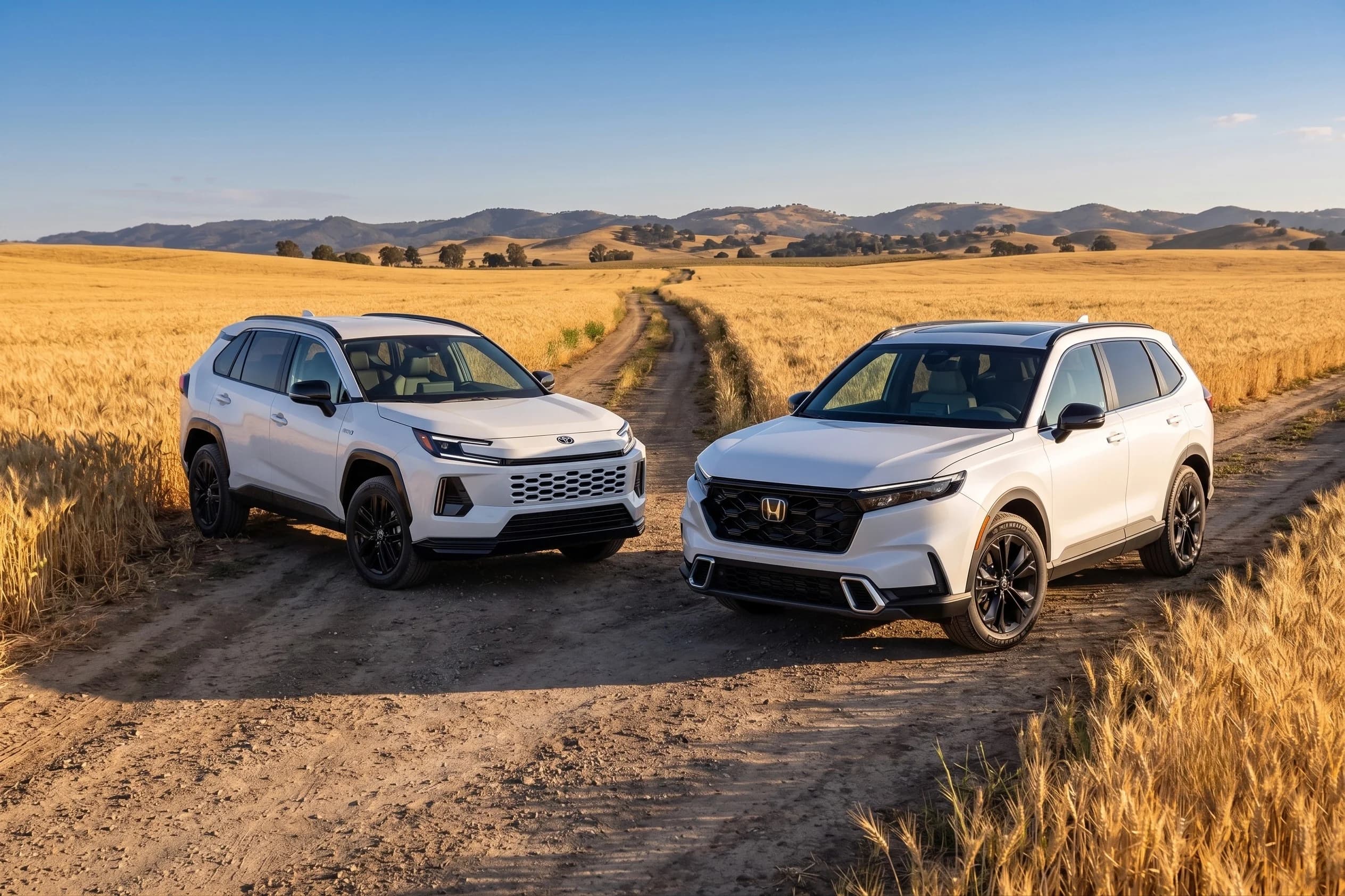
A 2026 Toyota RAV4 Hybrid and Honda CR-V Hybrid parked side-by-side on a mountain road
SUV Heavyweight Bout: 2026 Toyota RAV4 Hybrid vs. Honda CR-V Hybrid
The 2026 model year marks a turning point for the compact SUV segment. In a significant strategic shift, Toyota has discontinued the gas-only RAV4, making a hybrid powertrain standard across the entire lineup. This decision directly challenges the Honda CR-V Hybrid, which remains a compelling, but slightly different, choice for buyers.
Both vehicles are at the top of their class, but the details reveal distinct personalities and advantages. This comparison will dissect the 2026 Toyota RAV4 Hybrid and Honda CR-V Hybrid across every critical category—fuel economy, interior space, technology, safety, and value—to determine which one truly deserves the crown.
The Big Shift: Hybrid-Only vs. Hybrid Option
The most significant difference between these two SUVs isn't their styling or their interior design. It is their powertrain strategy.
The 2026 RAV4 is exclusively a hybrid. Toyota has committed to a hybrid-only lineup for its best-selling SUV. The system uses a 2.5-liter four-cylinder Atkinson-cycle engine paired with Toyota's fifth-generation hybrid system. Total output is 226 horsepower for front-wheel-drive (FWD) models and 239 hp for all-wheel-drive (AWD) variants.
The CR-V Hybrid, on the other hand, offers a choice. The base engine is a 1.5-liter turbocharged four-cylinder with 190 horsepower. The CR-V Hybrid uses a 2.0-liter four-cylinder engine with a two-motor hybrid system, producing a combined 204 horsepower.
"The RAV4 Hybrid offers more power and superior or comparable fuel economy, making it the more efficient and powerful option." — Automotive Analyst
Powertrains and Fuel Economy
| Specification | Toyota RAV4 Hybrid | Honda CR-V Hybrid |
|---|---|---|
| Engine | 2.5L 4-Cylinder Hybrid | 2.0L 4-Cylinder Hybrid |
| Horsepower | 226-239 hp | 204 hp |
| Transmission | e-CVT | e-CVT |
| MPG (Combined) | 41 MPG | 37 MPG |
| Drive Options | FWD, AWD | FWD, AWD |
The RAV4 Hybrid is the clear fuel-economy champion. The RAV4 Hybrid AWD achieves an EPA-estimated 41 mpg city / 35 mpg highway / 38 mpg combined. The CR-V Hybrid AWD achieves an EPA-estimated 43 mpg city / 34 mpg highway / 37 mpg combined. While its city fuel economy is slightly higher, the RAV4's combined figure is more impressive.
Winner: Toyota RAV4 Hybrid. The RAV4 Hybrid offers more power and superior fuel economy, making it the more efficient and powerful option.
Interior Space and Comfort
While fuel economy is a major factor, passenger comfort and cargo space are equally important for a family SUV. Here, the CR-V Hybrid makes a strong case.
| Dimension | Toyota RAV4 Hybrid | Honda CR-V Hybrid |
|---|---|---|
| Front Legroom | 41.0 in | 41.3 in |
| Rear Legroom | 37.8 in | 41.0 in |
| Cargo Space (Behind Seats) | 37.8 cu ft | 36.3 cu ft |
| Cargo Space (Folded) | 70.4 cu ft | 71.8 cu ft |
The CR-V excels in passenger room, offering 41.3 inches of front legroom and a generous 41 inches of rear legroom. It also provides 38.2 inches of headroom in both rows and a total passenger volume of 103.5 cubic feet. The "body-stabilizing" front seats are designed for comfort on long drives.
The RAV4 offers 41 inches of front legroom and 37.8 inches of rear legroom. It has 98.9 cubic feet of total passenger volume.
Cargo space is a complex comparison, as the figures vary by trim, particularly for the CR-V hybrid. The RAV4 Hybrid offers 37.8 cubic feet of cargo space behind the rear seats, expanding to 70.4 cubic feet with the seats folded. The CR-V Hybrid has 36.3 cubic feet behind the rear seats, dropping to 34.7 cubic feet on the top-tier Sport Touring Hybrid due to a subwoofer. With the seats folded, it expands to 71.8 cubic feet. However, the CR-V Hybrid lacks a spare tire, replaced by a repair kit, unlike the RAV4, which retains a spare.
Winner: Tie. For passenger comfort, the CR-V Hybrid is the clear winner with its superior rear legroom and overall cabin space. However, for pure utility and cargo capacity with a spare tire, the RAV4 Hybrid is more practical.
Technology and Features
Both SUVs come well-equipped with modern tech, but the RAV4 seems to offer a more feature-rich experience for the price.
| Feature | Toyota RAV4 Hybrid | Honda CR-V Hybrid |
|---|---|---|
| Infotainment Screen | 10.5-12.9 inches | 9.0 inches |
| Digital Instrument Cluster | 12.3 inches (standard) | 7.0-10.2 inches |
| Wireless CarPlay/AA | Yes | Yes |
| Unique Feature | Drive Recorder | TrailSport Trim |
The RAV4 Hybrid comes standard with wireless Apple CarPlay and Android Auto. It features a 10.5-inch infotainment screen on most trims, with a 12.9-inch unit available on higher trims. A 12.3-inch digital instrument cluster is standard across all trims.
The CR-V Hybrid also includes wireless Apple CarPlay and Android Auto, but the central touchscreen is a 9.0-inch display. It has a 7.0-inch digital cluster on base trims, upgrading to a 10.2-inch on higher trims.
The RAV4 Hybrid offers a standard Toyota Drive Recorder system, which uses exterior cameras to provide dashcam-like functionality. It also features a digital key with Apple Car Key and Samsung Digital Key support. The CR-V Hybrid includes a TrailSport trim for 2026, offering a more rugged, off-road-oriented package with all-terrain tires and a unique appearance.
Winner: Toyota RAV4 Hybrid. The RAV4 offers a more generous suite of standard technology, a larger infotainment screen, and useful features like the built-in Drive Recorder.
"The RAV4 Hybrid offers a significantly lower entry price and better overall value for money, especially given its superior fuel economy and standard features." — Automotive Analyst
Safety and Reliability
Safety is a paramount concern for buyers in this segment. Here, the story takes a significant turn in 2026.
| Metric | Toyota RAV4 Hybrid | Honda CR-V Hybrid |
|---|---|---|
| Predicted Reliability | 77/100 | 83/100 |
| Hybrid Battery Warranty | 10 years / 150,000 miles | 8 years / 100,000 miles |
| IIHS Top Safety Pick | Pending | Lost (Poor rating) |
The Honda CR-V Hybrid has a slight edge in predicted reliability, scoring 83 out of 100 compared to the RAV4 Hybrid's 77. Both are backed by strong warranties, though Toyota offers a longer 10-year/150,000-mile warranty on the hybrid battery.
In a major development, the Honda CR-V lost its IIHS Top Safety Pick award for 2026. It earned a "Poor" rating in the updated moderate-overlap front test, which evaluates rear-seat passenger protection. The redesigned RAV4 has not yet been tested by the IIHS. However, its predecessor was a strong performer, and Toyota's overall safety reputation is robust.
Winner: Toyota RAV4 Hybrid. While the CR-V Hybrid has the edge in predicted reliability, the RAV4 Hybrid wins this category by default because the CR-V Hybrid's 2026 IIHS safety rating is a major concern for any buyer prioritizing family safety.
Pricing and Value
The pricing strategy of these two SUVs is quite different, creating a clear value proposition.
| Trim | Toyota RAV4 Hybrid | Honda CR-V Hybrid |
|---|---|---|
| Base | $33,350 | $35,630 |
| Top Trim | ~$44,750 | ~$42,250 |
The RAV4 Hybrid starts at a lower price point ($33,350), making it one of the most affordable hybrid SUVs on the market. The CR-V Hybrid starts higher at $35,630. The gap narrows at the top end, with the RAV4 Limited priced around $44,750, while the CR-V Hybrid Sport Touring is slightly lower at $42,250.
Winner: Toyota RAV4 Hybrid. The RAV4 Hybrid offers a significantly lower entry price and better overall value for money, especially given its superior fuel economy and standard features.
The Final Verdict
The 2026 Toyota RAV4 Hybrid and Honda CR-V Hybrid are both excellent choices, but for very different reasons. The CR-V Hybrid offers a more spacious and comfortable cabin. However, the RAV4 Hybrid wins in almost every other category that matters to the average buyer.
The Winner: Toyota RAV4 Hybrid
The RAV4 Hybrid's superior fuel economy, more powerful and efficient powertrain, better standard technology, lower price point, and crucially, the CR-V's loss of its 2026 IIHS safety award, make the RAV4 the better overall SUV for 2026.
The Loser: Honda CR-V Hybrid
The CR-V Hybrid loses out due to its lower fuel economy, higher starting price, and its significant safety rating drop. While the interior is undeniably more spacious and refined, these advantages do not outweigh the RAV4's comprehensive package.
You might also like:
- Sedan Showdown: 2026 Honda Accord vs. Toyota Camry
- The Great Affordability Crisis: Why Car Ownership is Becoming a Luxury
- The 10 Most Controversial Cars Ever Made
Disclaimer: This article is for informational purposes only. Prices, specifications, and ratings are subject to change. Always verify with official sources before making a purchasing decision.
Drift Team
Automotive comparison experts