Woman 'Sleeps' Behind the Wheel of Tesla at 100 km/h — With Kids in the Back
A viral video shows a Tesla driver apparently asleep at 100 km/h with two children in the back. Here's what happened—and why Tesla's safety system failed.
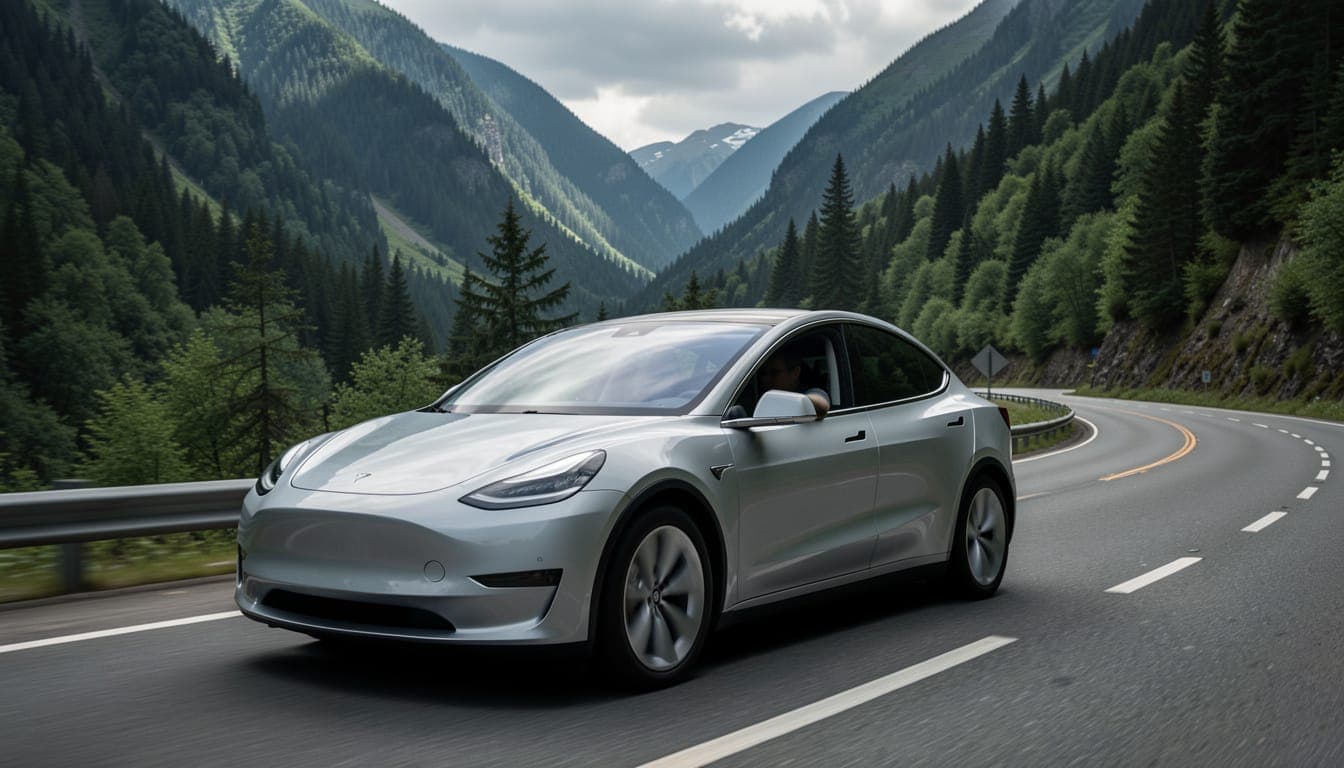
A Tesla Model Y driving on a winding mountain highway in British Columbia
Woman 'Sleeps' Behind the Wheel of Tesla at 100 km/h — With Kids in the Back
A viral video shows a Tesla driver apparently asleep at 100 km/h on a B.C. highway. The car continued driving on its own—and Tesla's monitoring system didn't stop it.
On July 5, 2026, a dark gray Tesla Model Y was cruising along Highway 1 between Golden and Revelstoke in British Columbia. The speed: approximately 100 km/h.
Inside, the driver appeared to be asleep.
Her head was tilted back. Her mouth was open. Her hands were off the wheel. She was wearing large sunglasses—the kind that might just block a camera from seeing her eyes.
In the back seat, two children were reportedly asleep.
The person filming the incident, Carleigh King, was stunned. "He's fully… He is totally asleep," she said as she recorded the surreal scene. She immediately contacted RCMP and provided them with the vehicle's license plate.
The video, which has since gone viral, has sparked a firestorm of debate about the limits of self-driving technology—and whether drivers are becoming dangerously overconfident.
But the most troubling part? Tesla's own safety monitoring system was supposed to prevent this.
The Video That Shocked the World
The footage is jarring. A Tesla traveling at highway speed, its driver unconscious, children in the back, and the vehicle continuing down the road as if nothing is wrong.
The image is almost too surreal to believe. As one commentator put it, the scene is complete with a "Domino's pizza box on the dashboard next to the stuffed animal." It's the kind of detail that transforms a safety incident into a cultural moment.
"What puts the scene right over the top, what takes it to the next level, is the Domino's pizza box sitting on the dashboard next to the stuffed animal. It's this final touch that puts this portrait—let's call it 'Tesla Driver in Slumber'—on the same level as Frederic Leighton's Flaming June and Vermeer's A Maid Asleep." — The Globe and Mail
The video has been viewed millions of times across multiple platforms. It's been shared, debated, and memed. But the underlying question is deadly serious: how did a driver monitoring system designed to catch exactly this scenario fail so completely?
How Tesla's Safety System Was Supposed to Work
Tesla's Full Self-Driving (Supervised) system includes two layers of driver monitoring designed to ensure the person behind the wheel remains alert and ready to take over.
The Cabin Camera
Tesla vehicles are equipped with a camera mounted above the rearview mirror. It's designed to track the driver's face, looking for:
- Eye position and blink rate
- Head movement
- Yawning
- Signs of drowsiness or distraction
The Steering Wheel Torque Detection
If the cabin camera is blocked or can't see the driver's eyes, the system falls back to an older method: detecting pressure on the steering wheel.
The vision-based monitoring "will not be activated" when the driver is wearing sunglasses or a hat that obscures the eyes. — Tesla Owner's Manual
The car requires the driver to apply a small amount of turning force to the wheel periodically—the so-called "nag." But torque detection doesn't confirm a driver is awake. It only confirms that some force is being applied. A slumped body or a resting arm can be enough.
Why It Failed
The driver in the video was wearing large sunglasses. This created a critical blind spot in Tesla's monitoring system.
Because the system couldn't see her eyes, it relied exclusively on steering wheel torque detection—and somehow, that wasn't triggered either.
"This driver is using sunglasses... so that's definitely part of the equation." — Fred Lambert, Electrek Editor-in-Chief
But this isn't just about one driver's sunglasses. It's about a broader pattern of easily exploitable weaknesses in Tesla's monitoring.
The $30 Plastic Head Problem
For years, drivers have found ways to defeat Tesla's monitoring systems. First, there were steering wheel weights—inexpensive devices that tricked the torque sensor into believing someone was holding the wheel. NHTSA shut down one such product, but knockoffs and alternatives persist.
Then came the cabin camera. The "smart" solution that was supposed to solve the problem.
Instead, a new workaround emerged: $30 plastic doll heads.
These doll heads, sometimes modeled to look like a human face (one infamous version resembles Dwayne Johnson), are mounted near the rearview mirror. They fool the camera into thinking an attentive driver is present.
In one demonstration, a Chinese Tesla Model 3 owner used a fake head and drove for 30 minutes without a single safety alert—while eating sunflower seeds and filming with his phone.
"If a cheap plastic head fools the system on purpose, a pair of sunglasses defeating it by accident is entirely consistent." — Electrek
The monitoring is designed to keep honest drivers honest—not to stop a driver determined to check out.
The Law: What Happens Next
The RCMP is investigating the incident. The driver's license plate has been identified.
But what laws might she have broken?
| Violation | Potential Penalty |
|---|---|
| Simple violation ticket | Up to $2,000 fine, driver penalty points, up to 6 months in jail |
| Dangerous operation of a motor vehicle | Criminal charges |
| Child endangerment (if children were in the car) | Criminal negligence charges |
"Just because your vehicle comes with some fancy electronic intervention and automation doesn't mean you can actually use it on our roads." — Cpl. Michael McLaughlin, B.C. Highway Patrol
The legal reality is that Tesla's Full Self-Driving system is classified as Level 2 driver assistance. This means the driver is legally responsible at all times.
Level 3+ automated vehicles are illegal in B.C.
You cannot legally let your car drive itself.
"You must always be alert, sober, fully-focused on the road, at least one hand on the steering wheel... It is not legal to rely on full self-driving technologies in British Columbia." — Cpl. Michael McLaughlin
Legal expert Kyla Lee of Acumen Law notes that the consequences could range from a simple ticket to criminal negligence charges—particularly if the report of children in the back seat is confirmed.
Not an Isolated Incident
The B.C. sleeping driver isn't a one-off event. It's part of a growing pattern.
- October 2025: A sleeping Tesla driver rear-ended a parked police SUV in Illinois.
- November 2025: A Robotaxi driver in San Francisco fell asleep three times during a single journey.
- May 2026: A Cybertruck driver was filmed sleeping on California Highway 101.
- Also May 2026: Another woman was filmed asleep in her Tesla in southern California.
- May 2026: An Uber driver in a Tesla slept for most of a 20-minute trip while passengers recorded.
NHTSA has identified 80 FSD traffic violations, including running red lights and crossing into wrong lanes. The agency has upgraded its investigation to an engineering analysis covering 3.2 million vehicles—the final step before a potential recall.
The Psychology of Overconfidence
FSD v14 is genuinely impressive on the road. It handles curves, merges, and complex intersections with a competence that can make you forget you're supposed to be supervising.
"You see it being so good that you get overconfident." — Fred Lambert, Electrek
"The better the system performs, the more tempting it is to stop paying attention—while the monitoring meant to counter that instinct can be beaten by a $2 accessory from the gas station." — Electrek
The data is sobering: FSD still leads to critical incidents every 4,000-5,000 miles per year. A skilled human driver can easily go 300,000 miles without an accident.
The Cruel Irony
Tesla's Full Self-Driving technology has a split personality:
- The Marketing: "The car is driving itself"
- The Legal Reality: "You are responsible at all times"
Tesla has spent the past year in court fighting rulings that it misled customers about its self-driving capabilities. The gap between the marketing and the legal reality is exactly where incidents like this one live.
What Needs to Happen Next
For Tesla:
- Implement liveness detection that can distinguish between a real person and a static image
- Add body-pose correlation that matches the driver's face with their actual body position
- Use gaze tracking that works with sunglasses (head-based tracking)
- Implement stronger anti-spoofing measures
For Regulators:
- Update laws to keep pace with rapidly advancing technology
- Clarify what happens when Level 2 systems fail to protect drivers
- Consider stronger penalties for defeating safety systems
For Drivers:
FSD (Supervised) is not autonomous. It requires a human driver to supervise and take over at any moment.
- Level 2 systems require FULL attention
- You are legally and morally responsible for your vehicle
- No pizza box, stuffed animal, or nap is worth the risk
The Road Ahead
The viral video of the B.C. sleeping driver is more than a shocking clip to share with friends. It's a warning sign.
"If FSD needs monitoring, then monitors need to be monitored."
As self-driving technology continues to advance, the question of who is responsible—the driver, the automaker, or the regulator—will only become more urgent.
The video of the sleeping driver is a wake-up call.
The question is: will we answer it?
You might also like:
- Chinese Luxury EVs Are Coming to Canada – And They Start at $119,000
- Why New Drivers Are More Scared of Car Maintenance Than Anything Else
- Beat the Heat: Your Ultimate Summer Car A/C Guide for 2026
Disclaimer: This article is for informational purposes only. The incident described is under investigation by RCMP, and facts may evolve as more information becomes available. This is not legal advice.
Drift Team
Automotive technology and safety analysts