Volkswagen's Historic Crisis: 100,000 Jobs and Four Factories at Risk
In the 89-year history of Volkswagen, there has never been a moment like this. The company that built the Beetle is fighting for its survival.
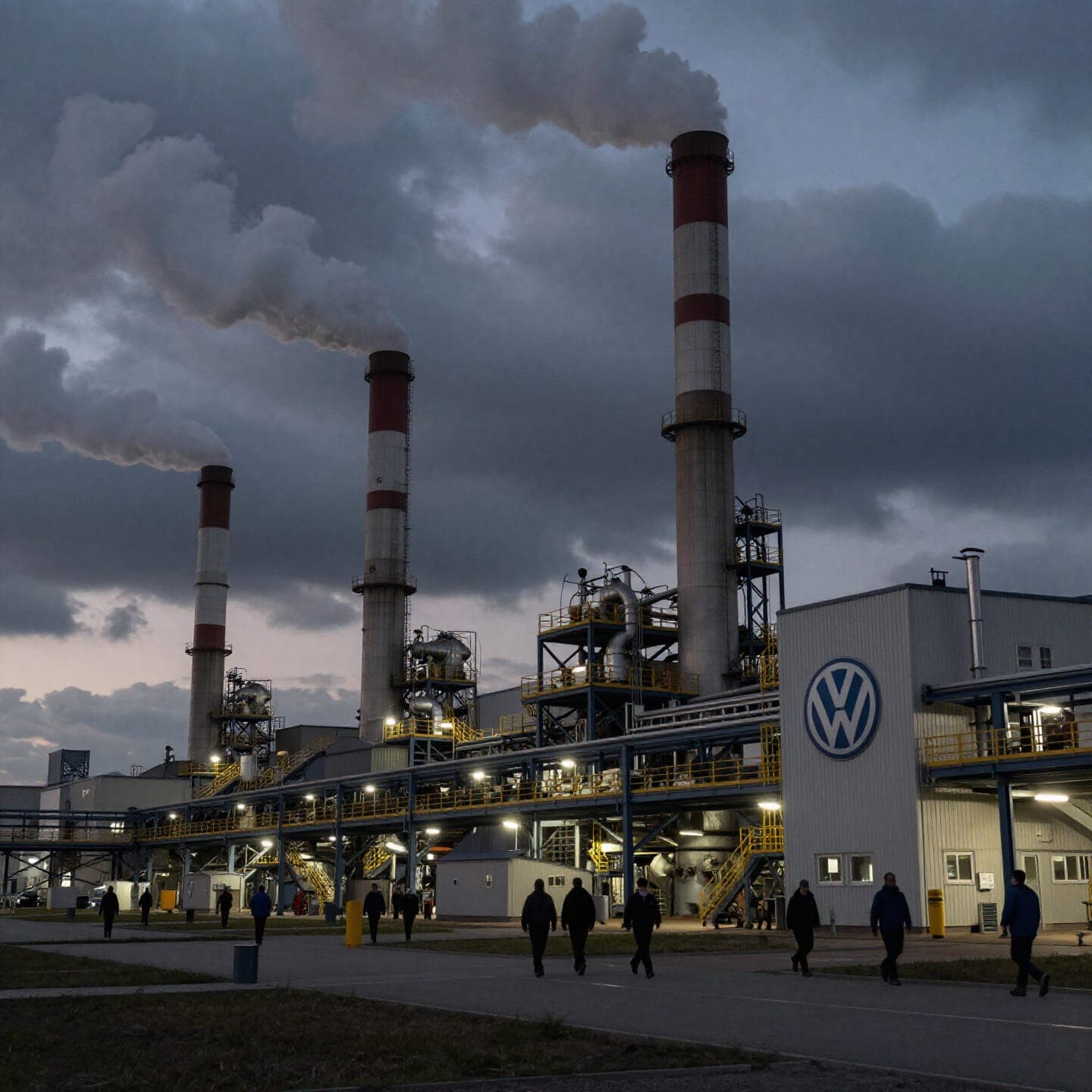
A Volkswagen factory in Germany at dusk, with workers leaving and dark clouds gathering overhead
Volkswagen's Historic Crisis: 100,000 Jobs and Four Factories at Risk
In the 89-year history of Volkswagen, there has never been a moment like this. The company that built the Beetle and the Golf, that defined German engineering for generations, is contemplating the unthinkable. Closing four German factories. Cutting up to 100,000 jobs.
The number is staggering. Volkswagen employs roughly 650,000 people worldwide. A cut of 100,000 positions would represent approximately 15% of its global workforce. This is not a normal restructuring. This is a survival plan.
"I can fully understand how deeply the current situation affects people within the company, as well as everyone in its immediate circle. I have spent my entire professional life with the group." — Oliver Blume, Volkswagen CEO
A Storm That's Been Brewing for Years
Volkswagen's problems did not appear overnight. They are the result of years of mounting pressure from multiple directions.
The company's operating profit fell 14.3% year-over-year in the first quarter of 2026. First-half vehicle deliveries dropped 6% to 4.1 million units. In China, once Volkswagen's most important market, deliveries plummeted 26% to their lowest level since 2010.
The company has calculated a cost disadvantage of about 20% compared to its rivals. That is a massive gap in the highly competitive automotive industry.
Meanwhile, the global market is shifting. Chinese automakers now collectively hold 13.5% of the global market. Volkswagen's China deliveries fell 26.1% in the first half of 2026, and sales declined 37% in the second quarter alone.
The Factories on the Line
Volkswagen is considering closing four German factories, putting more than 45,000 jobs at risk. Each plant has a rich history and a unique story.
Emden
Founded in 1964, Emden was the first Volkswagen site in Lower Saxony. It was built to take advantage of the seaport, allowing the company to export vehicles around the world. Today, it employs 7,700 people and produces the Volkswagen ID. series of fully electric vehicles. In 2025, the factory produced roughly 147,000 vehicles.
Hanover
Hanover is the birthplace of the Volkswagen "Bulli," the iconic camper van that defined a generation of road trips. Since 1956, this factory has been the heart of Volkswagen's commercial vehicle production. Today, it employs approximately 14,000 people and produces the T-Series camper vans, the ID. Buzz electric van, heat exchangers, and cylinder heads.
Zwickau
Zwickau was the first factory in the Volkswagen Group to be completely converted to electric vehicles. The conversion cost 1.2 billion euros. Today, it employs about 8,000 people and produces the Volkswagen ID., Audi Q4 e-tron, Seat Cupra Born, and bodies for the Bentley Bentayga and Lamborghini Urus. In 2025, the factory produced 212,000 vehicles.
Neckarsulm (Audi)
Neckarsulm is the home of Audi Sport GmbH and the birthplace of the fully electric Audi e-tron GT. The factory employs approximately 15,500 people and produces the A5, A6, A8, and e-tron GT. It represents a mix of combustion, hybrid, and electric production.
Osnabrueck
Osnabrueck is also at risk. Production is scheduled to end in 2027, and there is a proposal to transfer the plant to an Israeli defense company for Iron Dome component production. This has been blocked by the Qatar Investment Authority due to tensions with Israel. The future of this plant is uncertain.
"Instead of taking this achievement as a model, the board is confronting employees with new downsizing plans." — Christiane Benner, IG Metall Union Chair
The Corporate Battle
The restructuring is complicated by Volkswagen's unique corporate governance structure. The Volkswagen Law gives the state of Lower Saxony 20% of voting rights, enough to block key decisions. Labor representatives also hold significant power on the supervisory board.
CEO Oliver Blume is considering carving out the passenger car unit into a separate division. This could open a path to sidestep the constraints of the Volkswagen Law. Citi analysts have described this as creating a "bad bank" to isolate weaker operations.
But the plan faces fierce opposition. Lower Saxony's premier has stated, "We will not agree to measures to weaken the influence of workers." The IG Metall union has called the plans "irresponsible threats."
Worker representatives have staged protests at 18 German sites. The tension between management and labor is reaching a breaking point.
The Human Cost
Behind every number is a person. A worker who has spent decades at the factory. A family that depends on the paycheck. A community that was built around the plant.
Widespread protests erupted at Volkswagen sites across Germany in July 2026. Workers at 18 German sites staged demonstrations. The IG Metall union has warned that the plans could lead to social unrest.
The emotional toll of uncertainty is immense. Workers do not know if they will have a job next year. They do not know if their factory will still be standing. They do not know what the future holds.
A Broader Crisis
Volkswagen is not the only German automaker struggling. Mercedes-Benz, BMW, and Porsche all saw China sales drop between 30% and 41% in the second quarter of 2026. The German auto industry is facing its greatest crisis in decades.
China's domestic car market has entered a period of intense competition. More than 500 new models entered the Chinese market in the first half of 2026, increasing competitive pressure. Chinese consumers are shifting away from European brands and toward domestic electric vehicles.
At the same time, Volkswagen is facing billions of euros in U.S. tariff costs. President Trump has threatened tariffs of 20-25% on the EU. The company is exposed to tariffs on vehicles exported from Europe to the United States.
What Happens Next?
The company has not officially confirmed the 100,000 job cuts. Supervisory board meetings are ongoing. Labor representatives have so far blocked the proposals.
A compromise is likely. UBS expects provisions and a downgrade to Volkswagen's 2026 outlook. The company is also accelerating its "in China, for China" strategy, partnering with XPeng and SAIC. It is reducing its model lineup by half and cutting investment by about 15% to just over €130 billion over five years.
A Moment of Reckoning
Volkswagen's restructuring is a story about the end of an era. The company that defined German automotive excellence for nearly a century is fighting for its survival. The decisions made in the coming months will shape not just Volkswagen, but the entire German economy.
What we are witnessing is a moment of reckoning. A company that built one of the most iconic cars in history is now fighting for its future. Whether it emerges stronger or falls behind remains to be seen.
You might also like:
- The Rise of Megacasting: How One Manufacturing Technique Is Reshaping the Auto Industry
- EV Sales Surge in Canada as Gas Prices and Incentives Drive Demand
- Three Chinese Automakers Crack Global Top 10
Disclaimer: This article is for informational purposes only. Data and projections are subject to change. The author is not affiliated with Volkswagen or its subsidiaries.
Drift Team
Automotive industry analysts and global market experts