Ford and Geely Join Forces in Europe
Ford and China's Geely have announced a joint venture to manufacture vehicles in Spain. The deal represents a pragmatic response to the challenges facing the global auto industry.
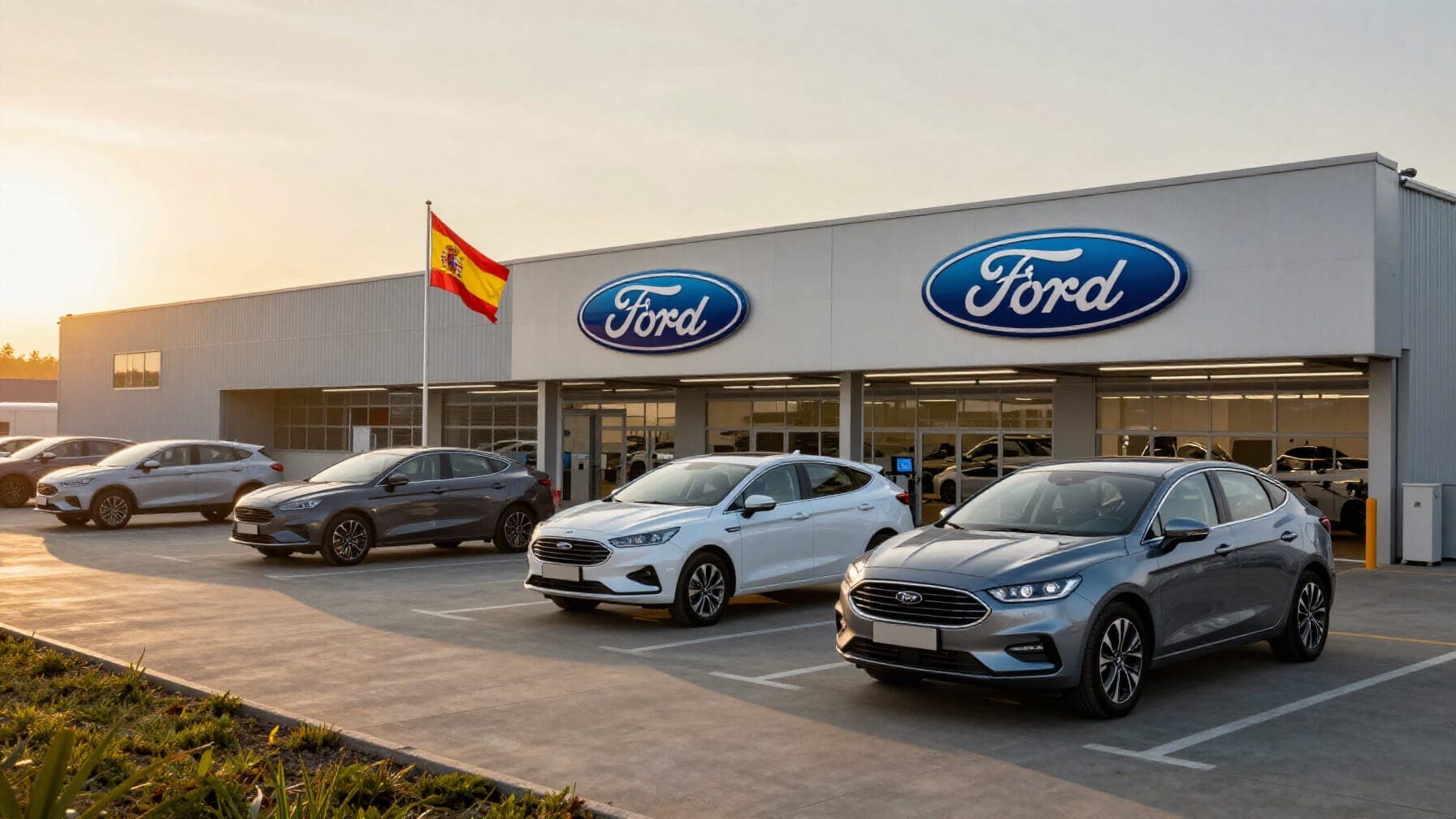
The Ford Valencia plant in Spain with Ford and Geely logos side by side
Ford and Geely Join Forces in Europe
For nearly 50 years, Ford's Valencia plant has been a cornerstone of the company's European operations. But in 2025, production at the factory dropped below 100,000 vehicles at a facility designed to make 500,000. The plant was in trouble. Something had to change.
On July 23, 2026, Ford and China's Geely Auto announced a joint venture that would transform the Valencia facility into a shared manufacturing hub for low- and zero-emission vehicles. Ford will hold a 66 percent stake in the joint venture, while Geely will own 34 percent.
Pending regulatory approval, the joint venture is expected to begin operations in the first half of 2027, with the first new vehicles rolling off the line in 2028.
Why This Deal Exists
The partnership is a response to the intense global competition, relentless cost pressure, and tightening regulation that are reshaping the European automotive market.
Ford's presence in Europe has declined significantly over the past decade. A decade ago, the company sold more than 1 million vehicles in Europe. Last year, that number was just over 426,000. Ford fell from fourth to eighth place in the European market.
The Valencia plant, which opened in 1976, was operating at just 26 percent of its 500,000-vehicle annual capacity in 2025. The plant needed a new direction, and Ford needed a partner to help it compete in a rapidly changing market.
"We can't be just an assembly plant. We need the technology to stay here. It's fundamental that the supply chain is grounded here and that this generates jobs." — Juan Jose Picazo, CCOO Secretary-General
For Geely, the deal represents an opportunity to establish a manufacturing presence in Europe. Chinese automakers are rapidly expanding overseas, recording 474,228 overseas sales in the first half of 2026, up 158 percent year over year. But with new EU regulations looming that will require a "Made in Europe" clause for EVs to avoid tariffs, local production is becoming essential.
Spain is a popular choice for Chinese automakers due to its lower labour and energy costs compared to other European countries. The Valencia plant also offers an experienced workforce and existing infrastructure.
The Five Vehicles
The joint venture will produce five new vehicles between 2028 and 2029.
Ford's Contributions
Ford Kuga: Production of the Kuga will continue uninterrupted at the Valencia plant.
New Bronco SUV: Ford will build a compact, adventure-ready Bronco SUV designed specifically for European roads. Production is set to begin in 2028.
All-New Multi-Energy Crossover: Ford and Geely are jointly developing an all-new crossover that will be available with multiple powertrain options, including hybrid and electric. It is also scheduled to arrive in 2028.
Geely's Contributions
Two Electric SUVs: Geely will build two electric SUVs at the Valencia plant, including the EX5, which is already sold in Europe. The second model is still in development.
Ford's contribution to the joint venture will be three vehicles, while Geely will contribute two. The partnership allows Ford to share development costs and gain access to Geely's electrification expertise, while Geely gains a European manufacturing base.
A Partnership Built on Pragmatism
The Ford-Geely partnership is not without precedent. Ford sold Volvo Cars to Geely in 2010, a deal that has been widely viewed as a success for both companies. The two companies also collaborated on Lynk & Co's European expansion in 2022.
Industry analysts see the deal as a pragmatic response to the realities of the modern auto industry.
"Ford gets the scale and cost efficiencies it needs for its Valencia plant, while Geely gets a direct shortcut around EU tariffs. More broadly, it underscores a major industry shift: automakers can no longer go it alone." — Jessica Caldwell, Head of Insights at Edmunds
Sam Fiorani, Vice President of Global Vehicle Forecasting at AutoForecast Solutions, offered a similar assessment:
"With the help of Geely, Ford can have new products designed for the European market without bearing the full development costs of a new platform."
A Different Reality in the United States
The partnership would likely be impossible in Ford's home market, where the U.S. Senate is advancing legislation to toughen a ban on Chinese automakers. Ford executives have publicly cautioned about Chinese EVs in the U.S. while simultaneously partnering with Geely in Europe.
This has drawn criticism from some U.S. lawmakers. Senator Debbie Stabenow called Ford's decision "incomprehensible."
Ford has acknowledged the difference in approach, emphasizing that the European market has different dynamics and regulatory requirements.
What This Means for the Future
The Ford-Geely joint venture is a sign of the times. In a world of tightening regulations, rising costs, and intense global competition, collaboration is no longer optional. It is a survival strategy.
For Ford, the partnership secures the future of the Valencia plant and protects jobs. It also aligns with CEO Jim Farley's broader strategy of leveraging global partnerships to improve competitiveness through speed, efficiency, and scale.
For Geely, the deal establishes its first production facility in Europe and allows the company to bypass EU tariffs while expanding its presence in a key market.
For the broader industry, the deal represents a road map for how traditional automakers can survive and thrive in Europe. As Chinese automakers increasingly partner with traditional automakers to gain local production capacity, the global auto industry is becoming more integrated, despite geopolitical tensions.
"This partnership shows how automakers are strengthening Europe's industrial base, but we can't do it alone." — Jim Baumbick, President of Ford Europe
A Reflection
It is easy to see this partnership as a sign of weakness for Ford or a power play for Geely. But the reality is more complex. The global auto industry is navigating an unprecedented transition. No single company has all the answers. No single company can do it alone.
The Ford-Geely joint venture is not a victory for one side or the other. It is an acknowledgment that the challenges facing the industry are too great for any single company to solve independently. It is a pragmatic, humble recognition that collaboration is the only way forward.
In that sense, the deal is not just about cars. It is about how we think about progress in a world that demands more from us than ever before.
You might also like:
- The Great Affordability Crisis: Why Car Ownership is Becoming a Luxury
- Why Maintenance Matters: The Science of Keeping Your Car on the Road
- The 10 Most Controversial Cars Ever Made — And Why They're Still Loved
Disclaimer: This article is for informational purposes only and does not constitute financial or investment advice. The joint venture is subject to regulatory approval, and details may change. The author is not affiliated with Ford, Geely, or any of their subsidiaries.
Drift Team
Automotive industry analysts and global market experts