Tesla's Misleading FSD Safety Data: A Marketing Gamble Under Fire
Tesla claimed FSD could save 32,000 lives. Independent researchers say the data is misleading. Now regulators and lawmakers are demanding answers.
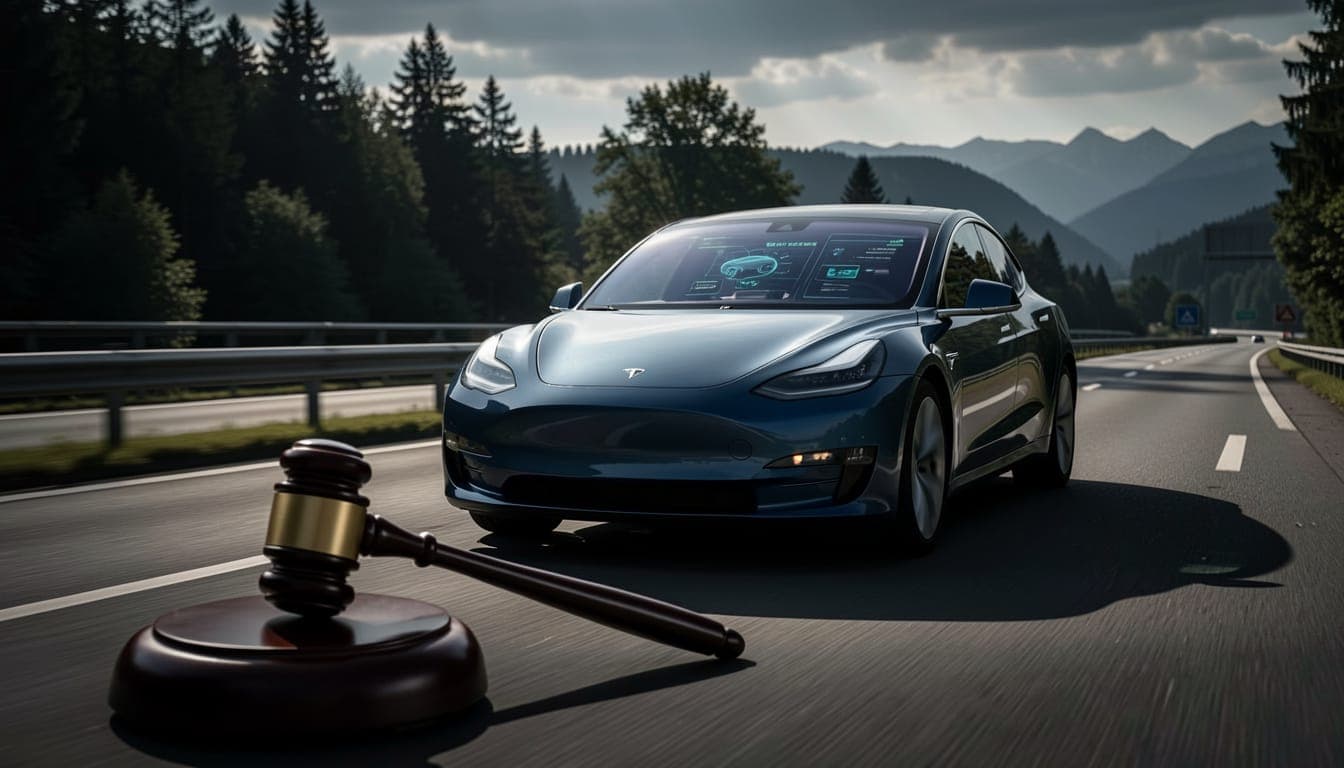
A Tesla vehicle driving on a European highway with a courtroom gavel in the foreground
Tesla's Misleading FSD Safety Data: A Marketing Gamble Under Fire
In November 2024, Tesla sent a letter to Dutch road regulators with a simple claim: increased usage of its Full Self-Driving system "leads to safer roads."
By April 2026, FSD had been approved in the Netherlands, and Tesla was pushing for EU-wide approval. But behind that approval was a set of safety statistics that independent researchers now say amount to misleading marketing.
The controversy has drawn scrutiny from European regulators, US senators, and safety advocates. It raises uncomfortable questions about how far a company will go to secure regulatory approval, and whether the system is truly ready for the road.
"If Tesla wants to make safety claims, they should give the data to a university, have it independently verified by a qualified researcher, and then let's talk." — European Transport Safety Council
The Safety Claims That Raised Eyebrows
Tesla has long claimed that FSD is up to 10 times safer than human drivers. The company has used this narrative to bolster its case for regulatory approval, investor confidence, and public trust.
But when Tesla presented its safety data to regulators in Sweden and the Netherlands, independent researchers spotted significant flaws.
One of the most striking claims was that FSD could have saved 32,000 lives and prevented 1.9 million injuries. Researchers said this figure is highly misleading because it assumes every vehicle in the United States, including freight trucks and motorcycles, would be replaced by an FSD-enabled Tesla. The claim also assumes every Tesla is at least seven times safer than the vehicle it replaces.
A senior editor of a European safety publication described the claim as "very optimistic" and "inconsistent with reality."
The Flawed Comparisons
The problems with Tesla's data go beyond the 32,000 lives claim. The company also used flawed comparisons to make FSD look safer than it actually is.
Tesla compared crashes in FSD-piloted Teslas that triggered airbag deployments to a United States crash rate for all vehicles that includes far less severe accidents. This is not a like-for-like comparison. It distorts the results in Tesla's favor.
The company also compared its cars to the average United States vehicle, which is much older than the average Tesla. Newer cars have better safety features, so comparing a new Tesla to an old car creates a misleading advantage.
The Reuters investigation that exposed these flaws noted that Tesla's methodology appears to be designed to produce the most favorable possible results.
"The European Transport Safety Council is 'certainly concerned' about the 'unreliable safety data' Tesla has presented to regulators."
The Regulatory Response
The Netherlands was the first European country to approve FSD, doing so in April 2026 after 18 months of testing. The Dutch road authority, RDW, said it does not rely on "marketing claims" and conducts its own testing. However, RDW declined to say whether it assessed Tesla's United States safety statistics.
Sweden, which received a presentation from Tesla making the inflated claims, has taken a more cautious approach. Swedish regulators said they "look beyond headline figures" and have indicated they may oppose EU-wide recognition over FSD's handling of speed limits.
The European Transport Safety Council has been outspoken in its criticism. The organization described Tesla's safety data as "unreliable" and expressed concern that it could influence regulatory decisions.
The EU-wide approval process is expected to come to a vote in October 2026. Major markets like Germany, France, and Italy have yet to approve the system. The outcome of that vote will depend, in part, on whether regulators trust the data Tesla has provided.
The US Response
The controversy has not gone unnoticed in the United States. Senators Edward Markey and Richard Blumenthal sent a letter to the National Highway Traffic Safety Administration demanding answers. They called Tesla's methodology "weak and misleading" and gave the agency a July 7 deadline to respond.
The senators' letter highlights the growing frustration with Tesla's approach to safety claims. It also reflects broader concerns about the oversight of autonomous driving systems and the adequacy of the current regulatory framework.
Why This Matters
FSD approval in Europe is key to Tesla's vehicle sales growth. The company's sales plummeted in Europe last year amid protests over Elon Musk's political activities. Meanwhile, Chinese EV makers are making steady inroads in the European market.
For Tesla, FSD approval is not just a technical milestone. It is a commercial imperative. The company needs European sales to offset slowing growth in the United States and China.
But the controversy undermines trust in Tesla's safety claims. It raises questions about the adequacy of regulatory oversight. And it highlights the broader challenge of validating the safety of autonomous driving systems.
The Ongoing Concerns
Europe has no equivalent of the United States National Transportation Safety Board. If a crash involving FSD occurs in Europe, it is unclear who would investigate and how findings would be shared.
Sweden has recommended that FSD be rejected if it allows vehicles to exceed speed limits. The system's handling of speed limits remains a point of contention between Tesla and European regulators.
The lack of a clear investigation framework and the unresolved speed limit issue add to the uncertainty surrounding FSD's future in Europe.
A Test of Trust
Tesla needs regulators to extend trust, but a pattern of questionable data submissions is making that difficult. The company's FSD safety claims have been called into question by independent researchers, European regulators, and United States senators alike.
The October 2026 vote on EU-wide approval will be a test of whether regulators trust Tesla's data. It will also be a test of whether the public can trust the safety of the vehicles on their roads.
This controversy is about more than just bad math. It is about whether regulators can trust the data that automakers provide, and whether the public can trust the safety of the vehicles they drive.
You might also like:
- BMW's Spider-Man Ads: The Outrage Over In-Car Advertising
- Your New Car Is Watching You
- Volkswagen's Historic Crisis: 100,000 Jobs and Four Factories at Risk
Disclaimer: This article is for informational purposes only. The views expressed are those of the authors and do not constitute legal or financial advice. The author is not affiliated with Tesla, the NHTSA, or any of the regulatory bodies mentioned.
Drift Team
Automotive technology and regulatory experts