Your New Car Is Watching You
Every new car sold in the European Union now comes equipped with an infrared camera pointed at the driver's face. It cannot be permanently disabled. Here is what that means.
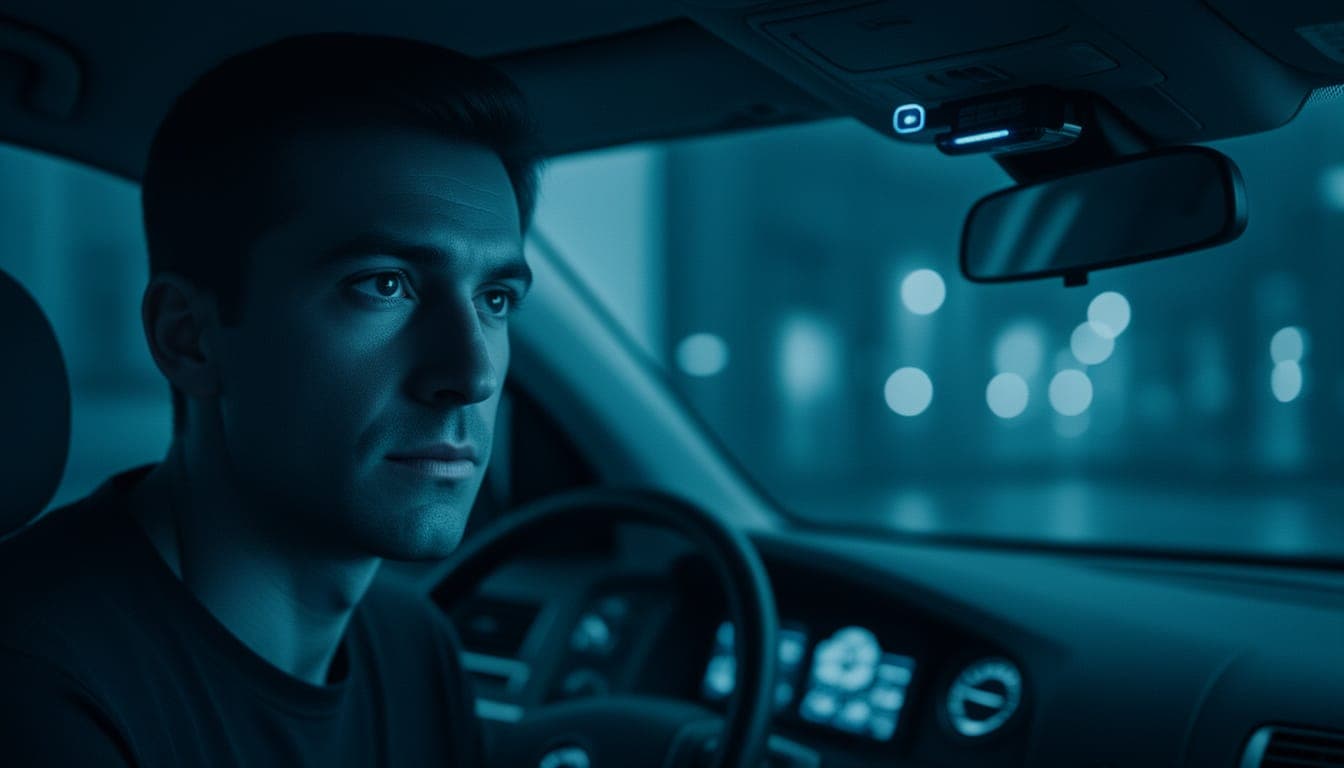
A car interior with an infrared camera mounted on the dashboard, watching the driver
Your New Car Is Watching You
On July 7, 2026, a new era in driving quietly began. Not with a product launch or a marketing campaign, but with a regulation. From that date forward, every new car sold in the European Union must be equipped with an infrared camera pointed at the driver's face. It is always on. It cannot be permanently disabled. You cannot opt out.
This is not a feature you can choose to buy. It is the law.
The system is called Advanced Driver Distraction Warning, or ADDW. Under the EU's General Safety Regulation, all newly registered vehicles must now include a camera-based system that monitors the driver's eyes, head position, and gaze direction. The system activates automatically once the vehicle exceeds approximately 20 km/h and remains active throughout the journey.
At speeds between 20 and 50 km/h, the system issues a warning if the driver looks away for more than 6 seconds. Above 50 km/h, the threshold tightens to just 3.5 seconds. Drivers can temporarily deactivate the alerts during a trip, but the system reactivates on the next start-up.
"Picture the Trojan Horse, but with a bureaucratic twist. The citizens of Troy weren't tricked into dragging that horse through the gates. They were legally required to buy it, park it in their driveway, and sit inside it every day." — Miguel Fornés, Information Security Manager at Incogni
Why This Law Exists
Distracted driving is a major cause of road accidents. The European Commission estimates that between 10% and 30% of crashes in Europe are caused by road user distraction. In the United States, the National Highway Traffic Safety Administration estimates that driver distraction contributes to 16% of all fatal collisions and 21% of all injury collisions. These figures are likely underestimated, given the difficulty of determining contributory factors after a crash has occurred.
The EU's goal is to move as close as possible to zero road fatalities by 2050. The new regulation is a key part of that strategy. The European Commission estimates that the full suite of safety measures, including ADDW, could save more than 25,000 lives and prevent 140,000 serious injuries by 2038.
On paper, the logic is simple: if a camera detects that a driver is not paying attention, it issues a warning. The driver looks back at the road. A potential crash is avoided.
But the reality is more complicated.
How the System Works
The ADDW system uses an infrared camera, typically mounted on the steering column or dashboard, to monitor the driver's face. It tracks eye position, gaze direction, and head movement. The system is designed to detect visual distraction, which it defines as the driver looking away from the forward roadway for an extended period.
The system's warning thresholds are based on speed:
- 20 to 50 km/h: The driver can look away for up to 6 seconds before a warning is issued.
- Above 50 km/h: The driver has only 3.5 seconds.
The regulation also requires the system to minimise false positives. A false positive occurs when the system issues a warning even though the driver is not actually distracted. Early testing has shown that these systems can be triggered by normal driving behaviour, such as glancing at a navigation screen or adjusting the radio.
"A single compromised API or a bad firmware push is all it takes to turn a local safety camera into a live feed. If a stranger can start your engine remotely through a back end API, pulling logs from a dashboard camera on the same network is not a big leap." — Miguel Fornés
The Privacy Question
The most difficult question raised by this regulation is about privacy. The European Commission has attempted to address these concerns by mandating that the ADDW system operate on a "closed-loop" basis. This means that facial images and eye-tracking data must be processed within the vehicle and must not be transmitted to manufacturers or third parties. The regulation also prohibits the use of biometric data for driver identification.
However, critics argue that these safeguards are not sufficient.
No Independent Audits
The regulation does not require independent audits to verify that manufacturers are complying with the closed-loop requirement. There is no independent body checking that the data is actually staying inside the vehicle.
Vague Data Retention Rules
The regulation does not clearly define how long any data may be stored or what information is considered necessary for the system to retain. This lack of clarity leaves a significant gap that could be exploited.
Questionable Compliance
There is evidence that some manufacturers may not be following the rules. For example, Volvo has been reported to send some real-time data from its driver monitoring system to a secure cloud server for processing. This directly contradicts the closed-loop principle.
Function Creep
While the law's purpose is safety, the existence of this surveillance capability raises concerns about its future use. Could law enforcement, insurance companies, or advertisers gain access to this data? There are precedents. In the United States, prosecutors have already used data from Tesla's internal cabin cameras and event data recorders in vehicular manslaughter cases to establish driver inattention. Similar precedents could emerge in Europe.
A European Parliament question submitted by Member Stanisław Tyszka highlights these gaps:
"Can a manufacturer circumvent these safeguards by using the same data for another function, and does the Commission intend to close this loophole? Who checks, and how, that the images and other data from the camera are not recorded or transmitted to the manufacturer or other parties?" — Stanisław Tyszka, Member of the European Parliament
These questions have not been answered.
The Weakness of Consent
The General Data Protection Regulation is designed to protect personal data. But consent is meaningless when there is no real choice.
The ADDW system activates automatically above 20 km/h and cannot be permanently disabled. Consent to share related vehicle data is often buried deep in the lengthy terms of service required to use a car's infotainment screen. As one expert put it, "You are not really being asked. You're being told: agree, or lose your navigation and Bluetooth".
This is not meaningful consent. This is coercion disguised as a choice.
The Effectiveness Problem
Even if the privacy concerns could be resolved, there is another question: does the system actually work?
Research suggests that the effectiveness of driver monitoring systems is not straightforward. A driving simulator study involving 125 participants found that the system only reduced visual distraction under specific conditions: when drivers were in assisted driving mode and when they had been properly instructed about the system. The mere activation of the system, without instruction, had no effect.
Another study found that the effectiveness of the DMS depended on task complexity and experience. For complex tasks, the system reduced distraction only for inexperienced drivers.
"The effectiveness of DMS is not inherently guaranteed but is contingent upon the driving mode and instruction." — ScienceDirect study, 2025
In other words, the technology is not a silver bullet. It requires the right conditions to work. And in manual driving conditions, the system appears to be largely ineffective.
What This Means for North America
The European Union is a global trendsetter in automotive regulation. What starts in Europe often spreads to other markets. The United States is already following a similar path.
The National Highway Traffic Safety Administration is actively studying driver monitoring systems. In June 2026, NHTSA issued a notice requesting comments on a proposed study of contextual driver monitoring systems. The agency is working toward a federal motor vehicle safety standard that would require passenger motor vehicles to be equipped with advanced drunk and impaired driving prevention technology.
A federal requirement could put driver monitoring technology in every new vehicle sold in the United States. The technology is often referred to as a "kill switch" because it could prevent or limit vehicle operation if impairment is detected.
The debate in the United States has mirrored the debate in Europe. Supporters of the regulation say it is about saving lives. Opponents argue it is an overreach that threatens privacy and constitutional rights.
"At what point is there just literally no privacy at all anywhere?" — Rep. Chip Roy, R-Texas
In January 2026, a group of House lawmakers introduced an amendment to defund the mandate. It failed in a 164-268 vote.
The Unanswered Questions
This article is not a call to oppose driver monitoring systems. Safety is important, and distracted driving is a real problem.
But there are unanswered questions that deserve serious consideration.
What happens to the data?
Even if the system is closed-loop today, what happens tomorrow? A software update could change how the data is processed. A cyberattack could expose it.
Who has access?
Can law enforcement obtain data from these systems? Can insurance companies? Can advertisers? We have seen data from connected vehicles used in court cases. The precedent has been set.
Is consent real?
When you buy a car, you have no choice. You cannot opt out. If you want to drive a new car, you must accept being monitored. Is that true consent?
Does the system actually work?
The research suggests that the system's effectiveness is limited. It only works under specific conditions. It is less effective in manual driving. It is more effective in assisted driving. But drivers are still responsible for their vehicles. The system is a tool. But a tool that only sometimes works is not always useful.
What about function creep?
The system exists for safety. But once the technology is in place, the temptation to use it for other purposes will be significant. Law enforcement, insurance companies, and advertisers will all have an interest in the data. The question is not whether they will try, but whether they will succeed.
A Humble Reflection
This is not a simple issue. It is a tension between two legitimate concerns. We want to save lives on our roads. But we also want to protect our privacy and our freedom. These values are not always easy to reconcile.
The EU's mandate is a statement of priorities. It says that saving lives is more important than protecting privacy. That is a reasonable position to hold. But it is also reasonable to worry about the long-term consequences.
The question is not whether the technology is useful. The question is whether we are building a world that we actually want to live in.
You might also like:
- The Great Affordability Crisis: Why Car Ownership is Becoming a Luxury
- Why Maintenance Matters: The Science of Keeping Your Car on the Road
- Ford and Geely Join Forces in Europe
Disclaimer: This article is for informational purposes only. The views expressed are those of the authors and do not constitute legal or financial advice. Laws and regulations are subject to change.
Drift Team
Automotive technology and privacy analysts