The Mercedes-Benz 300SL Gullwing: The Car That Defined the Supercar
In 1954, Mercedes-Benz built a car that changed everything. The 300SL Gullwing was the world's first supercar—a race car for the road that was faster, more advanced, and more beautiful than anything else on the planet.
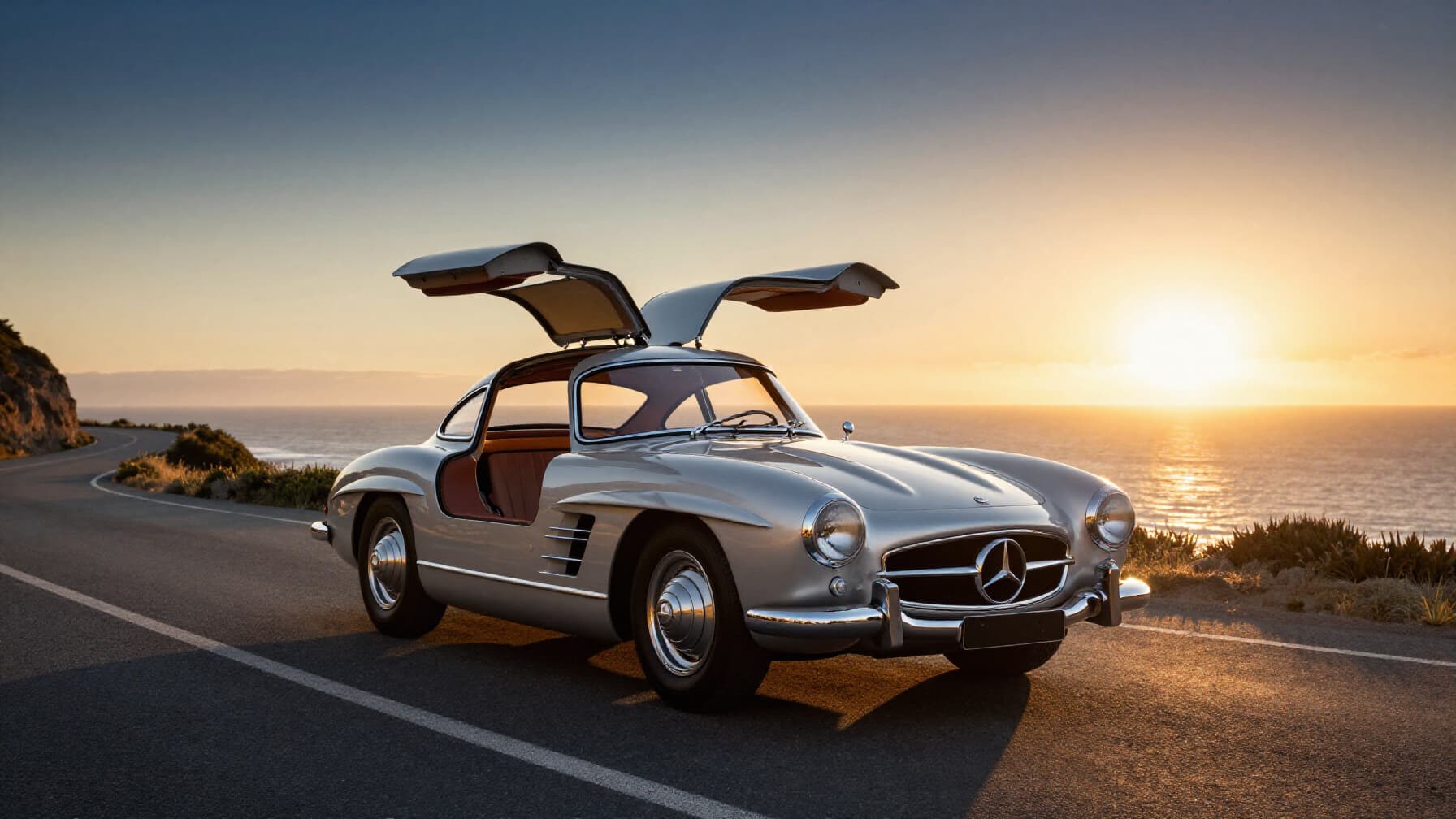
A dramatic cinematic shot of a silver Mercedes-Benz 300SL Gullwing with its iconic doors open on a coastal road at sunset
The Mercedes-Benz 300SL Gullwing: The Car That Defined the Supercar
In 1954, Mercedes-Benz unveiled a car that would change automotive history forever. The 300SL Gullwing was the world's first supercar. It was faster, more advanced, and more beautiful than anything else on the planet.
The 300SL was a race car for the road. It had a tubular space frame chassis that weighed just 82 kilograms. It had a 3.0-liter inline-six engine with direct fuel injection—the first production car with this technology. It had gullwing doors that opened upward, a feature that was born not of marketing, but of engineering necessity.
And it was fast. With a top speed of up to 260 kilometers per hour, the 300SL was the fastest production car in the world.
The 300SL became a legend. It was the car that proved Mercedes-Benz could build the world's greatest sports car. And it set the template for every supercar that followed.
Born on the Track
The 300SL's story begins not on the road, but on the race track. In 1952, Mercedes-Benz built the W 194, a competition car designed to dominate endurance racing.
The W 194 was a purpose-built race car with a tubular space frame chassis, a 3.0-liter inline-six engine, and lightweight aluminum bodywork. It was fast, agile, and reliable.
At Le Mans in 1952, the W 194 finished 1st and 2nd. At the Carrera Panamericana, a grueling road race across Mexico, it finished 1st and 2nd again. The W 194 was unstoppable.
The public was captivated. People wanted to buy the car that had conquered the world's toughest races. Mercedes-Benz saw an opportunity.
The Engineering Genius
The 300SL's engineering was revolutionary. At the heart of the car was a tubular space frame chassis, designed by the brilliant Rudolf Uhlenhaut.
The frame was a complex network of tubes, just 82 kilograms in weight. It was incredibly strong and rigid, but also lightweight. The total weight of the car was just 1,295 kilograms.
The frame's design had an unintended consequence: the raised side sills left no room for conventional doors. So Uhlenhaut designed gullwing doors that opened upward. They were born of necessity, not gimmickry.
Under the hood was a 3.0-liter inline-six engine with direct fuel injection. This was a first for a production car. The system boosted power by 40 horsepower over a carburetor version. The engine produced 215 horsepower in the standard car and 240 horsepower in the lightweight racing version.
The engine was tilted 50 degrees to the left, allowing for a lower hood profile. The result was a car that was both fast and aerodynamic.
The Iconic Design
The 300SL's design was as revolutionary as its engineering. The teardrop-shaped body was sleek and aerodynamic. The gullwing doors were dramatic and unforgettable.
But the doors were not the only design feature. The car had a distinctive front grille with the Mercedes-Benz star prominently displayed. The headlights were integrated into the fenders. The rear was clean and elegant.
The 300SL was designed by Friedrich Geiger, who had also designed the iconic Mercedes-Benz 540K. He created a car that was both beautiful and functional. Every line served a purpose.
The 300SL's design was so perfect that it influenced automotive design for decades. It is still considered one of the most beautiful cars ever built.
The Driving Experience
The 300SL was the fastest production car in the world. It could reach 260 kilometers per hour with the optional 3.64:1 axle ratio. The standard car could reach 235 km/h.
The driving experience was raw and engaging. The engine was a masterpiece of mechanical engineering, with a distinctive sound that was both aggressive and refined. The steering was precise, the brakes were powerful, and the handling was exceptional.
But the 300SL was not an easy car to drive. It was designed for skilled drivers. It demanded respect. "There is a whiff of menace in the extremes of its handling," one reviewer noted.
The 300SL was a car for enthusiasts, not for the faint of heart.
The Legacy
The 300SL was produced from 1954 to 1957, with just 1,400 coupes built. A roadster version followed in 1957, lasting until 1963 with 1,858 units produced.
The 300SL's legacy is immense. It is considered the first true supercar. It set the template for every high-performance car that followed.
Today, the 300SL is one of the most valuable collector cars in the world. A restored coupe can fetch between $2.5 and $3.5 million. The lightweight alloy-bodied cars are worth even more.
The 300SL's influence extends beyond its value. It proved that a road car could be a race car. It showed that engineering and art could coexist. It defined the supercar.
The Car That Defined an Era
The Mercedes-Benz 300SL Gullwing is more than a car. It is a symbol of a bygone era, a time when automotive design was driven by passion and innovation. It is the car that proved Mercedes-Benz could build the world's greatest sports car.
Its racing heritage, engineering brilliance, and iconic design make it a legend. Its influence is felt in every supercar built today. It is a car that will never be forgotten.
The 300SL Gullwing is not just a classic. It is the car that defined the supercar.
You might also like:
- The Ferrari F40: The Last Great Analogue Supercar
- The Lamborghini Miura: The Car That Invented the Supercar
- The Ford GT40: The Car That Conquered Ferrari
Disclaimer: This article is for informational and entertainment purposes only. All product names, logos, and brands are property of their respective owners. The views expressed are those of the author and do not necessarily reflect the official policy or position of any other agency, organization, employer, or company.
Drift Team
Automotive historians and classic car enthusiasts